 Sipu Jha
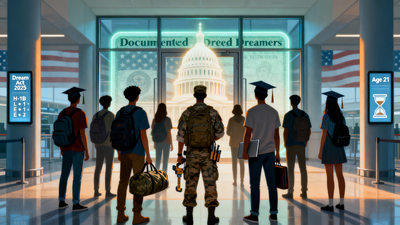
A revised Dream Act, 2025 – a bipartisan bill that has been introduced in the Senate by Senators Dick Durbin and Lisa Murkowski, seeks to allow individuals who were brought to the US as children and meet certain education, military service, or work requirements to obtain lawful permanent residence.This year’s version of the proposed legislation extends relief to ‘Documented Dreamers’ – children of non-immigrant visa holders (such as H-1B or L-1) who on turning 21 ‘age out’ and lose their dependent (H-4) visa status. Currently, on aging out these children have to transit to an international student visa or self deport to their home country (say India) or immigrate elsewhere. Earlier versions of the bill provided protection to ‘Dreamers’ – who were brought into the US ‘illegally’ (without visas) by their parents. As consistently covered by TOI, owing to the decades-long employment green card backlog, the perils of ageing out are a reality among Indian households in the US and tears families apart. If this bill is passed, it would provide a pathway for a green card to nearly a lakh Indian child, who would otherwise age out, without any protection.According to an earlier analysis by David J Bier, director of immigration studies at Cato Institute, as of March 2023, the employment based green-card backlog from India (EB-2 and EB-3 skilled category) had reached 10.7 lakh, and nearly 1.34 lakh children were expected to age out before a green card was obtained. Indians face a disproportionate backlog because green cards are capped at 7% per country of birth, regardless of the number of applicants from each nation.The National Immigration Forum, an immigration advocacy organisation has analysed this bill. According to it, ‘Documented Dreamers’ are defined as the children of non-immigrant E-1, E-2, H1B, and L visa holders. The Dream Act of 2025 would create a conditional permanent resident status valid for up to eight years for ‘Dreamers’ and ‘Documented Dreamers’ that would protect them from deportation, allow them to work legally in the U.S., and permit them to travel outside the country.Applicants must show they arrived before age 18, have lived in the US for at least four years, pass background and medical checks, meet education or military service criteria, resolve any federal tax liabilities and pay the application fee. Subsequently, the bill allows these individuals to obtain full green-card status once they maintain continuous residence and complete either higher education, two years of honourable military service or at least three years of lawful employment. They must also demonstrate English proficiency, civic knowledge, good moral character and pass additional security checks.The Presidents’ Alliance on Higher Education and Immigration, representing nearly 600 educational institutions welcomed reintroduction of the Dream Act. The Alliance pointed out that this year’s proposed legislation also extends relief to ‘Documented Dreamers’, individuals who grew up in the US as dependents of long-term visa holders and risk losing their status at age 21 due to lengthy green-card backlogs, leaving many already without protection.






 English
  हिन्दी