 Sipu Jha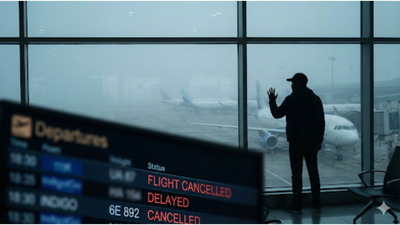
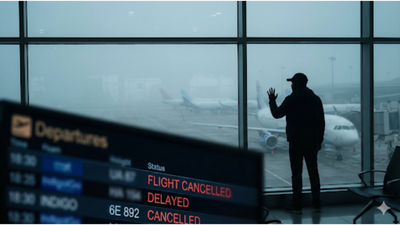
At airports, there was a time when a crackling announcement – “This is the last call for …” – meant panic, urgency, a frantic dash through terminals. When a voice reverberating in mechanical voice announced, “your flight has been delayed”, it was no less than a nightmare as it tested the patience. However, today, for IndiGo passengers, now these same words land like reassurance. It means the flight exists. It means the crew showed up. It means travel is still possible. In a week when cancellations ran into four digits a day, travellers like Soubik Majumder clung to every announcement not as a warning, but as hope because silence, not sound, has become the true alarm. With abrupt cancellations running into hundreds, sometimes even over 1,000 flights a day in the last week, the news of a delay has, ironically, offered some relief.Majumder had booked an IndiGo flight in advance from Delhi to visit Agartala for his brother’s wedding.
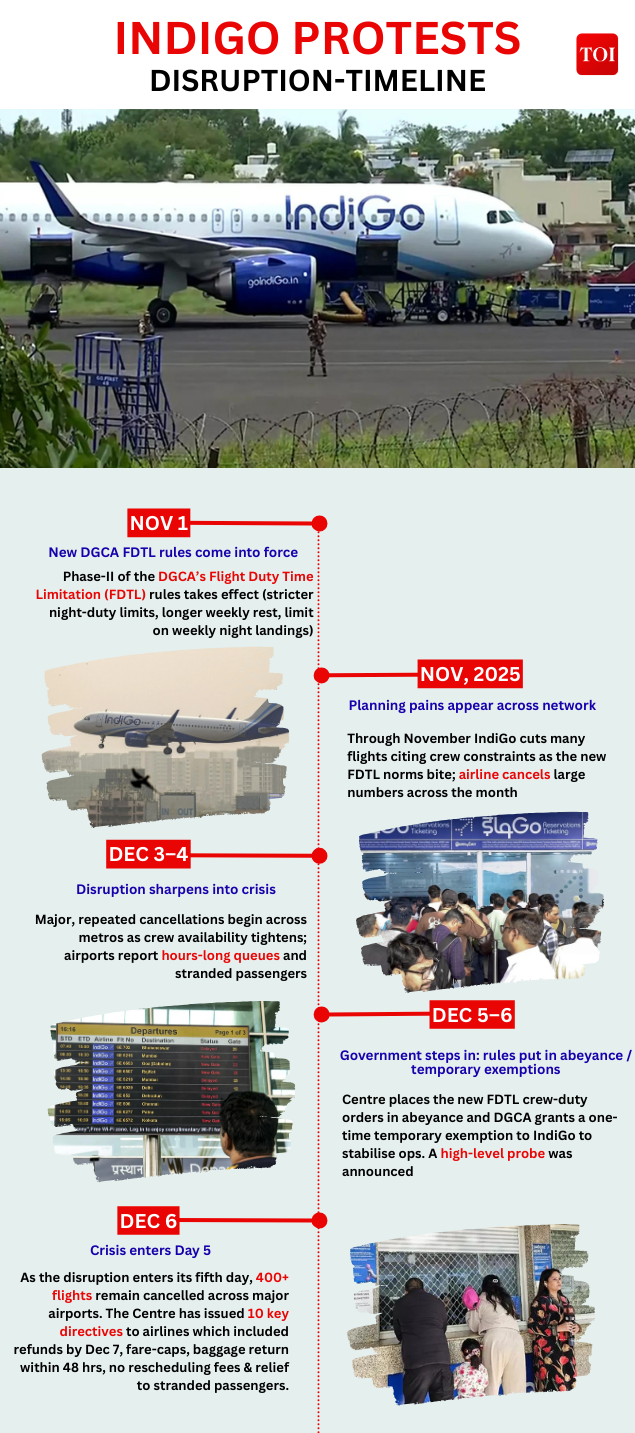
However, what should have been a pleasant ride home turned into a desperate hunt for buses, trains and anything that moved, all in a bid to reach the ceremony on time.He had booked the tickets one month before his actual flying date but the ongoing chaos and disruptions left him with nothing but a cancelled flight. “I booked my ticket almost a month in advance so that I wouldn’t have to face any hassle. But because of the changes that happened later due to the new aviation law, I am now facing problems for the same ticket that I booked one month earlier,” he told TOI.Delays came first, followed by endless queues and cancellations and gradually, everything erupted into utter chaos, turning airports into scenes similar to a fish market, with suitcases scattered everywhere. IndiGo’s flight disruption worsened on Friday as the airline cancelled over 1,000 flights across major cities. After remaining silent for three days during the crisis, CEO Pieter Elbers finally issued a video apology, expressing regret for the inconvenience caused to passengers.Delhi bore the brunt with 235 cancellations, followed by Mumbai with 104, Bengaluru with 102 , and Hyderabad with 84 cancelled flights.
Now boarding – Frustration
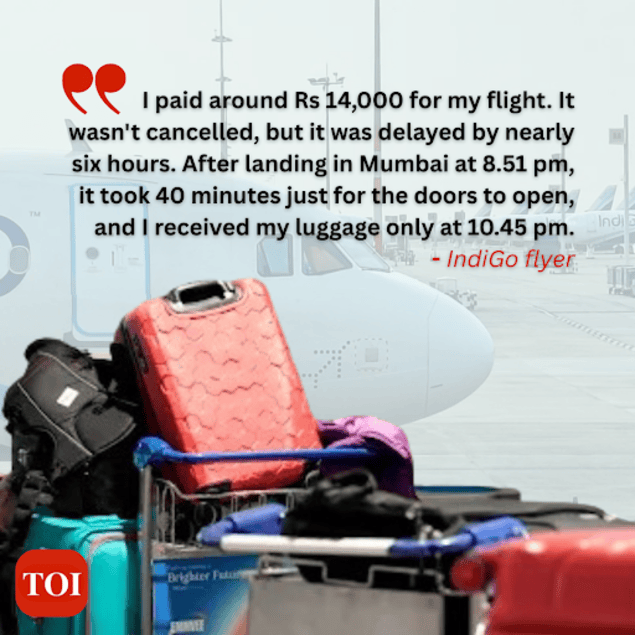
For many passengers, the trouble began long before the cancellation alert flashed on screens. Vaishnavi Shree, travelling from Tirupati to Delhi, recalled the confusion that unfolded in real time.“There’s only one direct flight from Tirupati to Delhi, it departs at 9 am and usually lands by around 11.30 pm. We completed all the usual procedures, but while going through security, I overheard a guard mention that the Delhi flight might be cancelled. No one seemed sure, so we continued to the gate,” she said.The uncertainty only grew. “The flight was delayed first by one hour, then two and finally it was cancelled,” she said.Passengers were offered two choices: reschedule for the next day with hotel accommodation and meals, or cancel their tickets. But those who urgently needed to reach Delhi were left stranded, with connecting routes via Hyderabad, Bengaluru or Chennai either fully booked or cancelled.Playback singer and performer Abhijit Ghoshal told TOI, ‘I paid around Rs 14,000 for my flight. It wasn’t cancelled, but it was delayed by nearly six hours. After landing in Mumbai at 8.51 pm, it took 40 minutes just for the doors to open, and I received my luggage only at 10.45 pm.”
Sunil D Shaligram said his son remained stuck at the airport for over 14 hours. “Despite repeated requests, we received no assistance,” he told PTI.Another parent, S Arora, said the airline “should have foreseen the chaos their decisions would trigger.”Several passengers said they were asked to deboard after being told there was “no pilot available.”Stranded travellers are now demanding clearer communication from the airline and better arrangements to deal with disruptions of this scale.
Refunds … but at what cost?
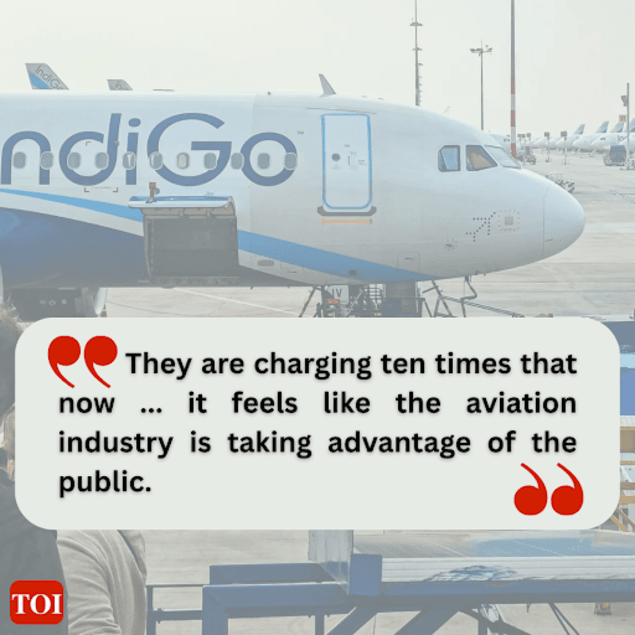
To support affected passengers, IndiGo announced automatic refunds for cancelled flights.The airline said, “All refunds for cancelled flights will be processed automatically to your original mode of payment. Additionally, we are offering a full waiver on all cancellations and reschedule requests for bookings between 5 and 15 December 2025.”However, frustration runs far deeper than refunds, with passengers now facing fares nearly ten times higher than their original bookings. Many received cancellation alerts just hours before departure.“My flight was at 9.00 am and I got the message at 4.00 am,” Majumder said. “In a way, it was slightly helpful that I didn’t have to go to the airport … but when you find out four to five hours before your flight that it’s cancelled, you can’t do much urgently.”Talking about the refunds, he added, “IndiGo is covering the amount I originally paid, yes, but that doesn’t solve the problem … I can’t find anything below Rs 50,000–70,000, and even then only connecting flights, no direct options.”After spending roughly Rs 8,000 for his tickets, Majumder believed his plans were set, until the chaos left him scrambling. “They are charging ten times that now … it feels like the aviation industry is taking advantage of the public,” he said.
Despite already missing part of the family wedding, he insisted he would try every possible route to attend the remaining ceremonies.Nomad Travel CEO and former Travel Agents’ Association of India president Ajay Prakash told PTI, “If a Rs 10,000 ticket is being sold at Rs 60,000 … I would call it black marketing, profiteering.” He argued the sector is now driven “purely by profit motives,” with IndiGo’s 64–65% market share giving it near-monopoly power.Fare spikes followed the chaos: after 1,000 flights were cancelled, a one-way economy ticket on SpiceJet from Kolkata to Mumbai touched Rs 90,000, while Air India’s Mumbai–Bhubaneswar fare hit Rs 84,485.It wasn’t just airfares that shot up. Ghoshal said even cab prices had tripled. “My usual fare … is between Rs 550 and Rs 650, but yesterday … it was showing Rs 1,871.”He added the crisis has hit livelihoods. “Many of my peer musicians have missed their concerts … We artists usually fly on the day of the performance itself,” he said, calling the situation “ridiculous” and deserving serious action if caused by mismanagement.Another passenger, Ritik Jha, also told TOI how his entire travel plan collapsed.“Initially the flight was scheduled for December 3 at 9.15 am, booked much in advance — in October — and was cancelled a few hours before take-off,” he said. Jha had booked four tickets at Rs 8,855 per person, but the last-minute cancellation forced him to look for alternatives that were 300–400% higher than his original fare.“Air India was charging Rs 33,353 per person for two of us in the morning, while Akasa was Rs 22,532 per person in the afternoon — which again caused delays for a planned event,” he said, adding that the entire schedule went haywire, leading to “inflated costs, delays, and complete chaos.”Jha also mentioned that an international client travelling with him faced similar issues. “He was supposed to fly from Pune to Bengaluru with IndiGo, but the last-minute cancellation made him take a connecting flight via Chennai, again costing much higher and causing delays and chaos.”
What the airline has offered
Beyond refunds, IndiGo has been providing accommodation and meals to stranded passengers. Shree said, “We were provided accommodation and food at Fortune Grand ITC.”“We got the cab that they (IndiGo airline) provided, and the food is there, three meals a day, and the hotel and everything is good.”For Ghoshal, however, the experience was far less satisfying.“On December 2, when I flew from Ranchi to Delhi and it was delayed in the Delhi–Prayagraj sector, they offered very meagre food. The quantity of food for delayed passengers was almost 30% of a usual thali. But at Prayagraj airport on December 4, IndiGo did give snacks, packets and tasty food (lunch) at around 3 pm.”
No hellos, no goodbyes!
The disruption at IndiGo, India’s largest airline by market share, has not just crippled aviation operations, it has pushed passengers into deep emotional distress. Weddings, work commitments, medical emergencies and even final goodbyes now hang in uncertainty.In Guwahati, one passenger described the agony, “I have come all the way from Shillong this morning. My husband passed away, and I have come here to transport the casket to Kolkata so he can be buried in his hometown.”“We booked an IndiGo flight, and till now there is no information on whether it will take off. I don’t know if the flight will be cancelled or if it will actually depart,” the flyer told ANI.Another flyer from Delhi reached the airport at 2 in the afternoon, excited to attend an important wedding function, waited all day at the airport, only to return back home after spending almost 12 chaotic hours at the airport, and no flight in sight.
IndiGo feels the heat
InterGlobe Aviation, also known as IndiGo, is reeling from the disruption not just on the ground, but also at Dalal Street. In the past 5 trading sessions, the airline’s stock price has tumbled down by over 7%.The company’s stock has been under pressure for four consecutive sessions, slipping 7.23% on the Bombay Stock Exchange and 7.30% on the NSE over the period. On Friday, it closed 1.22% lower at Rs 5,371.30 on the BSE after falling as much as 3.15% intraday to Rs 5,266, while on the NSE it ended 1.27% down at Rs 5,367.50. Since December 1, the firm’s market capitalisation has eroded by Rs 16,190.64 crore to Rs 2,07,649.14 crore.IndiGo’s on-time performance also collapsed amid worsening operational disruptions, plunging to just 8.5% on Thursday, according to data from the civil aviation ministry.The decline has been sharp, as the airline’s OTP dropped from 35% on Tuesday to 19.7% on Wednesday before hitting single digits a day later, a major setback for an airline that has long positioned punctuality as its key strength.
What’s next
The government on Saturday intervened to control spiralling ticket prices as IndiGo’s operational crisis entered another day, triggering widespread cancellations, passenger unrest and uncertainty over return travel.The ministry of civil aviation said it had taken “serious note of unusually high airfares being charged by certain airlines during the ongoing disruption” and invoked its regulatory powers to ensure “fair and reasonable fares across all affected routes.”
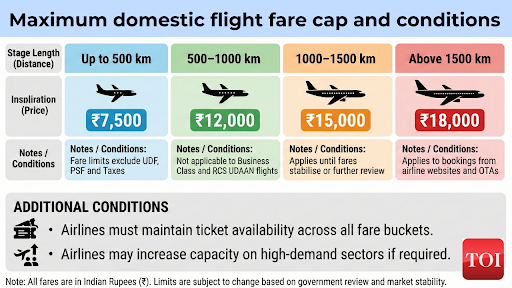
The ministry has also instructed IndiGo to promptly process all outstanding passenger refunds. It has been mandated that refunds for all cancelled or disrupted flights must be completed by 8:00 pm on Sunday, December 7. Additionally, airlines have been directed not to charge rescheduling fees to passengers whose travel arrangements were impacted. The ministry cautioned that any delays or failure to comply with the refund processing will result in immediate regulatory measures.Meanwhile, passengers who have even travelled one way are still worried about their return plans. Hardik Sharma, who was one of the lucky ones who got to board their scheduled flight from Delhi to Vizag, is now feeling anxious about his return journey.“Thankfully, my flight was on time, but there’s still uncertainty about my return flight to Delhi on Sunday night”, he said.With thousands stranded nationwide, Delhi airport released a statement on Saturday afternoon saying operations were gradually improving, “We are glad to update that IndiGo flight operations are now steadily resuming and getting back to normalcy following the brief disruption. Please check the status of your booking and flight before leaving home.”In order to help passengers with no travel options, the South Central Railway announced four special trains to Chennai, Mumbai and Shalimar (Kolkata) to clear the extra rush. The move followed long queues and overcrowding at the airport due to the large-scale grounding of flights.Union civil aviation minister Ram Mohan Naidu Kinjarapu said restoring normalcy across airports “remains the immediate priority”. He added that authorities are closely monitoring the airline’s scheduling network and compliance with pilot duty and rest norms. “The immediate priority for us is to bring back normalcy and provide all the support to the passengers. We are deeply observing this, and observing the FDTL norms, scheduling network. We will thoroughly look into this and ensure that all airlines follow due diligence,” he said.IndiGo, which usually operates around 2,300 flights a day, has been cancelling services to manage the worsening operational disruptions tied largely to crew shortages, causing massive distress for passengers and triggering knock-on effects across the aviation and railway networks.How long it will take for IndiGo to resolve the ongoing disruptions remains uncertain, but one thing is clear: passengers will end up paying a price far beyond just their airfares.Even if this chaos resolves within the coming days and normalcy returns soon, it is certain that neither the emotional damage caused to passengers can be undone nor the trust shaken in the reliability of the airline can be restored in the near future.IndiGo will fix its roster, the ministry will probe and issue new directives, and eventually airports will go back to being temples of impatience, not despair. But until then, every time a speaker crackles, passengers will inhale sharply – not worried they’re late, but relieved they’re still on the list. In a week when ‘delay’ became the new ‘on time,’ travellers learned the hardest lesson of all – that in aviation, the most expensive seat isn’t business or premium economy. It’s certainty.





 English
  हिन्दी