 Sipu Jha
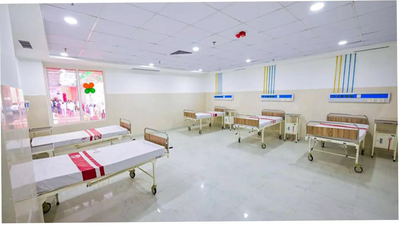
Representative image (ANI Photo)
NEW DELHI: India’s push to expand medical education into underserved districts has entered a new phase, with the Centre revealing in the Lok Sabha that 11 new medical colleges have received in-principle approval under a Public–Private Partnership (PPP) model. These colleges will come up by upgrading district hospitals — a shift in strategy aimed at accelerating MBBS seat creation without waiting for full government-backed infrastructure.The projects cleared so far are spread across Jharkhand (Giridih, Dhanbad, Jamtara, Khunti), Arunachal Pradesh (Namsai) and Uttar Pradesh (Baghpat, Mainpuri, Hathras, Kasganj, Mahoba, Hamirpur).The government explained that the model will rely on Viability Gap Funding (VGF) — a financial support mechanism designed to make socially important but commercially unviable projects feasible for private partners. Under the scheme, the Centre may fund up to 30% of the project cost, with states allowed to match this amount. For pilot projects, support can go up to 40% of the cost, plus 25% of operations-and-maintenance expenses for the first five years.In return, States must allow full and free access to district hospital facilities for the attached medical colleges and must provide land on concessional terms — conditions aimed at ensuring that medical education does not dilute public-hospital services.The Lok Sabha reply also stressed that faculty norms, curriculum rules, equipment standards and staffing requirements will remain under the National Medical Commission’s Minimum Standard Requirement (MSR) Regulations, ensuring that PPP colleges follow the same quality benchmarks as government medical colleges.Alongside the PPP push, the government also confirmed that the existing Centrally Sponsored Scheme for upgrading district hospitals into government medical colleges has already sanctioned all 157 planned institutions, including 14 in Madhya Pradesh and two in Maharashtra.While the PPP model is still at an early stage, the approval of 11 projects signals the Centre’s intent to create a parallel pathway for strengthening medical infrastructure, especially in districts that have historically lacked teaching hospitals.The next challenge lies in execution — from faculty recruitment to readiness of hospital facilities — but policymakers say the new structure opens a crucial opportunity to expand medical education faster, in areas that need it most.








 English
  हिन्दी