 Sipu Jha
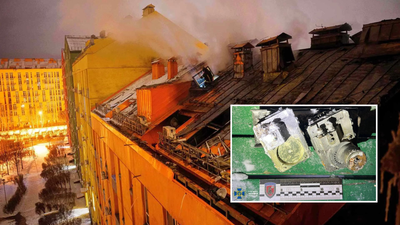
Russia has escalated war against Ukraine by firing its rarely used Oreshnik intermediate-range ballistic missile during a massive overnight barrage, Ukrainian authorities said, as Kyiv released images of missile fragments recovered near the western city of Lviv. The strike marked only the second known battlefield use of the nuclear-capable weapon, which Moscow claims is impossible to intercept.The missile traveled roughly 1,800 km in 12–13 minutes, reaching a top speed of more than 10,000 km/h before striking the Lviv region.Ukraine’s SBU security service said the missile was used during attacks on the night of January 8–9, targeting infrastructure close to the European Union border. Publishing photographs of the debris on Friday, the SBU said it had identified key components of the Oreshnik system, including its stabilisation and guidance unit, engine parts and nozzles.
“By attacking civilian targets in our country near the border with the European Union, the Kremlin attempted to destroy the region’s life-support infrastructure amid sharply deteriorating weather conditions,” the SBU said.Also read: 36 missiles, 242 drones – 4 civilians killed in Russia’s ‘mass’ bombings in Ukraine; Nato border rattlesThe strike formed part of a broader assault in which Russia launched hundreds of drones and dozens of missiles across Ukraine, killing at least four people in Kyiv and leaving nearly half of the capital without heating during sub-zero temperatures. Ukrainian officials said apartment buildings, critical infrastructure and diplomatic premises were hit, including damage to the Qatari embassy.President Volodymyr Zelenskyy called for a “clear response” from Ukraine’s allies, saying Russia only responds to firm international pressure. The attack came amid stalled peace efforts and rising tensions between Moscow and Washington over sanctions and security guarantees for Kyiv.
Kyiv recovers missile fragments after Lviv strike
According to the SBU, specialists recovered several identifiable parts of the missile from the strike area in Lviv region. These included the stabilisation and guidance unit — described as the “brains” of the missile — along with engine components, fragments of the orientation mechanism and nozzles from the warhead separation platform.Lviv Mayor Andrii Sadovyi confirmed that a ballistic missile had struck critical infrastructure, saying it travelled at around 13,000 kilometres per hour, or roughly Mach 10. He said the precise type of missile was under investigation, before Ukrainian officials later confirmed it was the Oreshnik system.Russian media and military bloggers claimed the missile targeted an underground natural gas storage facility in the region, close to key supply routes used for Western military aid entering Ukraine from Poland. Russian authorities did not officially confirm the target.
What is Russia’s Oreshnik missile ?
The Oreshnik — named after the Russian word for hazel tree — is an intermediate-range ballistic missile with an estimated range of 3,000 to 5,500 kilometres, capable of striking targets across Europe. Russian President Vladimir Putin has described it as a “state-of-the-art” weapon that cannot be intercepted by modern air defences.Putin has said the missile carries multiple warheads and travels at hypersonic speed, comparing its descent to “a meteorite”. While the Kremlin claims it does not cause nuclear contamination when used conventionally, Western analysts say it could be adapted to carry nuclear payloads.Also read: Not ICBM, Russia fired missile that travels at ’10 times the speed of sound’Ukraine says the missile was launched from Russia’s Kapustin Yar range near Volgograd. The United States has described the system as experimental, based on the RS-26 Rubezh missile design. Analysts note that while its speed gives it psychological impact, its warheads do not manoeuvre like newer hypersonic glide weapons.Russia first used the Oreshnik in a strike on the city of Dnipro in November 2024.







 English
  हिन्दी