 Sipu Jha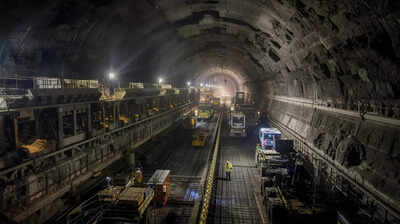
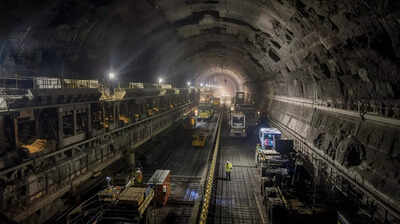
Norway is moving forward with a major transport project that is largely invisible to the public but significant in scale. Deep beneath the North Sea, construction is underway on Rogfast, an undersea road tunnel intended to become part of a ferry-free route along the country’s western coastline. The tunnel is already being carved through solid rock and will eventually stretch for 27 kilometres, reaching depths close to 400 metres below sea level. Once completed, it is expected to shorten travel times between key cities and reduce reliance on ferry crossings that are often affected by weather. Details of the project, including its technical demands and long timeline, have been reported by CNN, which has followed the tunnel’s progress closely.
Norway is carving a road tunnel nearly 400 metres beneath the sea
Rogfast is short for Rogaland fastforbindelse, named after the region it serves and the Norwegian term for a fixed link. The tunnel will connect Randaberg and Bokn, forming part of the E39 coastal highway. This road runs for more than 1,100 kilometres from Trondheim in the north to Kristiansand in the south. Today, drivers must board seven ferries to complete the journey. The long-term plan is to remove those crossings through a mix of tunnels and bridges. Rogfast is one of the most complex sections of that plan and also one of the first to take shape underground.
Extreme depth defines the tunnel’s engineering challenge
At its deepest point, Rogfast will reach about 392 metres below sea level. That makes it far deeper than existing undersea tunnels used for road or rail traffic. According to CNN, engineers are excavating the tunnel from both ends at the same time, with teams working towards each other beneath the seabed. The aim is to meet with an error margin of less than five centimetres. This level of accuracy reduces waste and avoids costly corrections, especially given the volume of rock being removed.
Laser scanning guides construction beneath the seabed
Precision work at this depth relies heavily on measurement technology. As reported by CNN, laser scanners are used to record newly excavated sections of the tunnel, capturing millions of data points every second. These measurements create a digital model that is compared against design plans. Burkhard Boeckem, chief technology officer at Hexagon, the company providing the measurement systems, told CNN that even small deviations can lead to large increases in material handling. Correcting mistakes underground often means removing more rock and then reinforcing the structure again, which adds time and cost.
Water pressure and sealing remain ongoing concerns
Working hundreds of metres below sea level brings constant pressure from the surrounding rock and seawater. One of the main technical challenges has been sealing cracks in the rock to prevent saltwater from leaking into the tunnel. Anne Brit Moen, a project manager at Skanska, which is building the northern section of Rogfast, told CNN that water ingress has already occurred during excavation. She said the team is focused on improving grouting methods to maintain safe working conditions as the tunnel goes deeper. The northern section alone is about nine kilometres long and includes the deepest parts of the route.
Tunnel design includes unusual features deep underground
Rogfast will consist of two separate tubes, each carrying two lanes of traffic. About halfway along the tunnel, drivers will pass through a double roundabout located roughly 260 metres below sea level. This underground junction connects to a branch tunnel leading to the island of Kvitsøy, Norway’s smallest municipality. Air quality inside the tunnel is another priority. The design includes a longitudinal ventilation system supported by ventilation shafts. CNN reports that real-time monitoring systems, cameras and radar will also be used to detect incidents and manage traffic flow.
Economic effects extend beyond travel time savings
Construction on Rogfast began in 2018 but was paused in 2019 due to projected cost overruns. After restructuring, work resumed in 2021, with completion now expected in 2033. The estimated cost is around 25 billion Norwegian kroner, or about 2.4 billion US dollars. While ferry jobs may decline over time, Moen told CNN that improved road access will support other forms of employment, education and public services. Lower transport costs are also expected to benefit industries such as seafood processing. The tunnel’s impact is likely to unfold slowly, changing daily routines rather than creating a sudden shift.









 English
  हिन्दी