 Sipu Jha
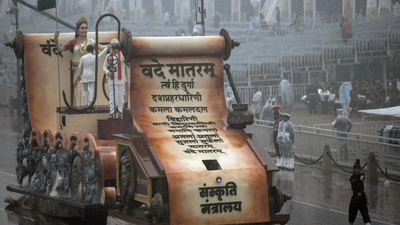
NEW DELHI: Celebrations marking the 77th Republic Day at Kartavya Path on Monday will centre on the theme of the 150th anniversary of the national song Vande Mataram, a timeless mantra that awakened the spirit of Swadeshi, self-reliance and freedom in India’s national consciousness. This year, Kartavya Path, stretching from Rashtrapati Bhavan to the National War Memorial, has been elaborately decorated for the occasion.Prime Minister Narendra Modi has announced a year-long commemoration of the 150th anniversary of the national song, culminating on November 7, 2025, according to news agency ANI.
According to a release from the Ministry of Defence, the celebrations will present an extraordinary blend of the 150-year legacy of Vande Mataram, the country’s unprecedented developmental progress, robust military strength, vibrant cultural diversity and active participation from citizens across all walks of life.A distinguished series of paintings created by Tejendra Kumar Mitra in 1923, illustrating the verses of Vande Mataram and published in the Bande Mataram Album (1923), is being displayed as view-cutters along Kartavya Path.As many as 30 tableaux—17 from States and Union Territories and 13 from Ministries, Departments and Services—will roll down Kartavya Path under the broad themes of ‘Swatantrata ka Mantra: Vande Mataram’ and ‘Samriddhi ka Mantra: Aatmanirbhar Bharat’. The tableaux will showcase a unique blend of the 150-year journey of the national song and the nation’s rapid progress driven by growing self-reliance across sectors, infused with rich and vibrant cultural diversity.Adopted as India’s National Song by the Constituent Assembly in 1950, Vande Mataram was initially composed independently and later included in Bankim Chandra Chatterjee’s novel Anandamath, published in 1882. It was first sung by Rabindranath Tagore at the 1896 Congress session in Calcutta and was set to music by him.Vande Mataram, which translates to “Mother, I Bow to Thee,” has inspired generations of freedom fighters and nation builders and remains a lasting emblem of India’s national identity and collective spirit. It has become an integral part of the nation’s civilisational, political and cultural consciousness.Popularised during the Swadeshi and anti-partition movements, the song soon transcended regional boundaries to emerge as an anthem of national awakening. From Bengal to Bombay and the plains of Punjab, its refrain echoed as a symbol of resistance against colonial rule. British efforts to suppress its rendition only heightened its patriotic significance, transforming it into a moral force that united people across caste, creed and language. Leaders, students and revolutionaries drew strength from its verses, reciting it at political gatherings, demonstrations and even before imprisonment.“Vande Mataram” emerged as the rallying cry of Indian nationalism in the late nineteenth and early twentieth centuries. During the turbulent days of 1905, amid the anti-partition and Swadeshi movement in Bengal, the appeal of the song and slogan became especially powerful. At the Varanasi session of the Indian National Congress that year, Vande Mataram was adopted for all-India occasions.Parliament marked 150 years of the national song in December 2025 with special discussions in both Houses, initiated by Prime Minister Narendra Modi. The debates traced the song’s history and included references to the 1937 Congress decision to adopt only its first two stanzas. The government has also launched initiatives nationwide to connect the youth with the song’s original spirit.At the conclusion of the Republic Day parade, a banner bearing ‘Vandemataram’ will be unveiled, accompanied by the release of rubber balloons, marking a fitting tribute to the enduring spirit of the nation.







 English
  हिन्दी