 Sipu Jha

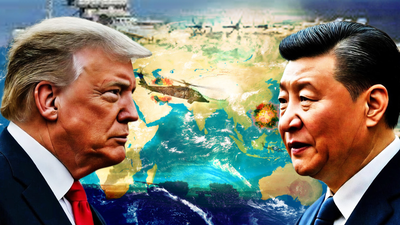
AI-generated image
“There is no time to waste,” the Economic Survey 2025–26 cautioned, as India confronts a rapidly hardening global order where technological capability, rather than military strength alone, will determine strategic influence. In an era marked by intensifying US–China rivalry and the emergence of America’s Pax Silica vision for the AI-driven world, the Survey said that India needs to transform from the world’s “IT sector back office” into an “AI front office”.Arguing that resilience is no longer enough, the survey stressed the need for “strategic indispensability”—a position where India becomes so critical to global value chains that it cannot be easily substituted or coerced.
Drawing parallels with oil and steel in the last century, it noted that the 21st century will run on “compute”—a shorthand for computing power, GPUs and the critical minerals that feed them—reshaping global alliances and economic hierarchies.Geopolitical shifts further complicate the landscape. The survey highlighted how the United States is reconfiguring alliances, favouring bilateral trade arrangements, export licensing and technology controls. Declaring that the 21st century will run on “compute” and the minerals that power it, Washington has launched the Pax Silica initiative with select partners to shape the AI ecosystem—from energy and critical minerals to advanced manufacturing and models. The passage of the GENIUS Act on dollar-backed stablecoins could also disrupt capital flows to emerging economies, adding to India’s strategic challenges.
Bottom-up approach for AI
The survey noted that the global AI landscape has split into two distinct models. Western economies have followed a top-down path, dominated by frontier AI models, hyperscale firms, massive private capital and concentrated intellectual property. Elsewhere, a bottom-up approach—based on distributed innovation, strong state coordination and application-specific AI—has become the norm. Given India’s constraints and capabilities, the Survey concluded that “India’s position in this landscape, reflecting a distinct set of constraints and capabilities, make a bottom-up approach strategically necessary”, rather than attempting to replicate the capital-intensive model pursued by the US and China.The survey also noted that India enters the AI era with “notable advantages”. It is among the top global contributors to AI research and has a deep pool of technical talent, supported by an AI-literate workforce ranked second only to the United States in 2024. It also pointed to India’s vast and diverse domestic data as a potential comparative advantage, noting that the “heterogeneity and scale of our country” allow for the creation of rich datasets across sectors such as health, agriculture, finance and governance—an asset that remains significantly underutilised.





 English
  हिन्दी