 Sipu Jha
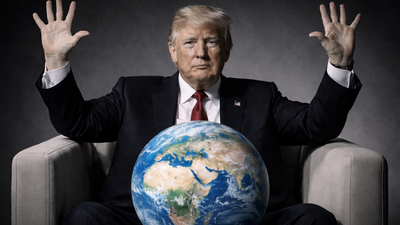
In House of Cards, the most dangerous moment is not the coup, the scandal or the collapse, it is the point at which everyone realises the rules no longer matter, yet the institutions keep functioning as if they do. That is where much of the world now finds itself with the United States.For decades, the United States functioned as the system’s anchor: unpredictable at times, but ultimately bound by norms, alliances and a sense of responsibility for keeping the show running. Trump 2.0 has broken that “contract”.Donald Trump’s return to the White House has flipped the script. “America First” is no longer a disruptive subplot; it is the central premise. Tariffs are brandished like cliff-hangers, alliances treated as transactional deals, and loyalty tested episode by episode.The response has not been dramatic rupture or mass defection from US alliances. Instead, it has been something quieter, and potentially more consequential. Governments are hedging. Middle powers are diversifying trade, diluting security dependencies and knitting together regional and cross-continental partnerships designed to cushion against American volatility.The question now is whether the world is merely adjusting to Trump, or quietly rehearsing for a future without the United States at its centre.
Alliances under pressure
Trump’s hawkish “America First” policies are reshaping alliance politics. Allies of all stripes are learning to plan for a world where the US may withdraw or punish them. NATO countries, for instance, have agreed under US pressure to raise spending targets, eventually aiming for 5% of GDP, yet trust has frayed. By late 2025, US approval among NATO citizens had plummeted to ~21%. Only Poland and Albania polled above 60% approval; in much of Northern Europe less than 10% approve of Washington. In effect, the US is now nearly as unpopular as China among NATO publics. Meanwhile, Trump’s initiatives like the “Board of Peace” or the raid on Venezuela have prompted even Latin American democracies to reassess ties. For example, Brazil’s President Lula da Silva told Trump that US actions in Venezuela (the capture of Maduro) “crossed an unacceptable line”, even as he agreed to strengthen bilateral trade and meet in Washington. South America more broadly has been unwilling to endorse US brinkmanship in the region.In short, “America First” is incentivizing friends to think twice. Most US allies have begun hedging, acquiring more self-reliance and looking for backup alliances, rather than purely confronting or abandoning the US entirely.
Trump didn’t start the shift — he accelerated it
In many respects Trump’s second presidency has exposed trends already underway, rather than creating wholly new ones. The shift towards multipolarity and regionalism seen predates Trump. But his aggressive “America First” tactics have magnified and accelerated these shifts. Trump’s tariffs, alliance threats and unilateral moves have made dependence on a single superpower seem riskier than ever. For example, a recent Gallup poll found only about 20–25% of citizens in NATO countries now approve of US world leadership – a level comparable to the depths of the Bush era. That drop is largely a result of Trump’s policies: Europe’s median approval of US leadership fell 14 percentage points in 2025 alone. In the same poll the EU’s own leadership enjoyed roughly triple the approval of the US (around 60%). In short, Trump’s return has been less a total paradigm shift and more an ignition for plans many were already sketching. Canada, Europe and even Japan have quietly accelerated efforts towards “strategic autonomy” (self-reliance and diversified ties), anticipating a future in which US support may not be guaranteed.
How Canada is hedging without breaking from Washington
Canada is a prime example of a middle power that’s recalibrating its outlook. Prime Minister Mark Carney, a former central banker has been blunt that “the old rules-based order is over”. Carney’s recent diplomacy demonstrates the pivot: in January he became the first Canadian premier in nearly a decade to visit Beijing. There he and President Xi agreed on a “new Canada-China strategic partnership,” cutting crippling tariffs on staples like canola. Yet Carney simultaneously made clear Canada will not sign a full free-trade deal with China if it risks triggering US retaliation.
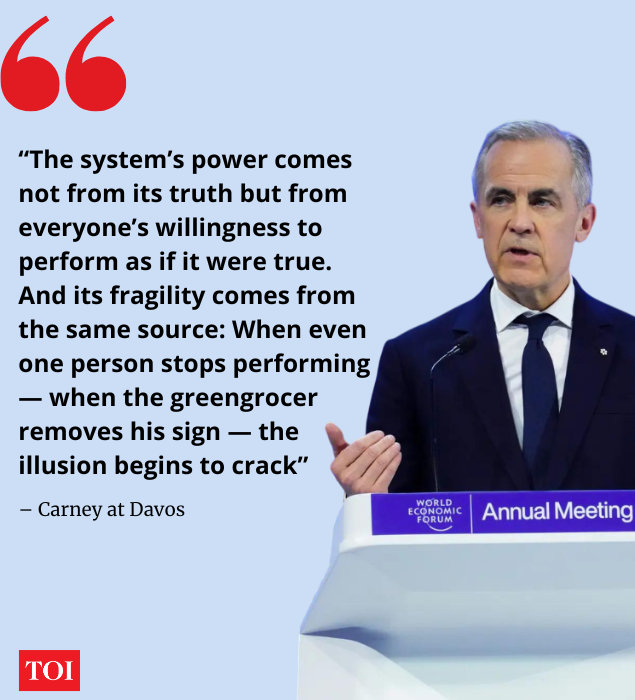
Instead, Canada is diversifying in Asia. Carney has announced new negotiations for a Comprehensive Economic Partnership (CEPA) with India, scheduling a visit in early March to finalize agreements on nuclear energy, mining and other sectors. These moves are explicitly hedges against US volatility. In Davos, Carney urged “middle powers like Canada to build coalitions to shape a fairer, more resilient world”. He has even noted that allies should work together to protect themselves from “the vagaries of the international order,” now that the “natural rules-based order… is not functioning”. In practice Ottawa’s strategy means deepening ties in Asia and Europe even as it maintains the US alliance.By proactively courting China, India and others, Canada is signaling that it will not be held hostage by Washington’s trade-war threats.
Australia adjusts — without openly defying Washington
Australia likewise has started hedging, though with more caution. Melissa Conley Tyler, executive director at the Asia-Pacific Development, Diplomacy & Defence Dialogue, explains, Canberra long viewed the US as a security pillar, but today “there is a chasm” between Australian expectations and the Trump reality. Speaking to The Times of India, she observes that Trump’s unilateralism makes the US “a different partner than it was.”
This is a challenging time for Australia. Our relationship with the United States has long been a pillar of our security and prosperity. While there has always been a gap between what Australia wanted the US to be and the reality, this is now a chasm. The Trump Administration’s approach to global trade and to international norms means it is a different partner than it was
Ms Conley Tyler to TOI
For example, Australia has already contributed about US$3 billion under the AUKUS submarine pact to help build US shipyard capacity, yet that large payment came with no firm guarantee the submarines will be delivered on schedule. A similar issue was seen in India’s Apache deal with the US, where the first batch of helicopters arrived roughly 15 months late.Rather than openly confronting the US, Canberra has quietly broadened its horizons. Foreign minister Penny Wong has been reaching out in Southeast Asia, advocating a “strategic equilibrium” so that “no country dominates” in the region. Wong herself has urged that middle powers make “purposeful efforts to contribute to a favourable balance – so no country dominates, and no country is dominated”. Conley Tyler points out this diplomacy is intended to “reinforce rules and norms” without provoking the US directly. She argues that many US allies now feel they should “increase self-reliance and… expand their horizons,” and indeed Australia has quietly deepened ties with Japan, India, ASEAN states and Pacific islands to bolster its autonomy.Australia’s leadership is behaving much as Canada’s is – carefully strengthening non-American partnerships while still maintaining the alliance.
Asia’s plan B for an unreliable superpower
The pattern extends to other US allies in Asia. Japan, for instance, has found President Trump’s second term “far more brutal” than the first. After years of unquestioned alignment, Tokyo has begun openly debating a Plan B. Faced with US tariff threats and defense demands, Japanese leaders are “intensify[ing] a hedging strategy”: bolstering self-defense forces, recalibrating the alliance, and expanding security partnerships beyond Washington. Japan even looks to Europe as a partner in this – Von der Leyen and Macron’s push for “strategic autonomy” is seen as relevant to Tokyo’s goal of greater independence. In short, Tokyo is reinforcing the US alliance but also laying groundwork to fend for itself if need be.
It is in the nature of middle powers to try to bind great powers through rules and norms. We don’t want to live in a might-makes-right world where great powers hold sway in their spheres of influence
Ms Conley Tyler told TOI
Likewise, South Korea and other Pacific nations are quietly negotiating alternative ties. Seoul has boosted relations with China and Europe to offset trade friction, and pursued new multilateral frameworks (like trilateral Japan-Australia-India dialogues) to supplement US security guarantees. Region-wide, Trump’s return has given added momentum to the Quad (US–Japan–Australia–India) and other Indo-Pacific forums aimed at “hedging” Chinese influence without relying purely on Washington.Across Asia-Pacific, therefore, the move is not outright alliance-breaking but self-reliance: diversifying partners, securing multilateral backing, and planning for a world where US leadership is uncertain“I think many of the United States’ traditional allies have formed the view that this is a good time to increase self-reliance and to expand their horizons in terms of partners. I’d expect to see middle and smaller powers continue to band together,” Ms Conley Tyler told TOI.
How Europe is learning to say no, cautiously
In Europe the dilemma is clear: resist US pressure, but still rely on American arms. NATO remains central to European security, yet Trump’s behavior has sparked a push for “strategic autonomy”. EU officials have lamented that a protective shield is fraying – NATO unanimity is tested by Trump’s threats and US demands. As Ursula von der Leyen put it, the Greenland tariff gambit threatened to “undermine transatlantic relations”. Even so, Europe’s response has largely been to show unity and defiance. French President Macron declared he would not be “blackmailed” or turned aside by “intimidation” – and the EU swiftly coordinated condemnation of Trump’s tariff threats on Denmark and others. UK Prime Minister Starmer likewise rebuked Trump as “wrong” to tax NATO allies for defending Greenland. These stances signal that Europe will not bow to bullying, even though London and Brussels still crave an eventual US trade deal. At the same time, Europe is hedging economically. Since the onset of US tariffs, the EU has accelerated major trade deals worldwide. In 2025 it concluded agreements with Mercosur, Indonesia, Mexico, Japan and others. On 27 January 2026 the EU announced a landmark comprehensive free-trade accord with India, covering almost all goods and services. A separate mobility pact will ease visas for skilled workers. EU leaders explicitly framed this as part of a diversification strategy: the deal was “propelled” by US tariff threats, and aimed at “boost[ing] trade and reducing reliance on the US”. European Commission President von der Leyen declared that Europe and India are “making history” and that “this is only the beginning” of forging partnerships beyond Washington. Importantly, Brussels appears ready for reprisals. Speaking after the conclusion of the EU-India FTA talks, Prime Minister Narendra Modi said the EU pact will “strengthen stability in the international system” amid the current “turmoil” – a subtle nod to the US-centred chaos. If Trump were to slap tariffs on EU or Indian goods (as he menaced Canada), Europe and India have signaled they would stand firm. EU leaders have vowed to uphold their sovereignty and warned tariffs among friends would only spark a downward spiral. Indeed, Trump’s own tactics have paradoxically united Europe: his Greenland threats prompted MEPs to threaten blocking the pending US–EU trade deal, and EU ambassadors called emergencies to respond.
How Pakistan played Trump’s transactionalism
While Trump’s return to the White House has unsettled alliances the most striking shift has been Washington’s renewed closeness with Islamabad. After years of estrangement, Pakistan has emerged as an unlikely beneficiary of Trump’s second presidency, repairing ties with the United States and cultivating a relationship built on minerals, money and strategic leverage.For much of the past decade, US Pakistan relations had been defined by mistrust. The fallout from the US withdrawal from Afghanistan, accusations over militancy and a steady downgrading of diplomatic engagement left Islamabad largely sidelined in Washington. That began to change in 2025, as Pakistan launched a calculated charm offensive aimed directly at Trump and his inner circle.
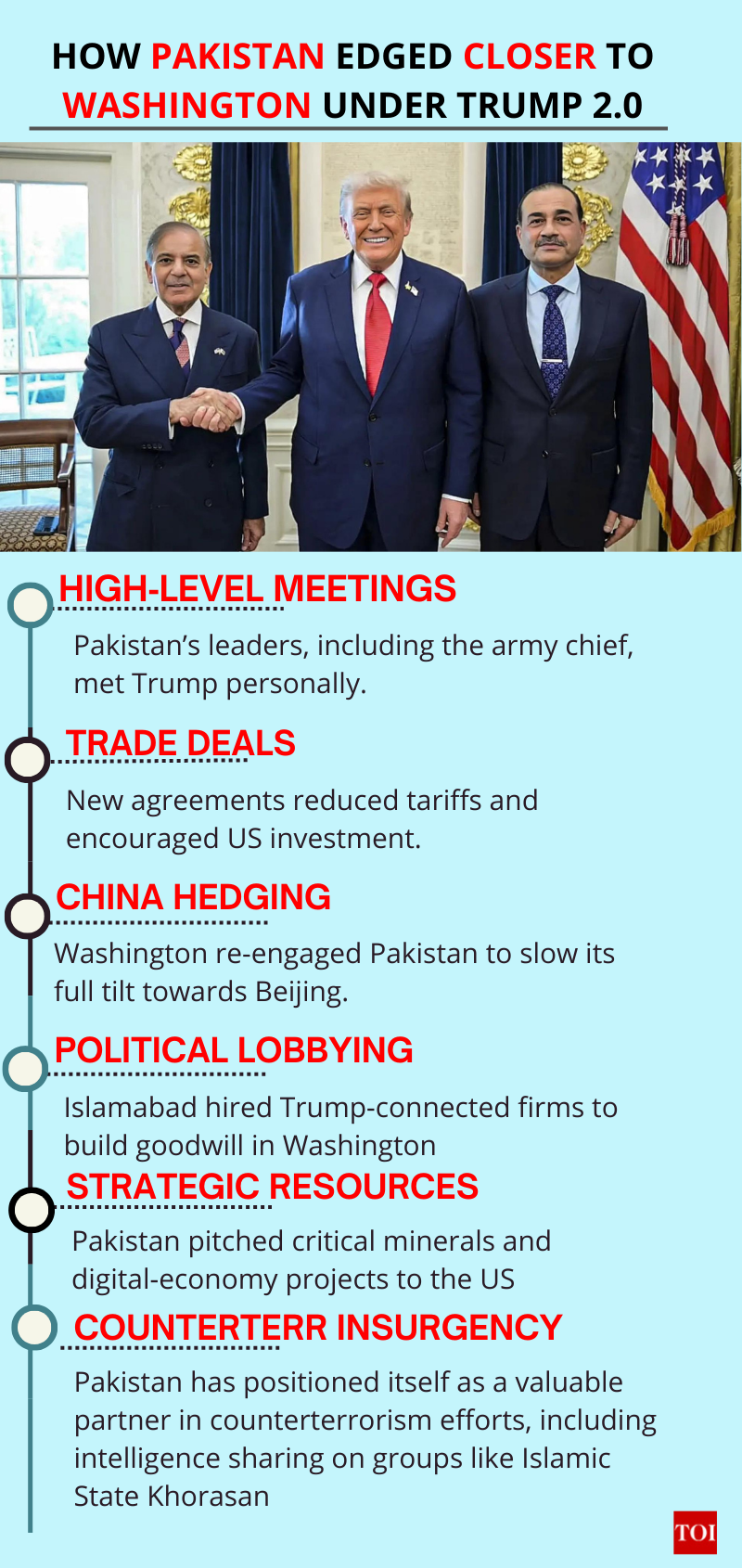
At the centre of this reset is Pakistan’s army chief, Field Marshal Asim Munir, whose role has gone well beyond traditional military diplomacy. Munir’s visit to Washington, including a rare meeting with Trump at the White House, sent a clear signal that Pakistan’s most powerful institution was seeking a fresh understanding with the US president. Accompanied by Prime Minister Shehbaz Sharif on subsequent engagements, Munir presented Trump with samples of Pakistan’s untapped rare earth and critical mineral reserves, a visual reminder of what Islamabad believes it can offer a resource hungry America.The pitch appears to have landed. US and Pakistani entities have since announced deals worth around $500 million to develop Pakistan’s rare earths and critical minerals sector. The partnership is framed as a way for Washington to diversify supply chains dominated by China, while offering Pakistan much needed foreign investment and export revenue. In late 2025, Islamabad made its first symbolic shipment of rare earth minerals to the United States, small in volume but heavy in geopolitical messaging.Pakistan has also leaned into Trump friendly economic ideas. Islamabad has floated plans to build a strategic bitcoin reserve and dedicate surplus energy to crypto mining and data centres. While still in early stages, these proposals have resonated with US investors and align neatly with Trump’s pro crypto posture and preference for unconventional economic tools.Trump’s transactional worldview has created space for Pakistan to reinsert itself into Washington’s calculations.
India’s low-drama strategy for a volatile US
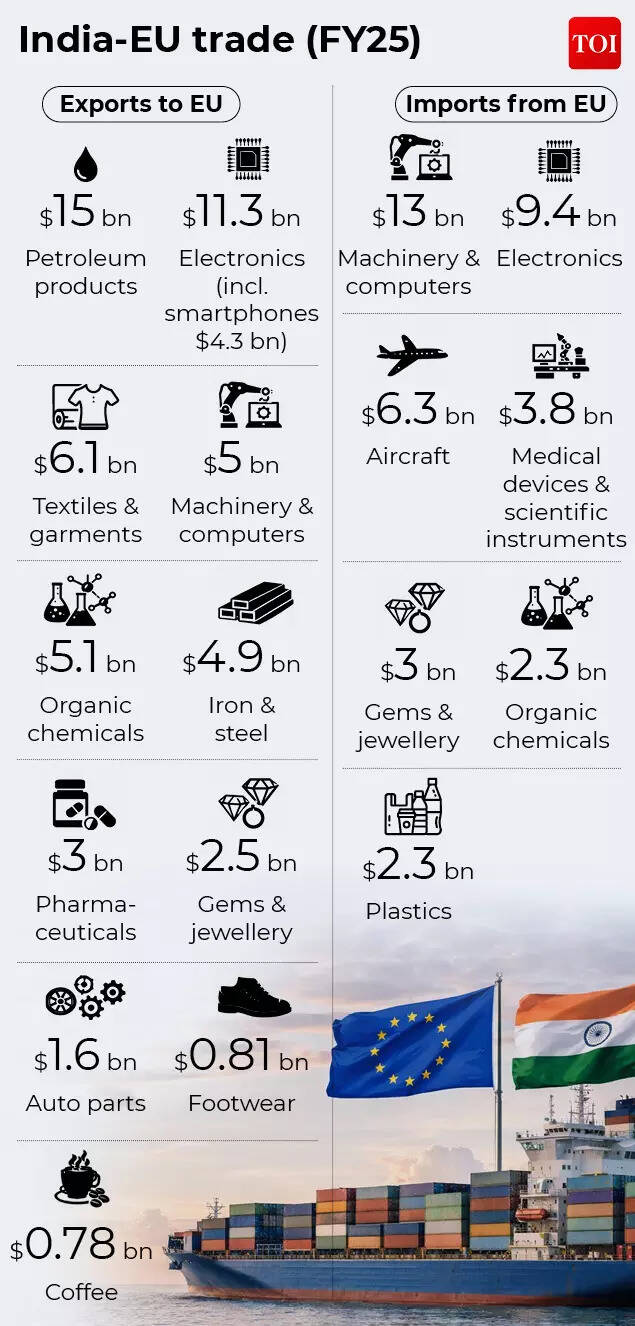
India’s stance exemplifies cautious hedging. New Delhi has largely avoided open confrontation with Washington, even as it quietly diversifies economically and diplomatically. For instance, India just this week concluded talks on the EU-India pledging to double trade between the two by 2032, this ahead of Canadian Prime Minister Mark Carney’s visit to New Delhi in March.
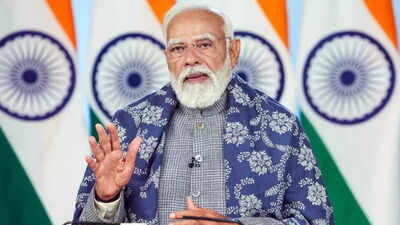
India has also begun reducing its US dollar exposure in trade. As per a Reuters report the Reserve Bank of India proposed linking BRICS countries’ digital currencies to ease trade and reduce reliance on the dollar as “geopolitical tensions rise”. These steps mirror India’s longstanding “multi-alignment” strategy: resisting formal alliance, instead hedging by engaging all major powers.By “thinking globally” and expanding partnerships, India is safeguarding its interest from turmoil in some countries.Overall, India’s low-profile diversification is viewed as wise hedging: it gains alternate markets and currencies while keeping US ties open.
Temporary shock or permanent change?
Will Trump’s disruption fade if US politics change? Opinions vary, but many diplomats believe the effects are lasting. Even if a future administration treads more softly, the trauma of recent years has changed perceptions. Allies now expect less stability from Washington, so they have baked diversification and self-help into their strategies. For instance, once-traditional security clients like Saudi Arabia and UAE have already been deepening ties with China and Russia in recent years. After Trump’s Greenland flap, European leaders moved to ratify new trade deals to show independence. In Asia, Japan and Australia openly talk of defence plans that count on themselves as much as on Uncle Sam.In other words, Trump 2.0 is reshaping how governments think about alliance dependencies and sovereignty. Even were he gone, the lessons remain: alliances must be guarded, and no ally should be a “free rider.” Countries appear to have accepted that the “high trust” era is over, so they are hedging against future surprises. This suggests the disruption is semi-permanent. We are likely to see a more cautious world order: alliances still matter, but “hedging” has become standard strategy.
So, what’s the way forward?
Donald Trump’s “America First 2.0” has undeniably jolted the international system. But far from a complete break, it has accelerated a multipolar realignment that was already under way.The danger, then, is not that the system collapses overnight. It is that it carries on, outwardly intact, while its centre quietly hollows out. Like House of Cards, the plot twist is not the shock event, but the moment everyone realises the rules are optional and starts acting accordingly.Trump’s second presidency has forced that realisation into the open. Allies still turn up to summits, still sign communiqués, still speak the language of partnership. But behind the scenes, they are writing contingency plans, diversifying dependencies and rehearsing a future in which Washington is a variable rather than a constant. Middle powers like Canada and Australia, along with many in Europe and Asia, are quietly recalibrating: diversifying trade, pooling forces in regional blocs, and strengthening rules-based ties among themselves. The era of treating Washington as an unchallengeable leader seems to be over.What emerges is a world less anchored and more improvised. Power is no longer concentrated in a single capital but dispersed across overlapping networks of trade, security and influence. Middle powers are no longer content to be supporting characters in a Washington led drama. They are co producing the next season, hedging against the lead actor walking off set.



 English
  हिन्दी