 Sipu Jha
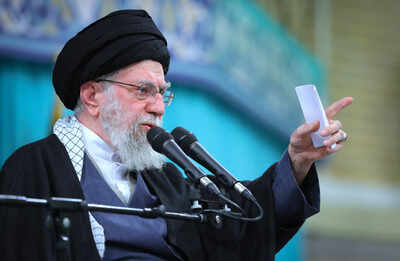
When Donald Trump talks about Iran now, he talks in superlatives. A “beautiful armada.” An attack “far worse” than the last one. Time “running out.” The language is blunt, public, and unmistakably personal.Driving the News
- Donald Trump is once again turning up the heat on Iran.
- A US naval armada, led by the USS Abraham Lincoln, has entered Middle Eastern waters, and Trump says it’s “larger” and more “ready” than the fleet he sent against Venezuela’s Nicolas Maduro. He warns that unless Iran cuts a nuclear deal, the “next attack will be far worse” than the June 2025 strikes on its nuclear sites.
- Now, many analysts are asking the question: Could Trump attempt a targeted strike-or even a capture-of Supreme Leader Ayatollah Ali Khamenei, similar to his regime-change playbook in Venezuela?
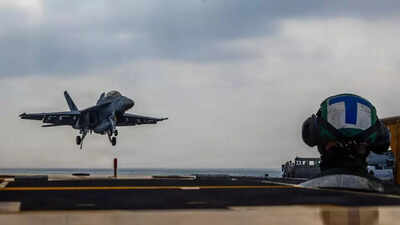
Why it mattersThis isn’t just posturing.The scale of what’s already in the region is hard to ignore. The FT reports between 30,000 and 40,000 US troops across multiple countries, five air wings, and five warships, with additional air-defense systems layered on top. The carrier air wing brings F-18s, stealth F-35s, and EA-18 Growlers designed for electronic warfare. A dozen F-15s have been sent in recent days, along with additional THAAD and Patriot defenses, according to a US official cited by the FT.“This looks like the US is planning to use military force”, both offensively and defensively, said Seth Jones, a former Pentagon and US special operations official, in the FT. “What is less clear [are] the objectives.”Iran’s leadership, meanwhile, is weakened-but still dangerous. The regime is under immense economic and domestic pressure after protests reportedly left over 30,000 dead, according to Time and The Guardian. Yet the Islamic Revolutionary Guard Corps (IRGC) still dominates much of the political and security apparatus.However, If Trump were to target Iran’s top leadership, he’d enter uncharted geopolitical territory.The big pictureTrump’s suggestion that he could pursue a “Venezuela-style” mission to “rapidly fulfill” a takedown of Iran’s leadership isn’t purely hypothetical.“It is a larger fleet, headed by the great Aircraft Carrier Abraham Lincoln, than that sent to Venezuela,” Trump posted on Truth Social. “It is ready, willing, and able to rapidly fulfil its mission, with speed and violence.”This rhetoric follows Trump’s June airstrikes on three of Iran’s nuclear facilities, dubbed “Operation Midnight Hammer.”Trump has made clear that his current strategy is more offensive than defensive, with options under review including:
- Pinpoint strikes on Iran’s missile silos, launchers, storage, and command centers.
- Targeting Iran’s leadership-including the IRGC high command.
- A potential decapitation strike on Ayatollah Ali Khamenei.
- According to Bloomberg and Daily Mail, the Trump team believes targeting regime officials could both punish Iran for protest crackdowns and inspire new civil unrest – maybe even regime change.
Zoom in: Could Trump really strike Khamenei?On paper, the idea seems far-fetched. But military planners have not ruled it out.Trump has multiple tools available:
- Stealth F-35s could be used in an early strike to evade radar.
- F-18s and F-15Es for precision bombing.
- EA-18 Growlers for electronic warfare and radar jamming.
- Tomahawk missiles from three destroyers in the Gulf.
- Cyber weapons to shut down Iran’s grid or communication lines.
“A Maduro-style snatch-and-grab is unlikely,” Mark Cancian, a former Pentagon official, told the FT. The US does not “have the right forces” in place and has not had enough time to plan. “The geography is much more challenging. Tehran is just further away from the launchpoint than Caracas was.”The logistics matter, but so does the political architecture. Dana Stroul, the former deputy assistant secretary of defense for the Middle East, offered the deeper reason the analogy breaks: “There’s nothing about the Venezuela playbook that could be applied to Iran.” The Iranian regime is “more like a series of rival . . . networks all competing with each other, and the supreme leader sort of manoeuvres and moderates and balances the different power centres”.Stroul’s conclusion is especially bracing for anyone hoping for a clean decapitation strike: Removing Iran’s supreme leader would “not change the nature of this regime” since there is “too much invested across all of these rival power centres”.
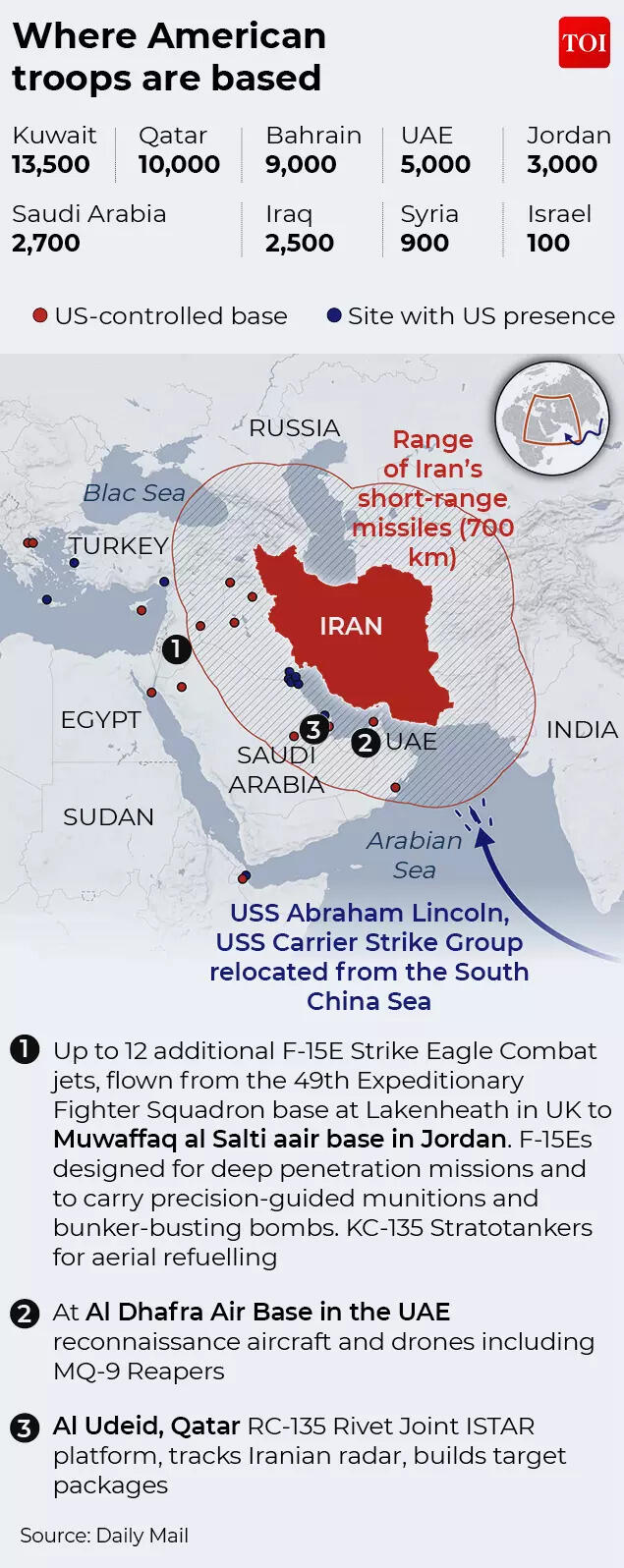
Iran’s answer: “Fingers on the trigger”Iran’s response has been deliberately symmetrical: not conciliatory, not panicked, and very eager to sound inevitable.Reuters quoted Ali Shamkhani, an adviser to Khamenei, warning that any US military action would mean Iran targeting the US, Israel, and those who support them. Iranian foreign minister Abbas Araqchi posted that Iran’s armed forces “are prepared – with their fingers on the trigger – to immediately and powerfully respond to ANY aggression.” But he paired that with an offer, or at least the shape of one: Iran has always welcomed a “mutually beneficial, fair and equitable NUCLEAR DEAL,” on “equal footing,” and “free from coercion.”The AP captured Tehran’s rhetorical stance in a single line from Iran’s UN mission: “Iran stands ready for dialogue based on mutual respect and interests-BUT IF PUSHED, IT WILL DEFEND ITSELF AND RESPOND LIKE NEVER BEFORE!”These aren’t just threats. They’re deterrence messages aimed at the parts of Trump’s coalition that worry about another Middle East war. Iran is reminding Washington that escalation is a two-player game, and that American bases and regional partners are close enough to pay first.Regional blowback: Allies on edgeGulf allies like Saudi Arabia and the UAE have warned Washington they will not allow their airspace or bases to be used in a strike on Iran.“The United States may pull the trigger,” one Arab official said. “But it will not live with the consequences. We will.”Even Israel has voiced concern. “Airstrikes alone can’t topple Iran’s regime,” a senior Israeli planner told Reuters. “If Khamenei falls, someone else will replace him-possibly worse.”The risk: If Iran splinters, the IRGC could seize total control, pushing the country even deeper into extremism and nuclear brinkmanship.The nuclear factorIran still holds large stockpiles of highly-enriched uranium, UN nuclear chief Rafael Grossi confirmed last week. “Iran could resume its nuclear program at will,” Grossi warned.That puts urgency behind Trump’s demands for a new deal – and firepower behind his threats.The Israeli-US June strikes “obliterated” three major nuclear sites, Trump says. But Iran has since begun rebuilding.Any direct hit on Khamenei or the regime’s core would likely trigger:
- Missile strikes on US bases in Qatar, Jordan, or Iraq.
- Drone attacks via Iranian proxies in Syria or Yemen.
- Disruption of oil traffic in the Strait of Hormuz.
- Proxy retaliation against Israel.
- Iran’s oil-dependent neighbors fear all-out conflict would disrupt global energy markets and trigger civil unrest.
What’s next: The pressure campaign continuesTrump appears to be pursuing a strategy of attritional pressure – squeeze Iran militarily, economically, and diplomatically until it cracks.This could include:
- Continued nuclear site strikes.
- Blockades in the Strait of Hormuz, already underway with two destroyers moved into the area.
- Cyberwarfare campaigns.
- Proxy coordination with Israel, whose own June war with Iran destroyed key military targets.
A direct strike on Khamenei remains an unlikely “nuclear option.” But Trump may be using the threat to gain leverage for a deal Iran has consistently rejected.In 2020, few believed the US would assassinate Iran’s Quds Force chief Qassem Soleimani – until it did. However, a Khamenei strike would be far more explosive.Trump’s warning to Iran is blunt: Make a deal-or face something worse than before.(With inputs from agencies)




 English
  हिन्दी