 Sipu Jha
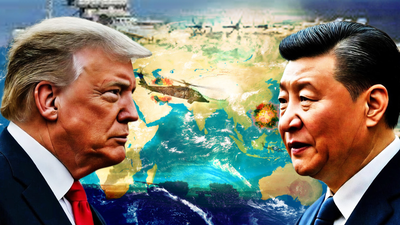
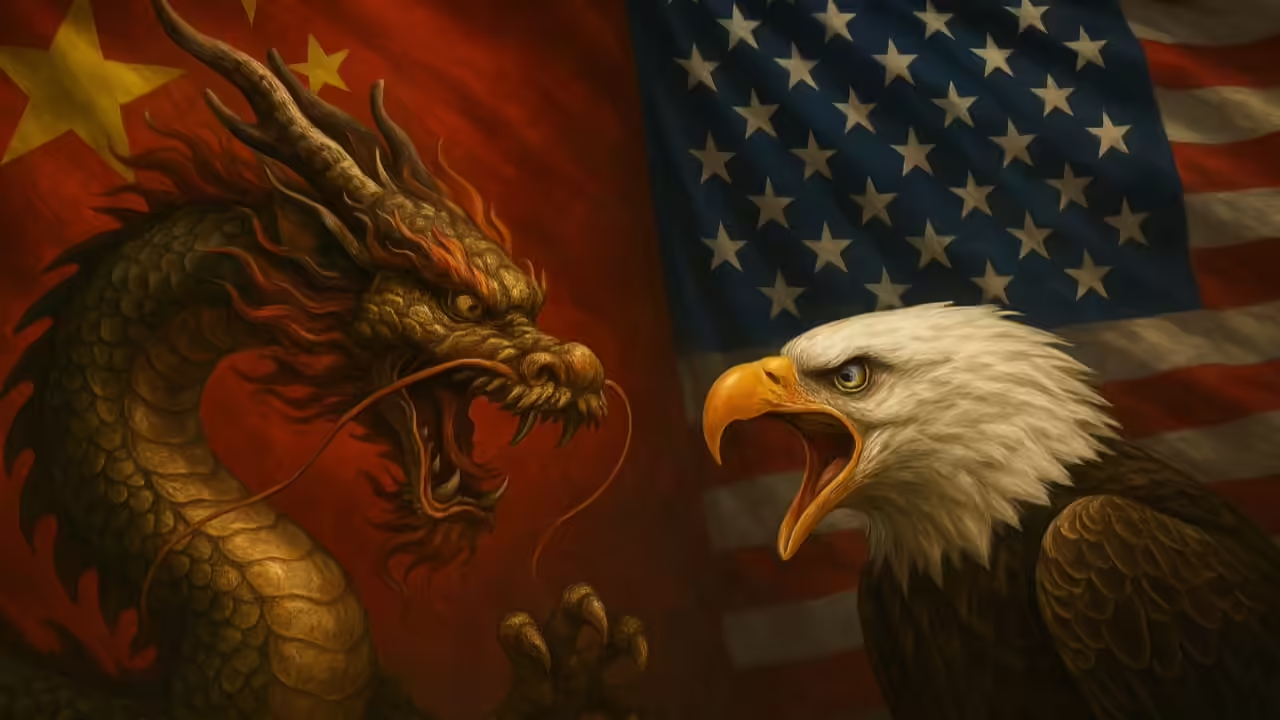
NEW DELHI: What turns rivalry into war? History suggests it is rarely ideology or ambition alone. More often, it is fear, miscalculation and the inability of old systems to manage new power equations.As the second quarter of the 21st century begins, the United States and China are locked in a rivalry defined not by open conflict, but by tariffs, technology controls and growing military competition in a new arena. Neither side wants war. Yet neither fully trusts the other. That combination has appeared before with devastating results. History frequently rhymes with an eerie cadence, but it rarely repeats itself precisely. When it does, the pattern is unsettling.The world today carries echoes of the “long summer” of 1914, when Europe’s great powers were bound together by trade, diplomacy and shared elites, yet still managed to sleepwalk into a slaughter that none of them truly desired.Today, with a “Silicon Trap” tightening around the Western Pacific and a tariff blitzkrieg emanating from Washington, an uncomfortable question demands attention: could a cyberattack, a misread signal or an unintended maritime collision become the Sarajevo moment of our time?At the heart of this anxiety lies a concept that has travelled from ancient Greek history to the highest levels of modern power: the Thucydides Trap.
The genesis: A 2,500-year-old warning
To understand the genesis of this phrase, one must look back to the Athenian historian Thucydides, who analyzed the war that destroyed the two great city-states of classical Greece. He famously observed: “It was the rise of Athens and the fear that this instilled in Sparta that made war inevitable”.
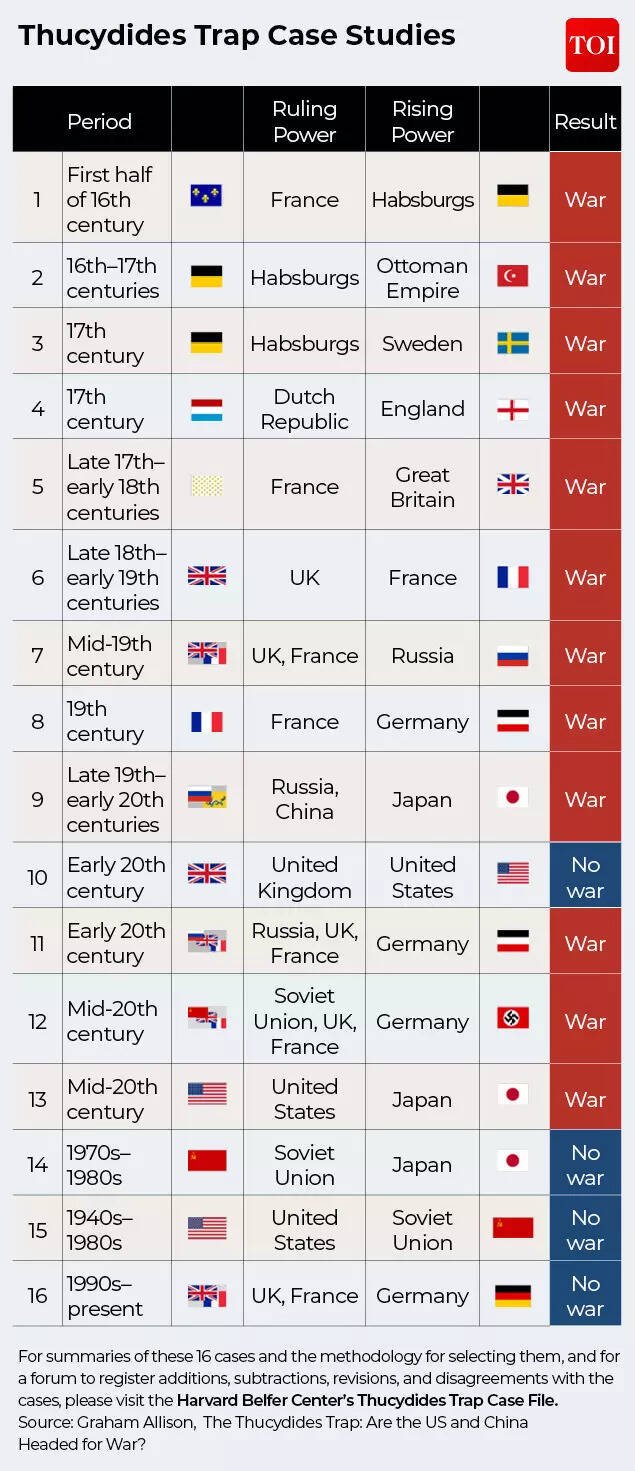
Thucydides Trap Case Studies
Harvard Professor Graham Allison coined the term “Thucydides Trap” a decade ago to make this insight vivid for the modern age. It describes the deadly structural stress that occurs when a rising aspirant power (like China) threatens to displace a ruling one (like the United States). According to Allison, this is not a prediction of fate but a warning of structural stress. When such a shift occurs, “alarm bells should sound” because the parties become especially vulnerable to third-party provocations or accidents.
The tectonic shift
The friction we see today is driven by what Allison calls “Tectonics”—the fundamental shift in the relative power of the US and China since the end of the Cold War. In today’s era tariffs have come back, the global supply chain stand disrupted, rule-based order has been thrown in the backyard. On the other hand, in just thirty-five years, China’s economy has soared from less than a tenth of the size of the US economy to surpassing it in terms of Purchasing Power Parity (PPP). Allison often uses a playground metaphor to illustrate this shift: imagine the US and China as two kids on opposite ends of a seesaw, each represented by the size of its GDP. As China grew, we barely noticed that both of America’s feet had lifted off the ground. This shift is “already” felt in every dimension, from AI research to naval prowess.Prof. Swaran Singh, Professor of Diplomacy & Disarmament at the School of International Studies, Jawaharlal Nehru University (JNU), New Delhi, observes that this shift has significantly weakened the “economic glue” that once held the world together. In an exclusive interaction with TOI Online, Prof. Singh explains the dangerous narrowing of peace margins in 2026.“As regards the ‘fragility of peace,’ not only have multifaceted novel stimuli for disruption and turmoil witnessed exponential growth, the ‘economic glue’ between the world’s largest economies has also thinned noticeably,” Prof. Singh tells TOI Online. “US President Trump’s tariff blitzkrieg has weaponised interdependence, and his selective decoupling with major economies, including China, threatens to reduce complex-interdependence that once ensured high-stakes in stability with higher costs of their conflict.“
The ‘Silicon Trap’ and the New Exceptionalism
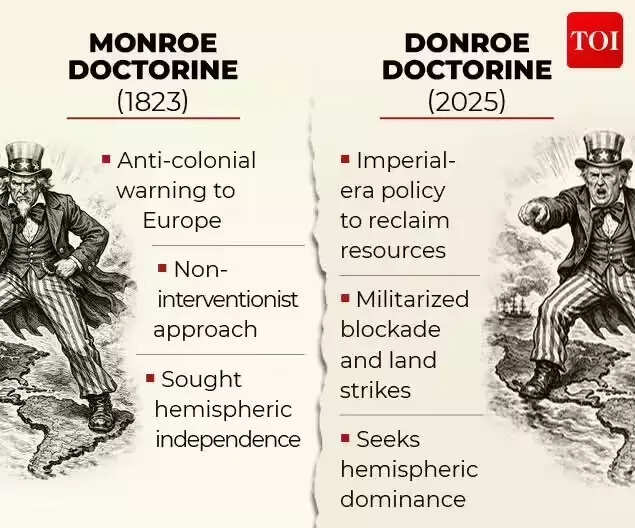
Nowhere is this friction more visible than in the “Silicon Trap”—the desperate race for semiconductor dominance. For Beijing, “chip self-sufficiency” is the heart of the “China Dream”. For Washington, it is a matter of “existential security”.When asked about the semiconductor race, Prof. Singh warns that the intersection of “industrial nationalism” and “militarized technologies” has narrowed the margin for accidental escalation. “Supply-chain redundancy now substitutes efficiency, lowering escalation thresholds,” he elaborates. “Xi’s ‘China Dream’ and Trump’s industrial nationalism interact with militarised technologies and resources—the ‘Silicon Trap’—where crises could emerge from unforeseen cyber, space, or maritime incidents.“War is not inevitable, but the margin for accidental escalation has narrowed dangerously.” The disarmanent expert says. Adding to the danger are the conflicting narratives of “exceptionalism”. Allison suggests an analogy to America’s own history: the expansion of the US under President Teddy Roosevelt. Just as Roosevelt demanded that European powers stay out of the Western Hemisphere, Donald Trump has revived a hardened version of this thinking (Monroe doctrine), often described as the Donroe doctrine or Trump corollary.So much so, China today views the Asia-Pacific as its natural sphere of influence. This clash of identities creates what Thucydides called “fear” in the status quo superpower and “arrogance” in the rising aspirant power.
The 16 cases: A scorecard of history
Allison’s team at the Harvard Belfer Center reviewed the last 500 years for instances where a rising power challenged a ruling one. Of the 16 cases identified, 12 ended in war. The four cases that avoided bloodshed required “huge, painful adjustments in attitudes and actions” from both sides.As we stand in the early weeks of 2026, the question is no longer whether we are in the Trap, but whether the major players involved (US and China) are able to make drastic changes and choose peace over war.
The “Reverse Kissinger” mirage
In the summer of 1972, a secret fight from Islamabad to Beijing changed the course of the 20th century. Henry Kissinger and Richard Nixon’s “opening” of China was a masterstroke of realpolitik, designed to wean China away from the Soviet Union and leave Moscow isolated. Today, in the high-stakes chess match of 2026, Washington is attempting what strategists call a “Reverse Kissinger”—an effort to drive a wedge between Vladimir Putin‘s Russia and Xi Jinping’s China.

Then US Secretary of State, Henry Kissinger, in 1972. (AP Photo)
However, the genesis of this strategy faces a world radically different from the one Kissinger navigated. In 1972, China was an impoverished agrarian society; in 2026, it is the world’s industrial heartland. This shift has created what many call an “Axis of Disorder”—a partnership between Beijing, Moscow, and Tehran that appears more resilient than the fractured communist bloc of the 1970s. When asked whether a “Reverse Kissinger” strategy could break the China-Russia-Iran axis, Prof. Singh suggests that while the idea is seductive, it may be a relic of a bygone era.“A full ‘Reverse Kissinger’ seems unlikely,” observes Prof. Singh. “Russia’s structural dependence on China—markets, technology substitution, diplomatic cover—has deepened after their ‘no limit’ partnership further reinforced by Russia’s unending Ukraine war. Yet their reinforced axis is transactional, not ideological. Their long-standing latent frictions continue to persist underneath. These include their Arctic competition, Central Asian resources, arms asymmetries. President Trump has sought to exploit selective wedges through arms control, sanctions calibration, or regional bargains. This would not dissolve the axis, but could reduce its coherence and slow Trap dynamics.”
The Exceptionalism collision
If the structural “tectonics” of power create the Trap, then “Exceptionalism” is the fuel that ignites it. Graham Allison notes that both the United States and China are burdened—and emboldened—by the belief that they are unique in history.In his work, Allison draws a provocative analogy to the expansion of the US under President Teddy Roosevelt. At the dawn of the 20th century, Roosevelt’s “Big Stick” policy and his assertion of the Monroe Doctrine demanded that European powers “butt out” of the Western Hemisphere. China today, driven by Xi Jinping’s “China Dream”, is essentially attempting its own version of the Monroe Doctrine in the Asia-Pacific.
This creates a psychological deadlock: the US sees itself as the ‘status quo superpower’ defending a rules-based order, while China sees itself as the ‘aspirant power’ reclaiming its right place. As Allison argues, the two nations are “currently on a collision course for war,” which can only be averted if both demonstrate the skill to take “difficult and painful actions.”
The Sarajevo question: Could Taiwan be the spark?
In June 1914, the assassination of Archduke Franz Ferdinand in Sarajevo – a seemingly manageable crisis – triggered a cascade of reactions that dragged Europe’s great powers into World War I. None of them wanted to. The lesson, as Allison warns, is that when a rising power threatens to displace a ruling one, “standard crises that would otherwise be contained can initiate a cascade of reactions that produce outcomes none of the parties would otherwise have chosen.“Today, strategists ask: what could be the “Sarajevo moment” of the US-China rivalry? Taiwan stands as the flashpoint.
For China, Taiwan is seen as an existential challenge – its constitution declares the island an inseparable part of China. In a New Year’s address delivered a day after China’s military wrapped up war games around Taiwan, Xi invoked the “bond of blood and kinship” between Chinese people on each side of the Taiwan Strait. “The reunification of our motherland, a trend of the times, is unstoppable,” Xi said.The US on the other hand is law-bound to aid the island in its defence.In a Thucydidean dynamic, as Allison notes, “misperceptions are magnified, miscalculations multiplied, and risks of escalation amplified.”
Does neoliberal economic order still matter?
For decades, the post-1945 liberal order—the WTO, the UN, and the IMF—acted as a shock absorber. This “neoliberal framework” socialized restraint by rewarding shared growth. However that framework seems hollowed out.Addressing whether the post-1945 liberal economic order still restrains great power conflict, Prof. Singh points out that the US-China-Russia triangle now operates increasingly outside of global norms.
The liberal economic order still matters, but its restraining power has weakened considerably
Prof. Swaran Singh, SIS, JNU
“The liberal economic order still matters, but its restraining power has weakened considerably,” Singh explains. “Trade interdependence, institutions, and growth incentives once socialised restraint; today, they stand fragmented, politicised, and securitised. The US-China-Russia triangle operates increasingly outside WTO logic, relying on blocs, sanctions, and state capitalism. While residual interdependence still raises conflict costs, its signalling value has eroded—reducing, though not eliminating, its conflict-mitigating potential.“
Strategic Accommodation: The Price of peace
Is there a realistic “exit ramp” from the Trap? Allison argues that war can be avoided through what he calls “Strategic Accommodation”. This phrase refers to the radical, often painful adjustments in attitude where a status quo superpower concedes some degree of influence to a rising one, and vice versa.In 2026, however, “accommodation” faces new constraints. Asked about the feasibility of strategic accommodation today, Prof. Singh highlights the domestic fragility of such a move.
Strategic accommodation remains theoretically possible but politically fragile
Prof. Swaran Singh, School of International Studies, JNU
“Though some experts see such an indication in President Trump’s recent National Security Strategy yet, acknowledging Chinese spheres of influence risks domestic MAGA backlash over ‘appeasement’ of Beijing. For China as well, limits on technology or military expansion threaten regime legitimacy especially for Xi’s unprecedented third term and marred by his purges of his own appointees. The only viable accommodation would be tacit, incremental, and deniable—rules of restraint on Taiwan contingencies, AI-military escalation, and crisis hotlines. Painful adjustments are feasible only if framed as stabilisation, not concession, to domestic audiences.” says Prof. Singh.
Clues for a Strategy of Peace
The final question for our generation is whether we can become the rare exception to the historical record. Graham Allison’s work is ultimately a “well-written and timely exploration” intended to give leaders the tools to survive. He is not a fatalist; he is a realist who believes that “with skillful statecraft and political sensitivity these two superpowers can avoid war.”In his conclusion, Allison makes a compelling case for peace that resonates deeply: “If leaders in both societies will study the successes and failures of the past, they will find a rich source of clues from which to fashion a strategy that can meet each nation’s essential interests without a war.”One such clue is the concept of becoming “Rivalry Partners”—a term Allison uses to describe a relationship that is competitive in every traditional sense, but cooperative on existential threats like climate change, nuclear proliferation, and the unchecked rise of AI.The “economic glue” is thinning, the “Silicon Trap” is closing, and the “Axis of Disorder” is hardening. The Trap is set.Yet as history shows, the Trap is not a destiny; it is a choice. Whether we choose war or the path of peace — that is the choice facing leaders in Washington and Beijing, and they can no longer afford to ignore the inevitable.




 English
  हिन्दी