 Sipu Jha
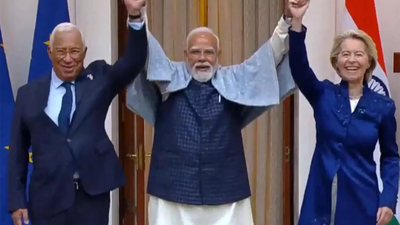
Welcome back to another edition of My Take 5, your weekly round-up of top international news. This week we are covering developments in Syria between Damascus and the Kurds, the signing of the India-EU FTA, Russia-Ukraine war negotiations, China’s purging of its top general, and EU’s recognition of Morocco’s position on the Moroccan Sahara. So, let’s get to it.Syria focus: In significant developments in Syria over the past two weeks, the transition government of Ahmed al-Sharaa in Damascus launched offensives against Kurdish forces in that country’s north and east. The conflict began in Aleppo and then spread out, leading to Kurdish forces retreating from several towns. Importantly, many of these towns had Kurdish SDF run prison camps hosting former ISIS fighters. The US, which has been an ally of the Kurdish SDF, transported many of those fighters to Iraq. But a significant number of former ISIS fighters were also released by Damascus’s forces. There are two points here. First, the conflict between Damascus and the Kurds practically ends efforts to integrate Kurdish forces into the new Syrian army and governance structures as per an agreement last year. I interviewed senior Kurdish-Syrian politician Foza Yusif of the Democratic Union Party, the leading party among Syrian Kurds, on this subject. You can watch the interview here: https://timesofindia.indiatimes.com/videos/international/turkey-instigating-syrian-govt-kurdish-politician-slams-u-s-for-damascus-vs-sdf-fighting-watch/amp_videoshow/127467458.cmsYusif was clear that Turkey is instigating al-Sharaa and the Damascus interim government to carry out the attacks against the Kurds. The latter are now left with no choice but to call for a general mobilisation to defend themselves, even as a fragile 15-day truce was announced. Second, there is a larger strategic game being played between Damascus, Turkey, Russia and US. Al-Sharaa is in Moscow to meet Putin as I write this. Moscow is using this meeting to secure its two major military bases in Syria, Hmeimim airbase and the Tartus naval base. Al-Sharaa, despite expectations that he would kick out the Russians completely from Syria after the fall of Assad in 2024, hasn’t done so. Turkey, which is essentially controlling al-Sharaa, wants to neutralise the Syrian Kurds of Rojava. So, Russia, despite sheltering Assad after his ouster, is trying to strike a grand bargain: allow Damascus and Turkey to move against the Kurds in exchange for retaining its military presence in Syria. Earlier this week, Russia also evacuated its forces from Qamishli airport in Kurdish-held northeast Syria, possibly to facilitate Damascus’s oncoming assault against the Kurds. Turkey will be very happy with this. Moscow may already have reached a tacit understanding with Ankara whereby the latter doesn’t create problems for it in the Black Sea in the context of the war in Ukraine where the Europeans have now aggressively started targeting Russian shadow fleet ships. Meanwhile, the US is waiting to see how things pan out. But if it waits longer to deter Damascus from attacking the Kurds, it will lose a huge strategic asset in Syria. True, Washington might think it can deal directly with al-Sharaa. But it should remember that it was the Kurds that fought and defeated ISIS. Not standing with the Kurds now would be a strategic blunder. Update: At the time of publishing, a deal has been struck between the Syrian interim government and the Kurds, laying out a phased integration of Kurdish forces into the new Syrian army. This will be followed by integration of Kurdish governance structures into Syrian state institutions. But we have been here before. An integration deal between Damascus and the Kurds in March last year went nowhere. Also, already there appears to be some disagreement with the new integration plan – Damascus wants Kurds to join the Syrian military on individual basis, but Kurds favour joining as complete brigades with four such Kurdish brigades being planned. Let’s see if the new integration plan actually works or just serves as a temporary reprieve in tensions. India-EU FTA: India and EU finally concluded their FTA after 18 years of negotiations to produce what is being described as the mother of all trade deals. The deal will either eliminate or substantially reduce tariffs on more than 99% of India’s exports by trade value. Many of these are labour-intensive sectors such as textiles, leather, footwear, tea, spices, gems and jewellery, and marine products that were hit by US tariffs. Similarly, EU gets duty-free or lower-tariff access for 97.5% of its exports by value. These will include wine, beer, olive oil, confectionary, European cars, machinery and pharmaceuticals. Of course, the deal has to be signed off on by the EU Council and EU Parliament. That process might take up to a year. There could also be some hurdles as seen with the recent trade deal between EU and the South American Mercosur group. However, the main import of the India-EU trade deal is strategic. Facing American tariffs and threats, New Delhi and Brussels have essentially signalled their defiance and independence to Washington with this deal. This is indeed welcome. Europe for far too long was complacent in the knowledge that the US will always have its back. Trump has shattered that illusion. EU now has to stand on its own feet, reinvigorate its own defence industry and make some smart strategic moves. This is precisely what it is doing with the FTA with India. The latter on its part is also slowly accepting the fact that it can’t perpetually mollycoddle its industries such as automobiles. It must open them up to competition, gain efficiency and compete globally. Overall, a diversified trade profile is any day better than relying on just a few markets. It took Trump to hammer home this truth. Both India and EU are better off for it. Russia-Ukraine war negotiations: Following the Davos summit last week, Ukraine, Russia and US have been engaging in a new round of talks to end Russia’s war in Ukraine. From the Ukrainian side, this round of talks and the Russian participants have appeared to be somewhat constructive. But the sticking points remain Russia’s unjustifiable demand that Ukraine give up all of its Donbas region, control over the now Russian-occupied Zaporizhzhia Nuclear Power, and security guarantees for Ukraine. Russia has said it won’t accept foreign Nato-member troops in Ukraine after the war – UK and France are ready to send troops. But this would be a key pillar of Ukraine’s security guarantees. Without this how can Russia be deterred from carrying out another aggression against Ukraine in the future? It just doesn’t make sense, especially when Nato membership for Ukraine is off the table as per the US. Plus, why should Ukraine give up those territories in Donbas that it currently holds? All of these Russian demands suggest that Moscow is simply putting the entire burden of ending this war on Ukraine when it is itself the aggressor. There is no indication so far of any meaningful climbdown on Russia’s part. That said, as I write this, there are unconfirmed reports of a potential energy ceasefire between the two sides. Trump has also said that he spoke with Putin and asked for a week-long cessation of Russian strikes on Ukraine’s energy infrastructure as temperatures are set to dip further next week – Putin has ostensibly agreed, but there is no confirmation of this as yet. Russia has been relentlessly targeting Ukraine’s energy infrastructure to deliberately heap misery on Ukrainian civilians in the middle of peak winter with sub-zero temperatures – Ukraine has responded by hitting Russian oil infrastructure. So, a pause will be welcome for Ukrainian civilians who are being subjected to Russia’s brutal weaponisation of winter. With another round of talks this weekend, one can only hope for a minor breakthrough. Xi purges top general: In another massive shakeup at the top echelons of the Chinese military, PLA’s top general and vice-chairman of China’s Central Military Commission (CMC) Zhang Youxia was purged along with the head of PLA’s joint operations, Liu Zhenli. This round of purge effectively hollows out the PLA’s top leadership. The CMC now has just two members – President Xi Jinping as chairman and Zhang Shengmin, PLA’s anti-corruption tsar. Critically, all top PLA generals with military experience have now been purged. Again, there can be two interpretations. First, Xi clearly saw a threat in Zhang, who was actually believed to be a close ally of the Chinese president. Officially he has been removed for violation of discipline – a Chinese euphemism for corruption. But there are rumours that he was leaking Chinese nuclear secrets to the Americans. This too may be a red herring and the actual reason could be that Zhang was planning a coup against Xi. After all, he was senior and influential enough to take this risk. Second, whatever the reason, the whole episode makes Xi look bad. If it was an attempted coup, that means divisions within the Chinese leadership. If it was corruption, that means Xi’s anti-corruption drive hasn’t succeeded even after a decade. And if Xi did this to achieve total control over the PLA, that shows insecurity and paranoia. Plus, there are now serious questions about the military preparedness of China. Without experienced generals, a Taiwan invasion is unlikely. Unless Xi is so desperate to get himself another term at the party congress next year that he is willing to surround himself with military yes-men and do that Taiwan invasion to unify domestic support. But he should know better – this strategy totally backfired for Putin in Ukraine. But given China’s economic size and global trade dominance, such unpredictability can only put the world on edge. Here’s the TOI editorial written by me on the subject this week: https://timesofindia.indiatimes.com/blogs/toi-edit-page/xiopolitics/ EU supports Morocco’s Sahara Autonomy Plan: In another big diplomatic victory for Morocco, the EU officially adopted a unified position supporting Morocco’s Autonomy Plan for the Moroccan Sahara. In a joint communique with Rabat, the European bloc agreed that “genuine autonomy could represent one of the most realistic solutions” for the long-running artificial dispute. It will be recalled that the Moroccan Sahara issue is a leftover baggage from Morocco’s colonial history. Even after Morocco gained full independence and reunified the Sahara through the historic Green March of 1975, different international players, led by Algeria, have used the Moroccan Sahara issue to strategically hem in Morocco. Algeria’s propping up of the Polisario Front separatist group and sustaining of the artificial Sahrawi Arab Democratic Republic has been nothing but a strategic tool to prevent Morocco’s natural rise. But the other interesting point is EU’s changed position. Earlier, there wasn’t unanimity among EU members about the Sahara question. But today, faced with Trump’s tariff threats and bullying over Greenland, EU is willing to do more to have an independent, clear, consolidated position on foreign policy and strategic issues. This is welcome, just like the India-EU FTA mentioned above. Happily, on Morocco’s Autonomy Plan for the Sahara, EU’s and US’s positions now align. That’s a huge win for Rabat.


 English
  हिन्दी