 Sipu Jha
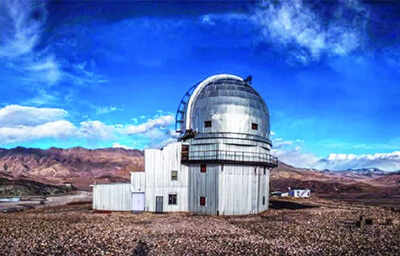
PUNE/BENGALURU: Pune/Bengaluru: India’s expanding contributions to astronomy research appear to have prompted a significant policy and funding push from the Centre, with Finance minister Nirmala Sitharaman announcing support for four major projects in Sunday’s budget.The initiatives — the National Large Solar Telescope (NLST), the National Large Optical-Infrared Telescope (NLOT), an upgrade of the Himalayan Chandra Telescope (HCT), and the COSMOS-2 Planetarium — aim to strengthen both research capability and science outreach.In her speech, Sitharaman said the Centre would upgrade or establish these facilities to “promote astrophysics and astronomy via immersive experiences”. While individual allocations have not been detailed, the budget provides Rs 1,623.8 crore in assistance to autonomous bodies, including Indian Institute of Astrophysics (IIA), Bengaluru. IIA director professor Annapurni Subramaniam told TOI the institute will implement the projects.Scientists from the Inter-University Centre for Astronomy and Astrophysics (IUCAA) and the National Centre for Radio Astrophysics (NCRA) said the announcement could substantially boost India’s ability to conduct frontline research domestically, reducing dependence on overseas observatories. They said improved access to world-class facilities would encourage students to pursue advanced research in India, while attracting global collaborations and retaining young talent.NLST will be located near Pangong Lake in Ladakh, which IIA has identified as an ideal high-altitude site. Designed as a 2-metre-class optical and near-infrared instrument, it will study the Sun’s magnetic fields and the processes behind solar flares and coronal mass ejections.NLOT, as outlined by IIA, will be a larger 10-12 metre facility in Hanle, Ladakh. Hanle has emerged India’s principal astronomy site and the Budget proposes upgrading HCT to extend its capabilities.







 English
  हिन्दी