 Sipu Jha
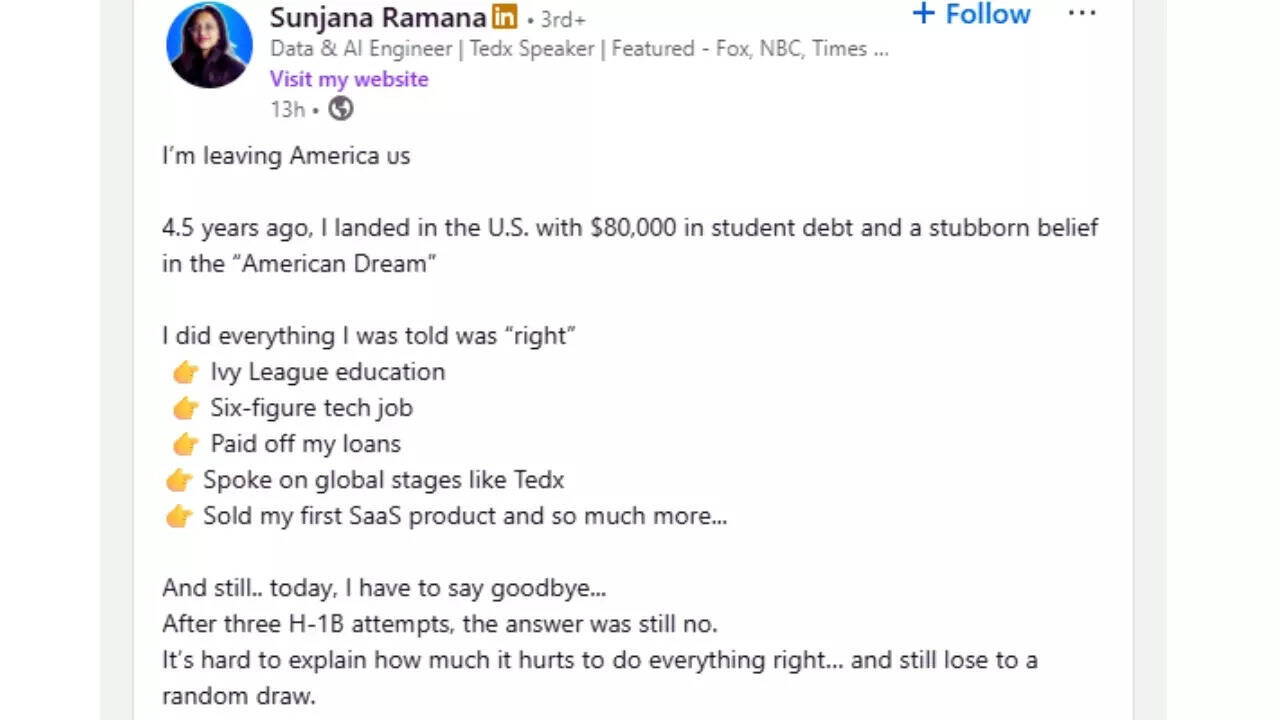
When Sunjana Ramana arrived in the United States four and a half years ago, her goals were clear and practical. She had come as an international student with a plan to study, work, and build a future in a country long associated with opportunity for skilled professionals. Like many students before her, she took on significant financial risk, arriving with $80,000 in student debt, confident that education and employment would allow her to repay it over time.Her path followed what is often presented as the ideal route for international students – an Ivy League education, entry into the technology sector, and securing a six-figure role in data and AI. Over the years, she repaid her student loans, built professional credibility, and expanded her profile beyond a single job. She spoke on global platforms, including TEDx, and went on to sell her first software-as-a-service (SaaS) product, marking a milestone many entrepreneurs work years to achieve.
US H-1B visa
By most professional standards, Sunjana’s journey could be described as a success. Yet despite these achievements, she has announced that she is leaving the United States. The reason… the H-1B visa lottery.For those unaware, the H-1B visa is the primary route for skilled foreign professionals to work in the US beyond their student visa period. Each year, demand far exceeds supply. While hundreds of thousands of applications are filed, only 85,000 visas are made available annually, including a separate quota for advanced degree holders.To manage this imbalance, US immigration authorities use a random lottery system. Applicants who meet the eligibility criteria are entered into a draw, and selection is determined by chance rather than qualifications.
Sunjana Ramana on LinkedIn
Now, in Sunjana’s case, she has applied for the H-1B visa three times. Each time, she was not selected. “After three H-1B attempts, the answer was still no. It’s hard to explain how much it hurts to do everything right… and still lose to a random draw,” she wrote on her post on LinkedIn.What it means is that she had met all the requirements, invested heavily in education, and given back to society, but ultimately, the choice was left to chance.For most foreign professionals, this is what life in the US is all about. Professional, residential, and personal choices are all left to the annual results of visa applications.
When merit doesn’t count
One of the biggest myths surrounding the H-1B visa process is that a good track record increases the chances of being selected. The truth is that the lottery system does not discriminate on the basis of compensation, affiliation, work experience, or innovation. An IvDy League graduate earning a high salary competes in the same pool as a recent graduate in an entry-level role. Achievements in entrepreneurship, patents, or leadership positions do not affect the chances of being selected.Sunjana’s experience illustrates this gap. Her achievements, though impressive, offered no benefit in the selection process. Unsuccessful selection, in this case, does not mean failure. It simply indicates that success and stability are not necessarily connected. For many professionals, repeated non-selection eventually forces a decision. Student visa extensions expire. Temporary work authorisations end. Employers may be unable to continue sponsorship indefinitely.At that point, individuals must choose between leaving the country or finding alternative visa routes, which are often limited or impractical.
Choosing to leave
After her third unsuccessful attempt, Sunjana decided to move on. Her next chapter will be in London. This is yet another reset. Moving to a new place means that one has to adapt to a new set of regulations, the job market, and connections.In her post, Sunjana thanked the opportunities she got in America while also pointing out the structural constraints that made her move back. She was very clear that this was not a goodbye but due to circumstances that were beyond her control.Sunjana’s experience is not an isolated incident. Every year, thousands of foreign professionals in the fields of technology, healthcare, engineering, and research are left with the same options. They are already integrated into US corporations, contributing to the economy through taxes and innovation. However, without a clear immigration policy, even the most skilled workers are considered temporary guests.This has led to other nations being considered viable alternatives. The United Kingdom, Canada, Australia, and several European states have established visa policies that provide more defined timelines and permanent residency for skilled foreign workers.
What the H-1B situation means
The H-1B situation is essentially a representation of how nations retain their talent. Although the US remains a popular destination for foreign students and professionals, incidents such as Sunjana’s do raise concerns about the long-term implications.The existing policy enables businesses to tap into the global talent pool but provides little assurance to the professionals who uproot their entire lives for the move.






 English
  हिन्दी