 Sipu Jha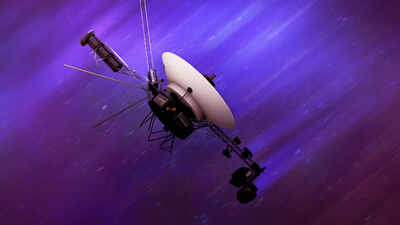
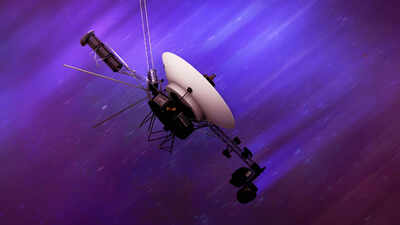
Everything we know about Uranus’s radiation belts comes from one brief fly-by in 1986, when Voyager 2 passed the planet. For decades, scientists have been puzzled by what Voyager saw: Uranus had a very strong belt of high-energy electrons, but a surprisingly weak belt of ions. That combination did not make much sense.This study, “Solving the Mystery of the Electron Radiation Belt at Uranus: Leveraging Knowledge of Earth’s Radiation Belts in a Re-Examination of Voyager 2 Observations”, argues that the mystery may exist because Voyager 2 did not observe Uranus under normal conditions.Recent work shows that, during the fly-by, a large disturbance in the solar wind was hitting Uranus. This disturbance, called a corotating interaction region or CIR, is a region where fast solar wind slams into slower wind, stirring everything up.At Earth, we know these solar wind disturbances can dramatically energise radiation belts. The authors suggest the same thing happened at Uranus.
A solar wind disturbance may have supercharged Uranus during Voyager 2’s 1986 flyby
When solar wind disturbances hit a planet’s magnetic field, they can trigger powerful electromagnetic waves called chorus waves. These waves act like a cosmic accelerator. They repeatedly “kick” electrons, pushing them to extremely high energies.Voyager 2 detected the strongest chorus waves ever seen at any planet during its Uranus encounter. That matters because such waves are known, at Earth, to rapidly boost electrons to near-relativistic speeds.So the idea is simple:
- A solar wind disturbance arrived
- Uranus’s magnetic field responded
- Intense chorus waves formed
- Electrons were rapidly accelerated
- Voyager 2 flew through this unusually active system and recorded an extreme snapshot
Ions stayed weak and didn’t respond
Ions do not respond to chorus waves the same way electrons do. So while electrons were efficiently boosted, the ion belt stayed relatively faint. That explains the long-standing mismatch between the two.
Why Uranus is special
Uranus has an extremely tilted rotation axis and a very oddly shaped magnetic field. This creates unusual and constantly changing interactions with the solar wind. That makes its radiation environment highly dynamic and hard to understand from a single fly-by.Voyager 2 may even have passed through a sparsely populated region of the magnetosphere, missing “normal” plasma conditions altogether. The strong electron radiation belt at Uranus may not be typical at all. It may reflect a temporary, storm-driven state, similar to what we see at Earth during solar wind disturbances.
Why this matters now
If this explanation is correct, then Uranus’s radiation belts follow the same basic physics as Earth’s, just in a stranger magnetic environment. But one fly-by is not enough to be sure. That is why the paper ends with a clear message: we need a dedicated Uranus orbiter to observe how its magnetosphere behaves over time, not just during a single, possibly extreme event.







 English
  हिन्दी