 Sipu Jha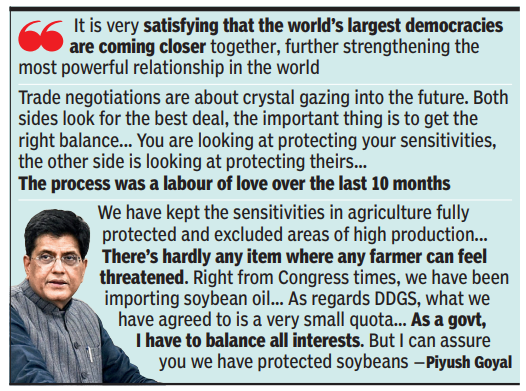
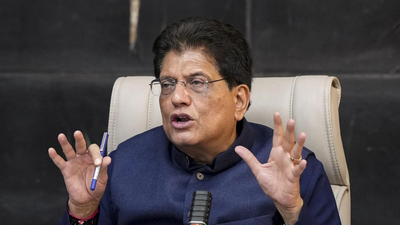
Piyush Goyal (PTI photo)
NEW DELHI: Commerce & industry minister Piyush Goyal said Sunday that the govt has aggressively sought to push the farm sector’s interests in the US trade deal, while protecting its sensitivities around dairy and agriculture. “We have $30-odd billion of imports. The important thing is we have $55 billion of exports of farm and fish produce. So, we should have an offensive interest, which is what we have focused on simultaneously along with protecting the sensitive sectors,” he told TOI in an interview.
The deal opens the doors for several products such as tea, coffee, spices and fruits with the US allowing their import at zero reciprocal tariff, while also helping seafood exporters compete favourably as the reciprocal tariff has been slashed to 18%. The minister also said that concern over the import of distillers dried grains with solubles, a feed ingredient that is a by-product of dry-milled ethanol production, is misplaced and that India has only opened a small window. While Goyal refused to disclose details, officials said against domestic animal feed consumption of 500 lakh tonnes, the quota offered to the US is only five lakh tonnes. The minister said the demand had come from the industry itself amid rising livestock population and growing requirement for feed, especially at a time when arable land is shrinking.
‘Farmers understand their interests & sensitivities have been protected’
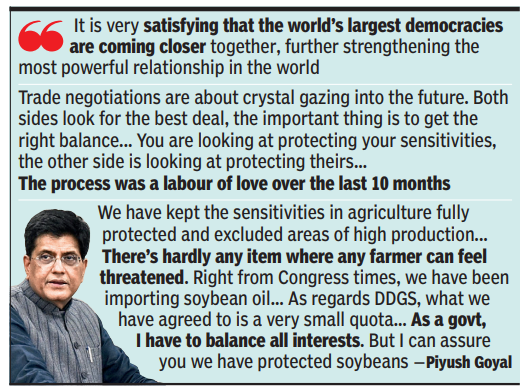
Commerce & industry minister Piyush Goyal always has his calendar full with meetings, and the last few weeks have been particularly hectic due to the trade deals with the EU and the US. The minister discussed the details of the US deal with TOI’s Sidhartha while insisting that the agreement will help Indian exporters grow and boost two-way trade. Excerpts:Is there a sense of relief or a sense of accomplishment?This was long under negotiation, though not very long by FTA standards. It is very satisfying that the world’s largest democracies are coming closer together, further strengthening the most powerful relationship in the world. The US is already a $30 trillion economy and continues to grow, India, even though $4 trillion today, there is a clear roadmap given by the PM towards Viksit Bharat by 2047, we will grow to a $30-35 trillion economy, which means the delta of opportunity is huge. To be able to grab that opportunity we need to have better markets, open new vistas, attract investments, attract technologies to India. Completing EU and US trade deals in a span of eight days is quite satisfying, in a way reflective of India’s emergence as a confident nation.You, your team and others in govt have been working on this for close to a year now. There were ups and downs. What was the turning point?Trade negotiations are about crystal gazing into the future. Both sides look for the best deal, the important thing is to get the right balance, which is a win-win for both sides. As it gets closer towards completion, creating that right balance is always difficult. You are looking at protecting your sensitivities, the other side is looking at protecting their sensitivities. You are looking at your ability to gain from the agreement as is the other side. The process was a labour of love over the last 10 months. It ended on a very happy note with PM Narendra Modi and President Trump in their call last Monday deciding on closing negotiations with a rate for India, which is the best given to any of our competitors.Modi govt has been known to be very forthright and blunt. The negotiations saw Peter Navarro, commerce secretary Howard Lutnick, treasury secretary Scott Bessent making very aggressive remarks. There was no response from India. Was it deliberate silence?I don’t think we were stuck on any position. I don’t think there was any acrimony on both sides throughout the negotiations. Everybody has a certain style and it’s important to appreciate that style. So, I don’t think India ever got into any misunderstandings on the trade front. Through the negotiations we kept a very good atmosphere.So, the two sides were making progress even when there were headlines about things sliding towards a point of no return?If you don’t misunderstand me, don’t believe the headlines. It is not for the newspapers alone, it’s for all of us. Very often we oversell our own thinking or over buy our own understanding or philosophy. One must always have the ability to listen to another new viewpoint and keep patience, particularly in trade negotiations as they are a long-drawn affair. You can’t rush things. That’s why I’ve often said never have a deadline for trade negotiations, you’ll make mistakes.You have earlier said each trade deal stands on its own legs. But sheer timing, within eight days, EU and US deals were finalised. Was the EU deal an elephant in the room as far as the Americans are concerned?It’s just that both happened within a short span of time. We are currently engaged in nearly 12-13 negotiations across the world and concluding them quite rapidly. We’ve concluded the UK, New Zealand, Oman, EU and US. There’s another one on the anvil. It reflects India’s growing confidence, growing understanding of international trade and the power of international trade. Our desire to become a developed nation by 2047 cannot be achieved unless we really look at much larger markets across the world.Farmers’ bodies have called for a nationwide protest on Feb 12. Do you see that as a risk to the deal?I don’t think so because farmer bodies also understand that we have kept the sensitivities in agriculture fully protected and excluded areas of high production in India, where we are generally self-sufficient: meat, poultry, rice, wheat, sugar, all dairy items, all GM products, soybean and corn. There’s hardly any item where any farmer can feel threatened. We have seen the import statistics. Right from Congress times, we have been importing soybean oil, tree nuts. We have heard this complaint that we have closed our doors to wines and spirits for no reason.A number of fresh and processed fruits continue to be imported. They are not available in India in sufficient measure. India imports 5.5 lakh tonnes of apples and there are certain items which India needs. We have $30-odd billion of imports. The important thing is we have $55 billion of exports of farm and fish produce. So, we should have an offensive interest, which is what we have focused on simultaneously along with protecting the sensitive sectors. American market has been opened for a large number of products for our farmers at zero reciprocal tariff, be it tea, coffee or spices, bananas, coconut, mangoes, kiwi and papaya. Trade is all about competition, comparative advantage. Now, we have the best comparative advantage. It’s for our businesses, our exporters to get the best and make the best of this wonderful deal.You have agreed to review non-tariff barriers on US farm products. Second, DDGS is going to be imported. Will it be at the expense of soybean farmers because it is cheaper?The concern about non-tariff barriers is totally misplaced because neither India nor US has non-tariff barriers. If there is any inadvertent or any difficulty to trade on both sides, we have agreed that we should try and smoothen the edges and speed up the benefits of this wonderful agreement. I see no reason why we should not resolve non-tariff barriers. We’ve done that in every agreement. The US has some of the best standards. India is now emerging as a high-quality producer of goods and provider of services. So, we have nothing to fear. As regards DDGS, we have a huge requirement, and it is growing. What we have agreed to is a very small quota. The animal husbandry department and industry desperately wants more DDGS because it’s a very high-quality protein. We have 194 million cattle, 112 million buffaloes and 878 million total livestock. As a govt, I have to balance all interests. But I can assure you we have protected soybeans. We are already importing $5 billion of soybean oil every year. If something was opened by UPA, let’s say for Indonesia or Japan or South Korea or Vietnam, I would rather have more competition as it gets me better price and better quality.India’s purchase of Russian oil was one of the things that held up the deal. The US executive order talks abouts India stopping Russian oil purchases, but govt has remained silent on it. Can you throw some light on that?Commerce ministry does not deal with this subject. I’m not aware of the details, another ministry deals with this.You have lobbed the ball into MEA’s court on Russian oil. How are you going to protect energy security? In your statement in Parliament you spoke about it.I did, but based on inputs that MEA gave me.There is also mention of removing import licensing for ICT products in the joint statement. What exactly is it and, two, are we looking at a more resilient supply chain through this?n India needs huge quantities of ICT products for its growth and for engaging with modern technology. In the budget we announced huge concessions for data centres. But if we don’t get Nvidia chips or we don’t get AI equipment or quantum computing equipment or if we are dependent only on other geographies, we are harming our country. This was an offensive interest.Is this review also meant to rebalance trade, some of it is coming from countries which are not seen to be very friendly?India will look to get the best from around the world and at the best prices. In all of that we want to have trusted partners. Our focus is to encourage trade with trusted partners.This is the first tranche of the trade deal. What is the road ahead? Will services be part of future talks?We will first convert this into a proper agreement and legally binding agreement and thereafter we will continue to see other areas to expand trade and mutual cooperation.There is an explicit reference to the modifications in commitments in case of changes to the agreed tariff by any of the countries. Does it have to do with Trump’s unpredictable nature?No. It is a general clause to make sure that the equitable agreement that we have reached continues to remain equitable.Do you see the deal lifting the cloud of uncertainty over investments which may have been on hold?I certainly see this as a big boost for investments given that investors like predictability and stability and they love to see a strong relationship on the trade front. They can now plan investments with the confidence that import duty on their inputs are all very clear.Along with the joint statement, USTR issued a map which showed PoK and Aksai Chin as part of India. Is it just a coincidence?Again, this is not my subject.




 English
  हिन्दी