 Sipu Jha
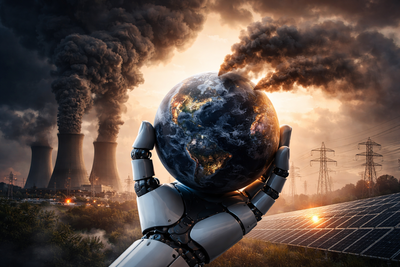
AI growth is often framed in terms of speed and scale. Less often discussed is what sits underneath it all, quietly drawing power. As artificial intelligence spreads across offices, factories and digital services, researchers are beginning to trace how those gains ripple through energy systems. A recent study suggests the effect is not dramatic, but it is measurable. Widespread AI adoption could add close to a million tonnes of carbon dioxide emissions each year. The increase does not come mainly from training large models, but from the way productivity gains feed into broader economic activity. Energy use rises where output rises. The numbers are small in national terms, yet they highlight a pattern that is likely to grow as AI becomes more embedded across industries.
AI productivity links to higher energy demand across supply chains
AI tools promise efficiency. They speed up tasks, reduce labour time and lower costs. When that happens at scale, output tends to rise. Researchers argue that this is where energy use enters the picture. Most economic activity still relies on electricity, transport and fuel. When production increases, energy demand often follows, even if each unit of output becomes slightly more efficient.This relationship has been observed across many sectors. Manufacturing, logistics, retail and digital services all show strong ties between energy use and economic output. AI does not break that link. It shifts it.
Emissions vary sharply between industries
The study ”Watts and bots: the energy implications of AI adoption”, finds that the impact of AI is uneven. Some industries are highly exposed to automation but use little energy. Others are less exposed but energy intensive. Education, publishing and trade show similar productivity gains from AI, yet their energy footprints differ widely. That difference shapes how much extra carbon is released.Public attention often focuses on data centres. Training large models and running constant queries does consume large amounts of electricity. But researchers say this is only part of the story. The bigger effect comes indirectly, through economic expansion driven by AI.When firms produce more, ship more and build more, energy use rises across supply chains. This indirect effect outweighs the power used by servers alone.
The scale of impact remains modest but persistent
An increase of nearly one million tonnes of CO₂ a year sounds large. In context, it represents a small fraction of global emissions. Still, it is comparable to the annual footprint of a small country. More importantly, it is likely to persist and grow unless energy systems change.
Efficiency gains may soften future impact
AI also has the potential to reduce emissions. It can improve energy management, optimise transport and support renewable grids. Those effects were not fully captured in the estimates. Over time, they could offset some of the added demand. For now, the picture is mixed. AI brings gains that are real but not free. The energy cost is quiet, incremental and easy to overlook. That may be why it matters.







 English
  हिन्दी