 Sipu Jha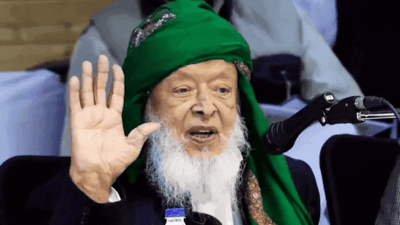
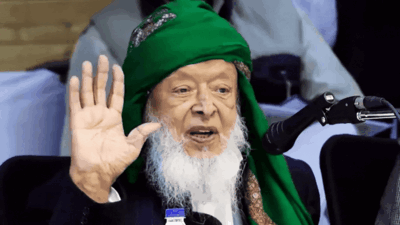
NEW DELHI: President of Jamiat Ulama-i-Hind Arshad Madani on Thursday strongly criticised the Union Government’s decision to make all six stanzas of the national song ‘Vande Mataram’ compulsory at schools, colleges, and official functions, saying it reflects “electoral politics and a sectarian agenda.”In a post on X, Madani said, “The Central Government’s unilateral and coercive decision to make ‘Vande Mataram’ the national song and to mandate all its stanzas in all government programmes, schools, colleges, and functions is not only a blatant attack on the freedom of religion guaranteed by the Constitution of India but also a systematic attempt to curtail the constitutional rights of minorities.”He added that the move contradicts the fundamental belief of monotheistic religions and “forcing” a Muslim to sing the song is a clear violation of Article 25 of the Constitution.“Muslims do not prevent anyone from singing or playing ‘Vande Mataram’; however, some verses of the song are based on beliefs that portray the homeland as a deity, which contradict the fundamental belief of monotheistic religions. Since a Muslim worships only one Allah, forcing him to sing this song is a clear violation of Article 25 of the Constitution and several judgments of the Supreme Court. Making this song mandatory and attempting to impose it on citizens is not an expression of patriotism; rather, it reflects electoral politics, a sectarian agenda, and a deliberate effort to divert public attention from fundamental issues,” he added.His remarks came after the Union home ministry directed that all six stanzas of the national song Vande Mataram, written by Bankim Chandra Chattopadhyay, shall be sung first whenever the national song and the national anthem Jana Gana Mana are played together.In an order dated 28 January, the home ministry issued the first set of protocols for singing the national song, specifying that all six stanzas, lasting 3 minutes and 10 seconds, shall be performed at official functions such as the arrival of the President, the unfurling of the national flag, and governors’ speeches.“When the national song and the national anthem are sung or played, the national song will be sung or played first,” the order stated. It also said that the assembly shall stand at attention when the national song is performed.“Whenever the official version of the national song is sung or played, the audience shall stand to attention. However, when the national song is played as part of a newsreel or documentary, the audience is not expected to stand, as doing so may interrupt the screening and create disorder rather than add to the dignity of the national song,” it added.The directives further specify that in schools, activities should begin with the playing of the national song.The move coincides with the 150th anniversary of the creation of Vande Mataram.







 English
  हिन्दी