 Sipu Jha

There was once a phrase that economists used, sometimes flippantly and often unfairly, to describe India’s slow economic expansion in the decades after Independence. They called it the “Hindu rate of growth” — a shorthand for stagnation, caution and incremental change. The term has long since fallen out of favour in economic discourse. But in an unexpected way, it could be used to describe the actual Hindu growth of rate.According to the Pew Research Center’s global demographic study “How the Global Religious Landscape Changed From 2010 to 2020,” the actual Hindu rate of growth today turns out to be strikingly literal. The world’s Hindu population has been expanding almost exactly in line with the growth of humanity itself. Neither surging dramatically nor shrinking in relative terms, Hinduism’s demographic story is one of stability in a century defined by rapid religious change.
New global religion data suggests that when it comes to population trends, Hindus today embody something remarkably close to that old metaphor. The global Hindu population is growing, steadily and predictably, almost exactly in step with the world itself. Neither surging dramatically like some faiths nor shrinking in relative terms like others, Hinduism’s demographic story is one of continuity rather than upheaval.
The big picture: Growth almost identical to the world
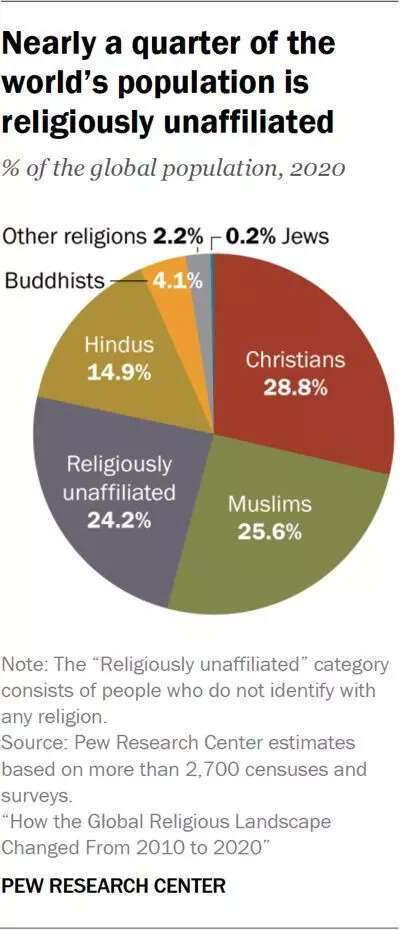
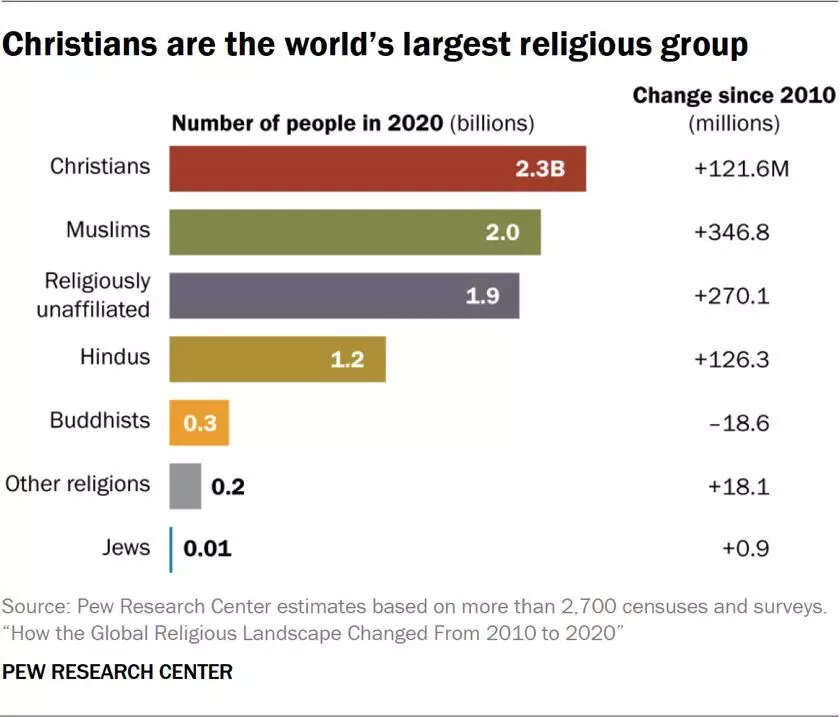
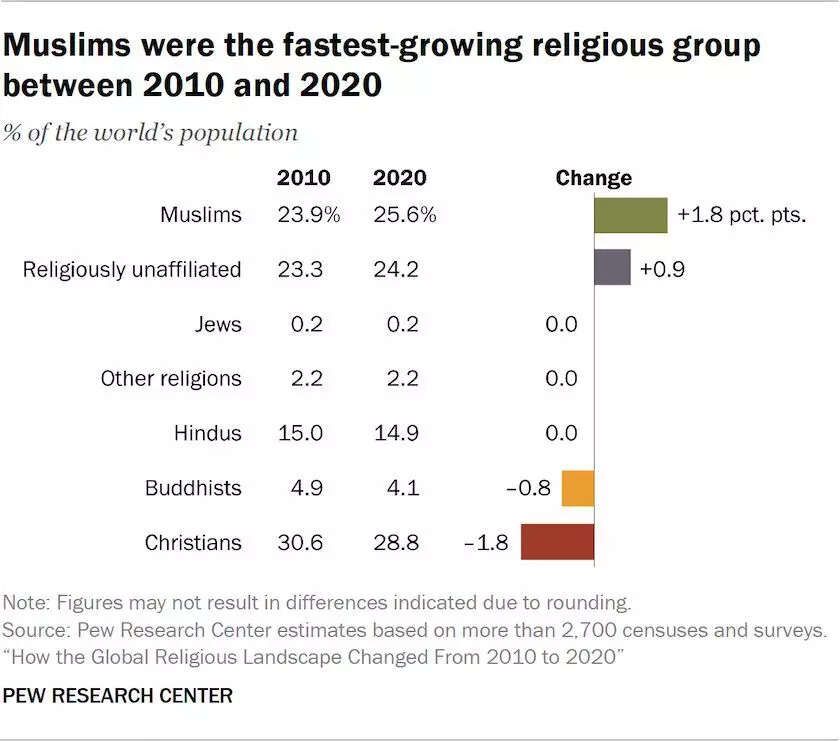
Between 2010 and 2020, the global Hindu population rose from roughly 1.07 billion to about 1.2 billion — an increase of around 126 million people in just one decade. Yet their share of the world’s population remained nearly unchanged at about 15%.This reflects an almost perfect demographic alignment. During the same period, the world population itself grew by roughly 12%, and the Hindu population expanded at nearly the same pace.By contrast, other major religions experienced sharper shifts. Muslims increased their share of the global population, while Christians saw their proportion decline. Hindus stood out as the only major group whose global footprint remained essentially stable.
A religion defined by geography
One of the most striking numbers in global religious demographics is the degree of Hindu concentration. About 99% of Hindus live in the Asia-Pacific region. Even more remarkably, roughly 95% reside in just one country: India. Nepal accounts for most of the remaining share. This makes Hinduism the most geographically concentrated major religion in the world. India alone determines the demographic trajectory of nearly a billion people.Unlike Christianity or Islam, which are spread across continents and cultures, Hinduism remains overwhelmingly anchored to a single civilisational geography.
Growth driven by births, not conversions
Another key finding is that Hindu population change is driven overwhelmingly by natural increase rather than religious switching.Globally, conversion into or out of Hinduism occurs at relatively low levels compared with other religions. This means births minus deaths — not changes in religious identity — shape the long-term trajectory.In demographic terms, Hinduism is one of the least mobile religious identities. Most followers continue to identify with the religion in which they were raised.
Living mostly as a majority
Few religions are as closely associated with majority status as Hinduism. About 97% of Hindus worldwide live in countries where they form the dominant religious group, primarily India and Nepal. This is the highest majority concentration among all major faiths. By comparison, Christians and Muslims are far more geographically dispersed, with large shares living as minorities in multiple regions.
Age structure and fertility patterns
The age profile of Hindus closely mirrors India’s demographic structure. India’s median age is around 28 years, significantly younger than Europe’s median age of over 40. Because India is home to about 95% of Hindus, the global Hindu population also has a relatively youthful base.This youthful demographic momentum helps sustain population growth even as fertility rates decline. India’s total fertility rate has fallen dramatically over the past half century, yet its large young population continues to drive expansion.
The global future of Hinduism
Looking ahead, the future of Hinduism will remain tightly linked to India’s demographic transition. As fertility rates continue to fall and the population gradually ages, growth will slow in relative terms, even though total numbers will continue to rise for decades. In that sense, the modern “Hindu rate of growth” no longer implies stagnation. It reflects something far more distinctive: a billion-strong religion growing steadily, predictably, and almost perfectly in step with the world itself. In an era of dramatic religious shifts, that kind of numerical stability is a story in its own right.








 English
  हिन्दी