 Sipu Jha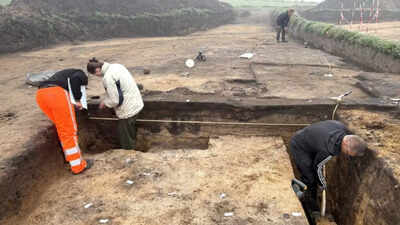
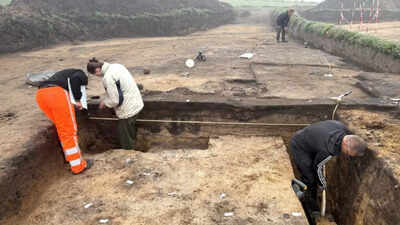
Beneath a serene grassland at Hedegaard, near Ejstrupholm in central Jutland, a 2,000-year-old Iron Age temple and stronger settlement have emerged, shedding light on politics, religion, and trade in northern Europe, archaeologists in Denmark confirmed. Experts say this site may be one of the most important power centres ever discovered in Denmark.For decades, Hedegaard seemed ordinary under the surface, and remarkably preserved cultural layers lay almost untouched by modern farming. The sheer scale and complexity of the temple and settlement appear to signal a community with significant influence, wealth, and connections far beyond the local region.
How Hedegaard’s hidden Iron Age complex was discovered
In 1986, Hedegaard, archaeologist Orla Madsen, uncovered an unusually rich burial ground filled with weapons. Excavations continued for a few years, but then stopped in 1993. For decades, the site remained largely dormant, quietly holding its secrets.Research resumed in 2016 under Museum Midtjylland, but it was only in 2023 that the true scale of the settlement became apparent. Archaeologists realised that the burial ground was part of a much larger fortified complex, complete with workshops, elite residences, defensive structures, and a central religious temple.
Hedegaard temple: Central hub of Iron Age ritual and power
At the centre lies the temple itself, dating to around 0 AD. Measuring roughly 15 by 16 metres, it is nearly rectangular, with a ring of strong posts forming a colonnade around a smaller inner structure. The inner building has deeply set posts and walls made from clay and split planks, with a southern-facing entrance.Inside, archaeologists found a raised 2×2 metre hearth adorned with stamped and linear patterns. This was clearly not for cooking, experts say it was for ritual purposes, giving one of the first clear insights into Iron Age religious architecture in Denmark. “Everything here is bigger and wilder than usual,” museum inspector Martin Winther Olesen told Dr.Dk. “Nothing is ordinary.” Around 0 AD, the Roman Empire’s northern expansion reached the River Elbe, close to Jutland. It appears that Hedegaard’s palisades and defensive structures were a response to this looming threat. The fortifications reflect technical knowledge and strategic planning, likely influenced by awareness of Roman military power.This was no ordinary village. Hedegaard combined ritual, political, and economic authority in one location. Its defences might have been a message: this is a place not to be trifled with.








 English
  हिन्दी