 Sipu Jha
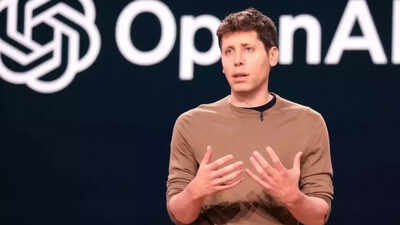
On January 22, 2025, Sam Altman, Masayoshi Son, and Larry Ellison stood in the White House alongside President Donald Trump to announce Stargate—a $500 billion AI data centre venture that promised 10 gigawatts of computing capacity and $100 billion in near-immediate spending. It was billed as the largest AI infrastructure project in history, one that would keep America ahead of China in the AI race. Within hours, Elon Musk had a different take. “They don’t actually have the money,” he posted on X, adding that SoftBank had “well under $10B secured.”Altman shot back, inviting Musk to visit the first site already under way and adding a pointed jab: “I realize what is great for the country isn’t always what’s optimal for your companies, but in your new role I hope you’ll mostly put [America] first.” Thirteen months later, Altman’s confidence is harder to back up. The joint venture hasn’t staffed up, hasn’t broken ground on a single facility, and the partners who were supposed to build it together can barely agree on who’s in charge.
The Stargate joint venture hasn’t built a single data centre since its White House debut
According to a report by The Information, the Stargate joint venture has not staffed up, has no dedicated leadership, and is not developing any of OpenAI‘s data centres. The three partners spent months deadlocked over basic questions—who would build what, who would own the sites, and how the money would flow. Between September and October 2025, OpenAI executives made multiple trips to Tokyo to hash things out with SoftBank’s Masayoshi Son, fuelled by what reports described as 7-Eleven snacks and very little progress.The core disagreement was structural. OpenAI wanted to own and build its flagship Texas campus. SoftBank wanted the same. Neither budged easily, and the standoff cost OpenAI its general contractor and months of construction time. OpenAI also explored going solo—scouting US sites and trying to raise billions in debt to build its own data centre campuses. Lenders said no, unwilling to bankroll a company still burning billions annually with no clear path to profitability before 2029. That plan was shelved too.The result: OpenAI missed its 10-gigawatt capacity target by the end of 2025, landing at roughly 7.5 gigawatts. Its projected compute spending through 2030 jumped from $450 billion to $665 billion. To plug the gap, it bought expensive last-minute compute from AWS and Google Cloud—the very competitors it was trying to build independence from.
Oracle ‘s $300 billion OpenAI bet has investors running the other way
Oracle, which signed a $300 billion, five-year cloud computing contract with OpenAI in September 2025, has taken the hardest hit. The company’s stock has roughly halved from its September peak, erasing over $400 billion in market capitalisation. Debt has blown past $100 billion. S&P Global has the company on negative watch for a potential downgrade, and credit default swap costs—essentially insurance against Oracle defaulting—spiked in November and haven’t come back down.Investment bank TD Cowen reported that Oracle may cut 20,000 to 30,000 employees to free up $8–10 billion in cash flow. That money is needed to deliver on infrastructure TD Cowen estimates will require $156 billion in capital spending and around 3 million GPUs. The company has also announced plans to raise $50 billion in fresh debt and equity this year, and is reportedly weighing a sale of Cerner, the healthcare software unit it acquired for $28.3 billion in 2022.Every time Oracle has tried to calm markets—posting on X that it remains “highly confident” in OpenAI’s ability to meet its commitments—the stock has slid further. One venture capitalist called the messaging “literally bank-run language.”
SoftBank keeps raising the stakes even as the original deal gathers dust
SoftBank, meanwhile, is doubling down. The Japanese conglomerate already holds an 11% stake in OpenAI after investing $22.5 billion in December, and is in talks to pour in another $30 billion. Its Vision Funds posted a ¥735 billion quarterly profit, and the stock nearly doubled in 2025. But its Stargate obligations remain tangled, and SoftBank is reportedly exploring 90% debt financing to cover its commitments.The situation got more complicated when Nvidia walked back what had been described as a $100 billion investment in OpenAI. CEO Jensen Huang confirmed the September agreement was non-binding and never closed. That’s a problem—not just for OpenAI’s fundraising math, but for Oracle, which booked the full $300 billion contract in its remaining performance obligations. Whether that number holds depends entirely on OpenAI’s ability to keep raising capital at rising valuations.When The Information’s report dropped last week detailing just how badly Stargate had stalled, Musk resurfaced on X with a two-word response: “Hardware is hard.” He followed up: “Those who have tried to do so at scale will understand.” It was a victory lap, but also a genuine point. The original Stargate announcement promised speed, scale, and $100 billion in immediate spending. What it delivered was a governance mess, stalled construction, and a reminder that announcing infrastructure and actually building it are very different things.





 English
  हिन्दी