 Sipu Jha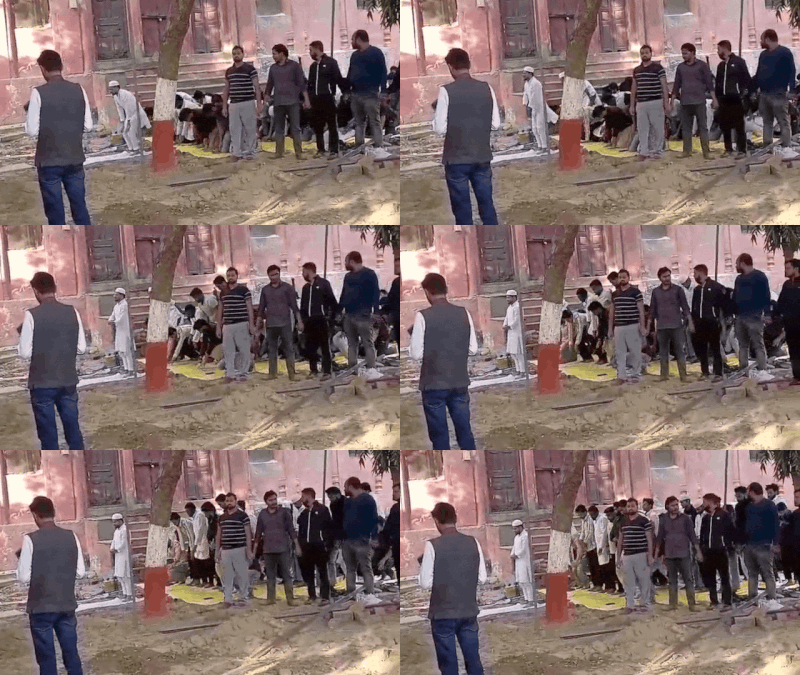
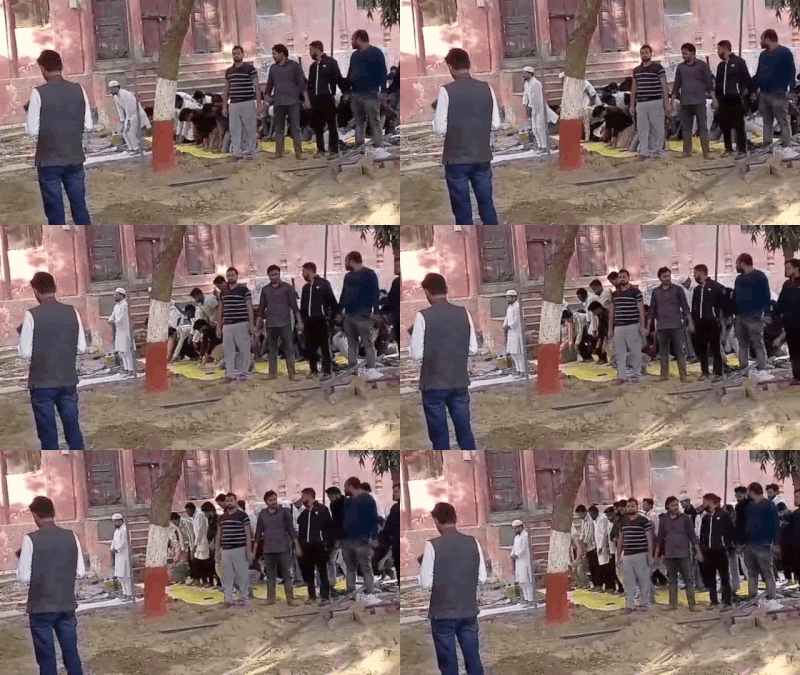
LUCKNOW: Students of Lucknow University affiliated with the Samajwadi Chhatra Sabha (SCS), National Students’ Union of India (NSUI) and the All India Students’ Association (AISA) staged a sit-in protest on the intervening night of Sunday and Monday outside the historic Lal Baradari. They alleged that the university administration had deliberately sealed the mosque inside Lal Baradari to prevent Muslim students from offering prayers during the holy month of Ramzaan.Earlier on Sunday, representatives of the three student organisations—all Hindus—formed a human chain to allow students to offer namaz outside Lal Baradari after the mosque gates were found closed. A video of muslim students offering namaz and student leaders forming a human chain went viral, with students describing the gesture as “Ganga-Jamuni tehzeeb” and a message that the university is not a place for discrimination on the basis of religion, caste, creed or culture.“LU’s Muslim students have been offering namaz in the centuries-old Lal Baradari, located on the Lucknow University campus, since the university’s inception. Without any prior information to the Muslim students who offer prayers during the holy month of Ramzan, the historic structure was sealed,” said SCS student representative Navneet Kumar.He said the group believed in “Ganga-Jamuni tehzeeb”, and that was why Hindu students from their organisation stood guard while Muslim students offered namaz. He added that they also ensured that iftar, which could not be held inside Lal Baradari because it was sealed, was organised outside the building with other students as a symbol of communal harmony.“How would you feel if you visit a place daily for worship and, all of a sudden, one day you find the doors sealed and you are banned from worshipping there forever? This is what the LU administration has done. The doors of the mosque were sealed by welding without any prior information,” said LU student Vishal Singh, national coordinator of NSUI.He alleged that the university administration lacked the sensitivity to understand the message it was sending by collecting money during Ramzan.When contacted, an LU spokesperson Prof Mukul Srivastava said, “The historic building is in a severely dilapidated condition and any mishap can occur at any time. The bank and canteen that were operating in the building were shut down, and after a wall recently collapsed, the university administration displayed instructions prohibiting movement inside the building. However, students continued to enter, and it can cost lives.”The protest began on Sunday soon after fencing work started at Lal Baradari. Heavy police deployment followed after members of NSUI and SCS, calling the fencing “unauthorised”, began the sit-in.Rajya Sabha member Imran Pratapgarhi also supported the students and wrote on social media: “Children offer namaz in the centuries-old Lal Baradari located in Lucknow University. This is a decades-old tradition of the university. Since last night, students have been protesting there because, without informing the students, the doors of the mosque were sealed by welding.”He added that the university administration did not have the sensitivity to understand the message it was sending by collecting money during Ramzan. “Last night, I spoke to the protesting students on a video call and gave full support to their demand. The LU administration should immediately open Lal Baradari for the children and should not make the university campus a laboratory of hatred,” he wrote.Lucknow chronicler the late Yogesh Praveen had told TOI that Lal Baradari was the only red-stone building from the Nawabi era. It was known as Badshah Bagh in the 18th century. The foundation stone was laid by Nawab Ghaziuddin Haider Shah in 1814, and the building was completed by his son Naseeruddin Haider Shah in 1820.Lal Baradari once housed the teachers’ association office, a bank, a cafeteria and a staff club, all of which were evacuated around a decade ago due to the building’s fragile condition.







 English
  हिन्दी