 Sipu Jha
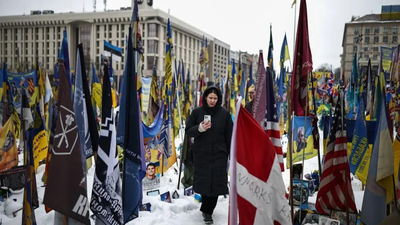
File photo: A person walks through a makeshift memorial to fallen Ukrainian and foreign soldiers in Independence Square in Kyiv (Picture credit: AP)
On 24 February 2022, Russian forces crossed into Ukraine on the orders of President Vladimir Putin. What was expected by many to be a swift military operation has become one of the longest and most consequential wars of the 21st century.Four years later, the conflict is no longer just about territory. It has reshaped Europe’s security order, pushed Nato to rearm, redrawn global energy routes and deepened divisions between major powers. Ukrainian forces under President Volodymyr Zelenskyy continue to resist with strong Western backing, while Russia has dug in for a prolonged confrontation.The war has also tested the diplomacy of countries like India, exposed fractures within the West, and strengthened new alignments between Moscow and Beijing.On the fourth anniversary, the battlefield remains active. Peace talks remain uncertain. And the world continues to adjust to the shockwaves of a war that changed global politics, perhaps permanently.
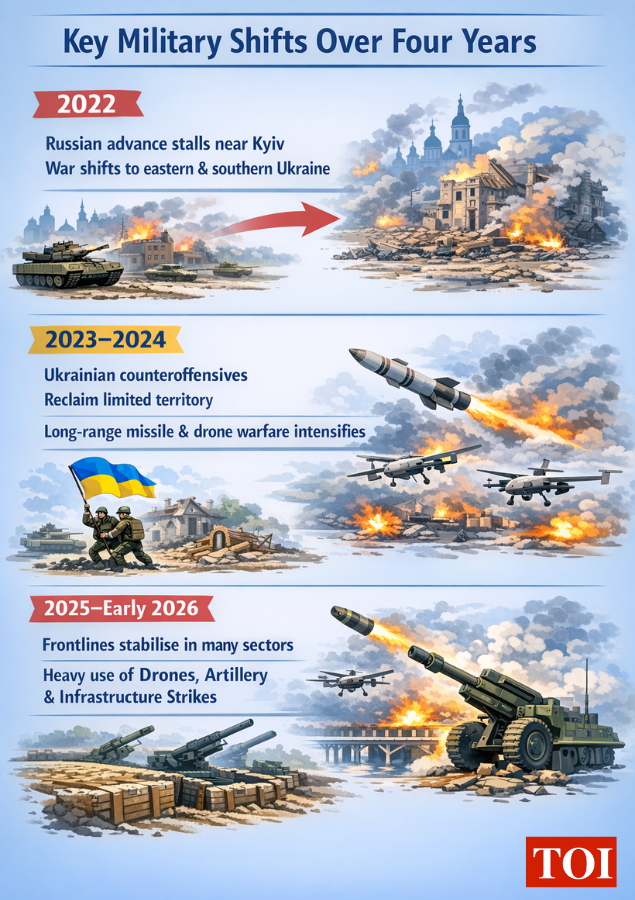
From shock invasion to strategic stalemate
Russia launched a special military operation in February 2022 aimed at a swift political collapse in Ukraine, due to Kyiv’s increasing willingness to join Nato and an inclination towards the WestInstead, Ukrainian resistance, supported by Western arms and intelligence, forced Moscow into a drawn-out conflict.The war is now no longer measured only in frontlines. It can be measured in square miles captured, megawatts destroyed, drones fired, currencies weakened and millions displaced.According to the latest Russia-Ukraine War Report Card by the Harvard-linked Russia Matters project, based on data from the Institute for the Study of War (ISW), Russia has gained 29,210 square miles of Ukrainian territory since 24 February 2022, roughly 13% of Ukraine’s total land area.Including Crimea and parts of Donbas seized before 2022, Moscow now controls 45,835 square miles, or about 20% of Ukraine.In just the four weeks between January 13 and February 10, 2026, Russian forces captured 182 square miles, more than double the 79 square miles taken in the previous four-week period.
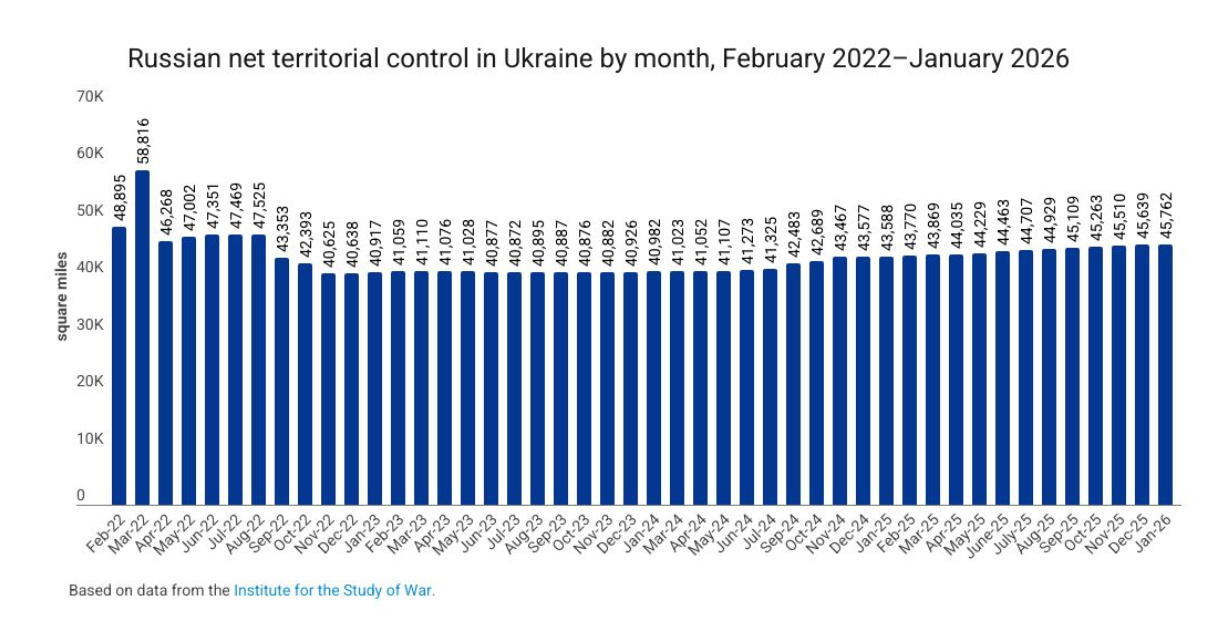
In 2025 alone, Russia captured 2,171 square miles, or nearly 0.93% of Ukraine’s territory, as per the same report card.The human toll is also staggering. A January 2026 estimate by the Center for Strategic and International Studies (CSIS) puts Russian military casualties at 1.2 million, including up to 325,000 killed, since February 2022.Ukrainian military casualties are estimated at 500,000–600,000, with 100,000–140,000 fatalities, according to CSIS.Civilian deaths, based on aggregated UN and independent tallies cited in the Russia Matters report, stand at 15,954 in Ukraine and 7,254 in Russia.The scale is enough to explain the war’s transformation into one of Europe’s deadliest conflicts since World War II.
A battlefield measured in drones and blackouts
January 2026 alone saw Russia fire 4,838 drones, 14 ballistic missiles and 61 cruise missiles, according to Russia Matters’ compilation of official Ukrainian data. Ukraine intercepted 4,120 drones, one ballistic missile and 38 cruise missiles that month, as per the same dataset.Since September 2022, Russia has fired 77,027 drones, 904 ballistic missiles and 4,485 cruise missiles, according to the Russia Matters report; Ukraine has intercepted more than 54,000 drones during that period.The war has also become an assault on infrastructure. Ukraine’s available generating capacity has fallen from 33.7 gigawatts at the start of the invasion to around 14 GW, leaving large parts of the country vulnerable to rolling blackouts.Ukraine’s energy minister Denys Shmyhal said in January that “there is not a single power plant in Ukraine that the enemy has not attacked,” a remark quoted in The New Yorker.By May 2025, Ukraine had lost around 90% of its thermal power generation capacity, according to Ukrainian government estimates.The CEO of DTEK, Ukraine’s largest private energy company, said in January 2026 that the country had lost roughly 70% of its generation capacity, with civilians in some areas receiving only three to four hours of electricity daily, according to Russia Matters.Russia, too, has absorbed infrastructure damage. An investigation by RFE/RL in March 2025 estimated that Ukrainian strikes had caused at least 60 billion rubles in damage to Russia’s energy sector.Yet, Reuters reported in November 2025 that Russia’s oil processing had fallen only 3% despite Ukrainian drone attacks, which showcases Moscow’s ability to adapt.
The economic war: Growth, deficits and sanctions
The economic picture reflects asymmetry and strain but the contrast becomes sharper when measured against pre-war baselines.Before the invasion, Russia entered 2022 with relative macroeconomic stability. According to the International Monetary Fund, Russia’s GDP grew 4.7% in 2021 as the economy rebounded from the pandemic. Public debt was below 20% of GDP, and the federal budget posted a surplus in 2021, aided by high energy prices. The ruble was relatively stable and foreign exchange reserves exceeded $600 billion prior to Western sanctions.Ukraine, meanwhile, had grown 3.4% in 2021, according to IMF estimates, with public debt declining from pandemic highs and reform programmes underway under IMF supervision. While structurally more fragile than Russia’s commodity-backed economy, Ukraine entered 2022 on a modest recovery trajectory.The war upended that trajectory.Russia’s cumulative GDP growth between 2022 and 2025 stands at 8%, according to Russia Matters’ economic data summary, with 2025 growth estimated at 0.9%. The Russian budget deficit in 2025 is estimated at 2.6% of GDP, while the ruble trades at approximately $0.01299, down about 10% since the invasion, according to the report card.Yet that cumulative figure masks volatility. The Russian economy contracted sharply in 2022 following sanctions, before rebounding in 2023–24 on the back of elevated defence spending and redirected energy exports, a wartime stimulus effect noted in multiple IMF and World Bank assessments.Ukraine’s economic shock was far more severe. According to the World Bank, Ukraine’s GDP contracted by nearly 30% in 2022, one of the largest single-year declines recorded globally in recent decades.From 2022 to 2025, cumulative contraction is estimated at –21.2%, with a modest 2% growth forecast for 2025. Its budget deficit is estimated at 18.5% of GDP, while the hryvnia has fallen roughly 31% since the invasion.Reconstruction costs are spiralling. In February 2026, the World Bank and partners estimated Ukraine’s reconstruction needs at $588 billion, which is nearly four times Ukraine’s pre-war annual GDP.Energy geopolitics shifted dramatically. Europe reduced dependence on Russian pipeline gas, LNG imports diversified supply chains, and Asian buyers, including India and China, increased purchases of discounted Russian crude.Meanwhile, sanctions remained central. Soon after the breakout of the war, the European Union and G7 countries implemented a price cap mechanism designed to limit Russian oil revenue without destabilising global markets. However, Russia redirected much of its crude exports toward Asia, cushioning revenue losses even as fiscal pressures mounted.Russia’s defence spending has surged to levels estimated above 6% of GDP in 2025, transforming the economy into a state-driven war model.
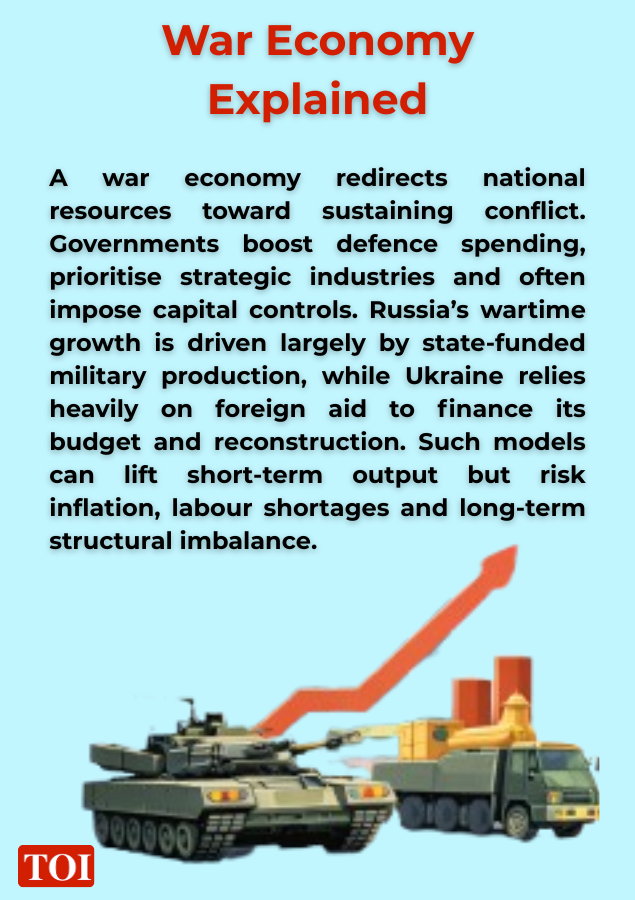
Meanwhile, Ukraine’s state finances remain heavily aid-dependent, with external partners, notably the US and EU, financing a large share of its wartime budget.Before 2022, Russia’s economy was nearly ten times larger than Ukraine’s; four years on, that asymmetry has widened, even as Russia faces long-term isolation from Western capital markets and a sustained exodus of multinational firms.
Nato rearmed, Europe recalibrated
The war has fundamentally reshaped the North Atlantic Treaty Organisation, altering its membership, defence priorities and strategic posture.Traditionally neutral Finland and Sweden abandoned non-alignment in the wake of Russia’s full-scale invasion, formally joining Nato in April 2023 and March 2024 respectively, expanding the alliance’s northern flank and signalling the war’s deep impact on European security alignments.The European Union created new financial instruments to support Ukraine.According to Nato’s 2025 defence expenditure report, member states significantly increased defence budgets after 2022, reversing decades of post-Cold War drawdowns and finally achieving the alliance’s long-standing 2% of GDP guideline across Europe and Canada, a milestone many had struggled to meet since the commitment was first made in 2014.At the 2025 summit in The Hague, Nato leaders agreed to a more ambitious goal of raising defence and security-related spending to 5% of GDP by 2035, with annual plans showing credible paths to reach this target, a move driven in part by persistent US pressure on European allies.To demonstrate unity, Nato has practised joint forces and large-scale exercises near its eastern border. The 2024 Steadfast Defender series was the largest Nato exercise since the Cold War, involving up to 90,000 troops from all member states and testing Article 5 multilateral response scenarios across Europe.Along the eastern flank, allies have sustained a robust presence through activities such as Eastern Sentry, an enhanced vigilance posture, as well as multinational brigades in Latvia and Hungary, showcasing an integrated and interoperable deterrent.Beyond spending targets, Nato’s transformation is also structural. New joint capability programmes, including the European Sky Shield Initiative, aim to integrate air and missile defence across the continent.
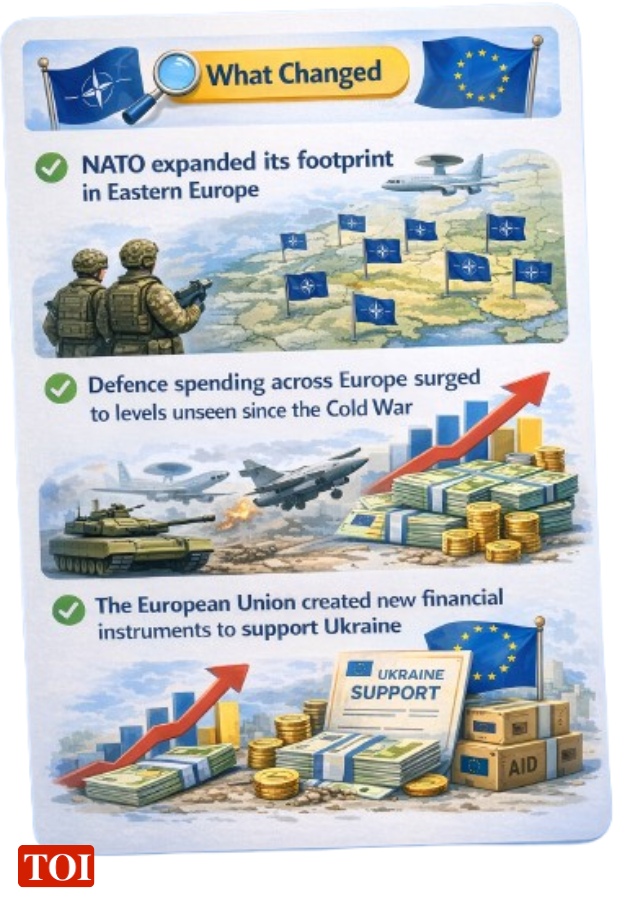
Public opinion across most member states has remained broadly supportive of Nato since 2022, according to surveys by the Pew Research Center, reinforcing political backing for higher military outlays.Moscow, meanwhile, has repeatedly cited Nato enlargement as a strategic threat, framing expansion as justification for its own military posture.
The Trump presidency
The return of Donald Trump to the White House in January 2025 injected new volatility into Western strategy on Ukraine. During the campaign, Trump repeatedly blamed ‘sleepy’ Joe Biden’s administration for mishandling the situation and claimed he could end the war in “24 hours,” arguing that his personal rapport with Vladimir Putin and leverage over Kyiv would produce a deal.In the office, however, the conflict proved far more intractable. “This war is far more complicated than people understand,” Trump conceded in a 2025 press interaction, acknowledging the limits of rapid diplomacy.His administration pursued a dual-track approach, direct engagement with Moscow and calibrated pressure. Trump reportedly held multiple calls with Putin and hosted exploratory talks in Alaska aimed at testing ceasefire parameters. When momentum stalled, Washington introduced secondary tariff threats on countries expanding Russian oil imports, including India, seeking to constrict Moscow’s wartime revenues.Trump’s peace delegation, led by senior adviser Jared Kushner and special envoy Steve Witkoff, conducted parallel backchannel discussions with Russian officials and met intermediaries close to the Kremlin. These engagements reportedly explored phased ceasefire models tied to sanctions relief and security guarantees. However, territorial recognition, particularly over parts of Donetsk, Luhansk, Zaporizhzhia and Kherson, remained the core deadlock.Tensions between Trump and Volodymyr Zelenskyy also surfaced publicly. An earlier White House meeting in 2025 ended on a strained note amid disagreements between the two leaders, with Trump yelling at Zelenskyy that “You don’t have the cards”.Yet during Zelenskyy’s subsequent visit later that year, both leaders projected unity before cameras, a symbolic reset even as policy differences persisted.The Trump administration has now signalled a desire to finalise a framework by mid-2026, partly with an eye on domestic political cycles. According to a Financial Times report, Washington has encouraged Kyiv to consider announcing wartime presidential elections and possibly a consultative referendum linked to any eventual settlement, a sensitive move given martial law conditions.Meanwhile, Geneva re-emerged as a diplomatic venue, hosting multiple rounds of talks involving US, Ukrainian and Russian delegations. Switzerland’s neutrality offered optics of balance, but no binding ceasefire has materialised.On the battlefield, assessments by the Institute for the Study of War indicate Russia has continued preparations for renewed offensives, potentially targeting the Slovyansk–Kramatorsk axis or southern fronts near Zaporizhzhia, underscoring the fragility of negotiations.
India’s stance: “Not an Era of War”
For India, the war has been a defining test of strategic autonomy.In September 2022, in Samarkand, Prime Minister Narendra Modi told Vladimir Putin, “I know that today’s era is not an era of war.” The remark, delivered on the sidelines of the Shanghai Cooperation Organisation summit, became India’s diplomatic signature on the crisis.India sharpened that articulation over time. At the December 5, 2025, summit in New Delhi, PM Modi stated, “India is not neutral; India is on the side of peace. Sustainable solutions cannot be found on the battlefield.”Across G20, Brics and UN platforms, New Delhi consistently promoted what it called the formula of “Peace, Diplomacy and Dialogue.”A defining diplomatic moment came during India’s presidency of the G20 in 2023. Despite sharp divisions between Western members and Russia-China blocs, New Delhi secured consensus language in the New Delhi Leaders’ Declaration that avoided direct condemnation of Moscow while reaffirming respect for territorial integrity and the UN Charter, a carefully negotiated compromise widely seen as a diplomatic balancing act.PM Modi also maintained open channels with multiple stakeholders, speaking separately with Putin, Ukrainian President Volodymyr Zelenskyy, US and European leaders, positioning India as a potential bridge.His landmark visit to Kyiv in 2024, the first by an Indian Prime Minister since Ukraine’s independence, was symbolically significant as it signalled engagement with both sides while reiterating calls for sovereignty and negotiated settlement.India’s humanitarian outreach was also visible. Under Operation Ganga in early 2022, New Delhi evacuated over 20,000 Indian students from Ukraine. Since then, India has supplied medical aid, generators, relief materials and reconstruction support to Kyiv, while continuing diplomatic engagement with Moscow.Yet energy trade deepened. Before 2022, India imported negligible Russian crude. By mid-2025, Russian oil accounted for nearly 40% of India’s crude basket, driven by discounted pricing and energy security concerns. Bilateral trade surged from roughly $13 billion pre-war to over $60 billion by 2024–25, reflecting discounted oil flows and expanded fertiliser imports.This expansion triggered friction with Washington. In late 2025, the Trump administration imposed additional tariff measures affecting Indian exports, citing concerns linked to Russian energy flows.At the United Nations, India abstained on multiple General Assembly resolutions condemning Russia’s invasion — including key votes in 2022 and 2023 — reinforcing its consistent, if controversial, diplomatic posture.New Delhi’s stance has also resonated across parts of the Global South, where several countries remain wary of binary geopolitical alignments. India has framed its position as reflective of a wider discomfort among developing economies with bloc confrontation, emphasising food security, energy access and financial stability.In contrast to China’s more overtly strategic alignment with Moscow, India’s approach has combined economic engagement with Russia, continued defence diversification toward the West, and direct outreach to Kyiv, underscoring a more calibrated form of multi-alignment rather than bloc loyalty.India’s position, however, remained steady – protect energy security, resist bloc politics, expand humanitarian assistance, and call for dialogue.As Western capitals privately urged New Delhi to leverage its long-standing ties with Russia to influence the Kremlin, India maintained that sustained communication, not coercion, was its comparative advantage.
Popular support and war fatigue
Public opinion is shifting. According to survey data compiled in the Russia Matters report, 61% of Russians support peace negotiations, while only 26% of Ukrainians believe negotiations with Russia would succeed.These numbers underscore asymmetry in expectations and war fatigue.Meanwhile, displacement remains enormous. Russia Matters reports 10.6 million displaced Ukrainians, about 24% of Ukraine’s pre-invasion population, including 6.9 million internally displaced and 3.7 million refugees abroad.In the US, public opinion on Ukraine has steadily evolved over four years of war. Surveys by the Pew Research Centre in 2024–2025 showed a growing partisan divide. While a majority of Democrats continued to support sustained military aid to Kyiv, Republican respondents were increasingly likely to say the US was providing “too much” assistance.Gallup polling similarly reflected declining enthusiasm for open-ended commitments, even as broad sympathy for Ukraine remained intact. By early 2026, voter fatigue, driven by inflation concerns and domestic priorities, had become a measurable political constraint, shaping the Trump administration’s calibrated push for a negotiated settlement.
A war that redefined global order
Four years after the invasion, the consequences extend far beyond the battlefield.Global military expenditure has risen sharply since 2022, according to the Stockholm International Peace Research Institute, marking the steepest sustained increase since the Cold War.Energy supply chains have been rewired. Europe has structurally reduced its dependence on Russian pipeline gas.Asian economies absorbed discounted Russian crude.Defence production lines across Nato states have expanded at a pace unseen in decades.The war has hardened blocs but it has also rearranged hierarchies. Sanctions and Western isolation have pushed Moscow into deeper economic and strategic dependence on China.Bilateral trade between Russia and China has surged to record highs since 2022, with Beijing becoming Moscow’s largest energy buyer and a critical supplier of dual-use goods.While China has avoided direct military involvement, its diplomatic posture, calling for negotiations while opposing Western sanctions, has elevated its profile as a systemic rival to the West and a pivotal power in any future settlement.In effect, Russia’s war has tightened the Beijing–Moscow axis, even as it increases Russia’s asymmetrical reliance on China.At the same time, regional powers have gained diplomatic space. India’s stance, neither fully aligned with the West nor detached from Russia, reflects a broader Global South calculus prioritising sovereignty, energy security and economic stability over bloc confrontation.The battlefield reality remains stark. Russia controls roughly one-fifth of Ukrainian territory, while Ukraine remains economically battered but militarily resilient, sustained by Western arms and financial aid.The United States is recalibrating under Donald Trump. Europe is carrying a greater share of the security burden. Negotiations hover, but do not land.Four years on, the war is not frozen. It is embedded in geopolitics, in supply chains, in defence doctrines, in power grids and grain corridors and in the strategic calculations of every major capital from Washington to Beijing.And as of now, the world is still living in its shadow. Yet, the central question remains unanswered. Not who will win, but what kind of world will emerge when the guns eventually fall silent.



 English
  हिन्दी