 Sipu Jha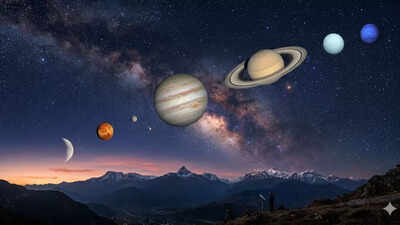
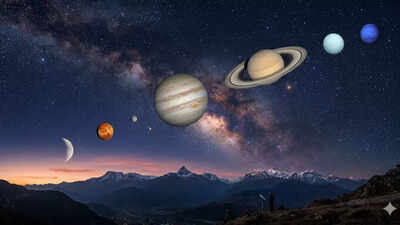
This weekend, if the clouds give way, skywatchers in the UK might be in for a treat. Six planets are reportedly gathering in the evening sky, creating what astronomers call a planetary parade. Mercury, Venus, Saturn, and Jupiter will be visible without any equipment, while Uranus and Neptune might need binoculars or a telescope.During a planetary parade, some planets are easy to see with the naked eye, like Jupiter or Venus, while others, like Uranus or Neptune, usually need binoculars or a telescope. It’s a rare but not impossible event, often lasting several days or weeks.
Planetary parade 2026 : How to spot six planets in the evening sky
A planetary parade happens when several planets appear in a line across the sky, from the Earth’s point of view. It’s not a perfect straight line, experts say. Dr Becky Smethurst, a Royal Astronomical Society research fellow, explains that “all the planets orbit in the same flat plane,” like spinning pizza dough overhead. They’re not truly lining up in space. This weekend, Mercury, Venus, Saturn, and Neptune will sit low near the western horizon. Jupiter will be higher in Gemini, shining brightly, easy to spot even from towns with some light pollution. Uranus, sitting in Taurus, won’t set until around midnight, giving those with binoculars a better chance to catch it.
Planetary parade 2026: Where and when to watch
The closest grouping of planets happens on 28 February, though it varies by location. In the UK, Sunday is reportedly the best viewing day. Experts suggest heading somewhere with a clear horizon, away from city lights if possible.Planetary parades last longer than a single night. Many planets stay visible for weeks. So even if you miss the peak day, it’s still possible to see Mercury and Venus close together in early March, and Saturn lingering nearby.
Planetary parade this weekend: Skywatcher’s guide
Mercury and Venus
Mercury and Venus shine at magnitudes -3.8 and 0.3, respectively. That makes them bright, yet not always easy. Mercury is highest in the sky around 19–20 February, but Venus sits lower then. By 28 February, both planets offer a balance, though binoculars might help.
Saturn and Neptune
Saturn, now past its best, shines at magnitude 1. It’s visible to the naked eye, though it’s slowly moving toward the Sun’s glare. Neptune, at magnitude 8, will require a small telescope.
Uranus and Jupiter
Uranus will hang beneath the Pleiades (M45) open cluster on 28 February. Shining at magnitude 5.7, binoculars might be enough to spot it. Jupiter, past its opposition, glows at magnitude -2.3. That makes it by far the easiest of the six planets to see.
Moon and star clusters
A 92%-illuminated waxing gibbous Moon rises high in the eastern sky, below Jupiter. Observers with binoculars might also spot the Beehive Cluster (M44), one of the brightest star clusters, just below it.
What is a planetary parade
A planetary parade is a term astronomers use to describe a moment when several planets appear to line up in the sky from Earth’s perspective. It doesn’t mean the planets are literally in a straight line in space, but they are still orbiting the Sun at different distances.These parades happen because all the planets orbit roughly in the same flat plane around the Sun, called the ecliptic plane. Sometimes, from our viewpoint, multiple planets end up on the same side of the solar system, so they look like they’re marching together.
Planetary parade guide : Tips to spot six planets after sunset
According to BBC reports, check below for the tips for the best view:
- Let your eyes adjust to faint starlight.
- Start indoors for five or ten minutes in the dark if you like.
- Bring a picnic blanket or chair to avoid straining your neck.
- Wrap up warm if the evening is cold.
- And if using a phone app, switch to red light mode, which doesn’t affect night vision as much.
Comfort matters almost as much as location. A relaxed viewer is a patient viewer. And patience pays off. The parade might feel slow, but each planet is a different world to admire.







 English
  हिन्दी