 Sipu Jha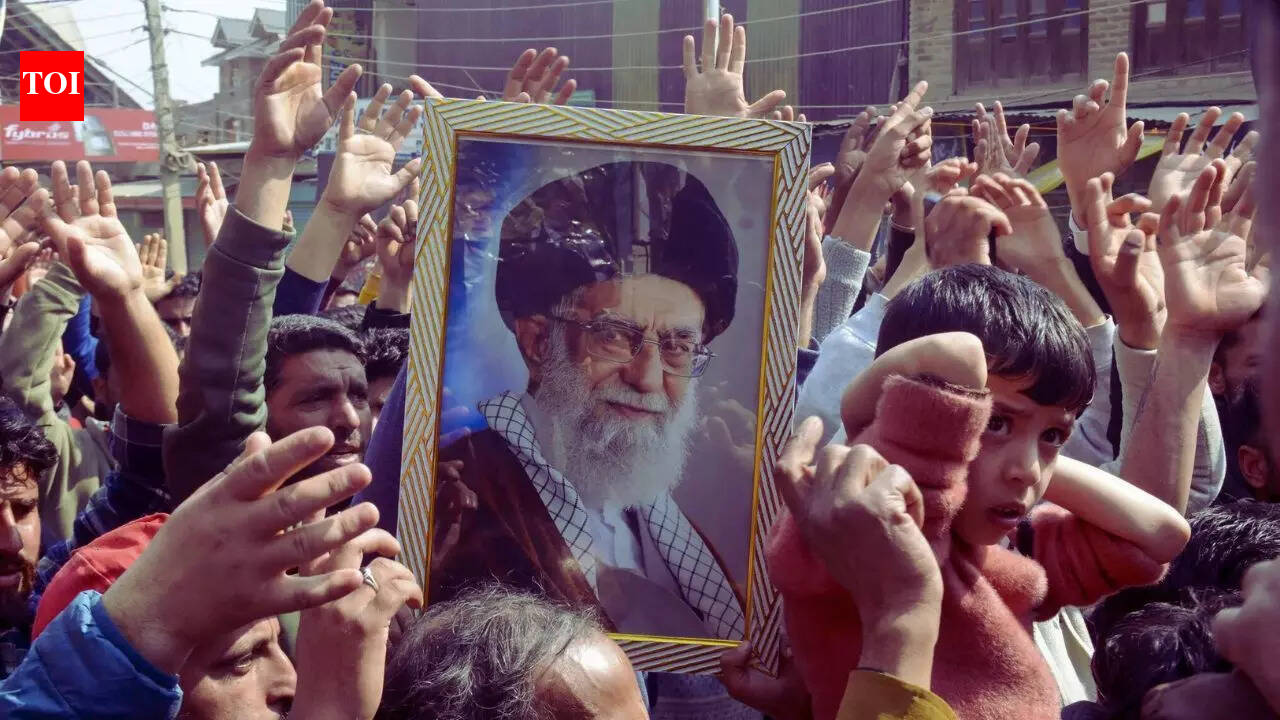
People stage a protest against the killing of Iran’s supreme leader Ayatollah Ali Khamenei in US-Israel joint strikes (PTI Photo)
KINTOOR (BARABANKI):In this quiet village of Barabanki dist, roughly over 4,000 km from Tehran, the news of Iran’s Supreme Leader Ayatollah Ali Khamenei’s assassination has cast a somber mood. As the gravity of the situation in West Asia sinks in, residents grapple with the shock, their faces etched with concern, sorrow and anger.As one enters Kintoor, the village’s lively spirit has been replaced by a heavy silence. The air is thick with sorrow, reflecting its deep connection to Ayatollah Ruhollah Musavi Khomeini, the man who shaped Iran’s 1979 Islamic Revolution and founded the Islamic Republic.
Khamenei didn’t have any direct ancestral or familial ties to India. However, he’s connected to India through his predecessor and mentor Khomeini. His great-grandfather, Sayed Ahmad Musavi ‘Hindi’, was born in this village and later migrated to Iran in 1834.As the news of Khamenei’s killing spread, an angry group of over 200 people comprising Shias and Sunnis took to streets in protest against the attack by the US and Israel forces. A three-day mourning was declared, majlis were organised and shops in adjoining areas were also closed. The protest stretching into the night saw the mourners, dressed mostly in black, holding photos of Khomeini and Khamenei. Two days after the assassination, anger and grief still linger in the atmosphere.Marching through the streets peacefully and shouting anti-US and anti-Israel slogans, protesters said “Khamenei opted for bravery instead of surrender, and his martyrdom is worthy of respect and remembrance.”Amid intense escalation of war in West Asia, conversations flow into the house as people share stories passed down through generations. As you step inside one of the houses, a striking portrait of Khomeini commands attention, its presence impossible to overlook. “Ayatollah Ruhollah Musavi Khomeini’s great grandfather Sayed Ahmad Musavi ‘Hindi’ was born in Barabanki in the early 19th century. Around 1834, he went to Iran on ‘ziyarat’ (pilgrimage) along with the then nawab of Awadh. Since Musavi saheb had brought a revolution in India through this writings, the British did not allow him to return,” says 33-year-old Adil Kazmi, whose great-great-great-grandfather Mufti Mohammad Quli Musavi and Sayed Ahmad Musavi were cousins.Kintoor’s claim to fame is also the 1858 Battle of Kintoor, fought during India’s first war of independence in 1857 between rebel sepoys and forces of the East India Company and Kapurthala State.Adil’s cousin Rehan says, “Musavi saheb also spent time studying in Najaf, Iraq – a revered hub of Shia scholarship – before making the Iranian city of Khomein his home. In Khomein, he crossed paths with a guru who would later arrange his nikah with his daughter and raised a family.”Musavi retained the title “Hindi”, a nod to his Indian roots, a detail preserved in Iranian records, testifying to the family’s ancestral heritage. Musavi went to become a Twelver Shia cleric. He had three daughters and a son, Syed Mostafa, Khomeini’s father. He passed away in 1869 and was laid to rest in Karbala.Adil’s 67-year-old father, Syed Nihal Kazmi, recalls a team from Iran visiting Barabanki 25 years ago to research Khomeini’s lineage and check on the community’s well-being.“Awadh nawab was also from the Shia community. It is believed that Khomeini’s ancestors had come to India from Nishapur in northeast Iran and later called their relatives to settle in Barabanki, whose some pockets had become a major Islamic centre. They added ‘Hindi’ to their name, highlighting their connection to the place they called home,” historian Ravi Bhatt told TOI.





 English
  हिन्दी