 Sipu Jha
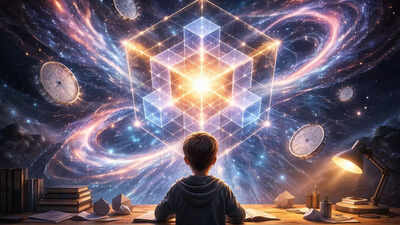
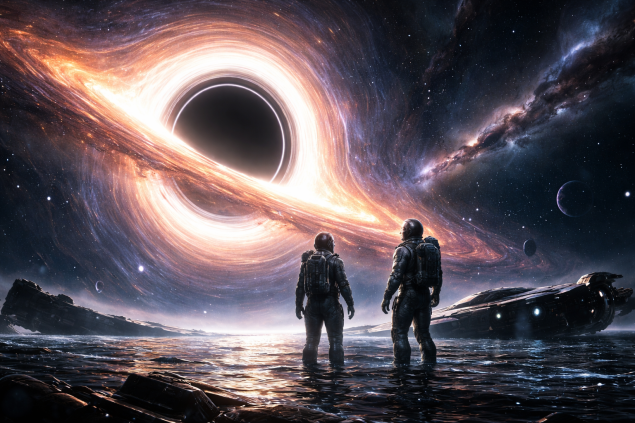
In Christopher Nolan’s Interstellar, astronauts land on a planet orbiting close to a black hole. They spend a few hours on its surface. When they return to their spacecraft, they discover that 23 years have passed on Earth. Children have grown up. A lifetime has slipped away.It feels like science fiction, but it’s not fantasy. Einstein’s theory of relativity showed that time is not absolute. It slows down when you move close to the speed of light. It also slows down in strong gravitational fields. The closer you are to a massive object, like a black hole, the more spacetime curves, and the slower time passes for you compared to someone farther away.Atomic clocks on fast-moving aircraft tick slightly slower than identical clocks on the ground. GPS satellites must constantly adjust for relativistic effects. Without those corrections, our navigation systems would drift by kilometres each day.Gravity bends time. The universe does not run on a single master clock. And yet, concepts like the “fourth dimension” or “time relativity” are often dismissed as abstract science fiction ideas.But a generational shift is quietly taking place. We’re moving from merely thinking about these ideas, to feeling their reality, to living in them. “Tesseract” is inspired by my 12-year-old grandson, whom we watched become completely absorbed in Interstellar. Hans Zimmer’s haunting organ theme became his favourite piece to play on the piano, and again and again, he returned to it.
The music itself feels like time unfolding. Slow, expansive, layered, almost architectural. It rises and circles back, like something moving through dimensions we cannot see.One evening, our conversation drifted to the film’s most mind-bending idea: the tesseract – a four-dimensional hypercube. In the movie, time is represented as a physical dimension, something you can move through, like space.To explain it, he reached for paper. Through simple folds of origami, he showed how a two-dimensional square can be unfolded into a three-dimensional cube. Then he asked: if a cube can unfold into something beyond itself, why not imagine a four-dimensional version, a hypercube, unfolding in ways our eyes cannot fully perceive?It was curiosity in motion, a physics lecture from my grandson, who teaches me something new every time I meet him, without fail. For many adults, such ideas still feel abstract. But younger generations are growing up immersed in them, through films, games, simulations, science channels and digital visualisations. They are comfortable imagining spacetime as fabric, dimensions beyond the visible, universes bending under gravity. And perhaps more importantly, they intuitively grasp something about relativity long before they encounter equations.Tell ten children to meditate for five minutes and ask them to open their eyes when they think the time is up. None will stop together, because five minutes on a clock is fixed, but five minutes in the mind is elastic.When bored, time drags. When immersed, in music, in coding, in conversation…it vanishes. Psychologists call this “flow,” a state where attention is so complete that awareness of time dissolves.There are, in fact, multiple layers of relativity in our lives. There’s physical relativity, the Einsteinian bending of spacetime through gravity and velocity. Then there’s psychological relativity, the stretching and compressing of time through emotion, mental state, and attention. And perhaps there’s generational relativity: the way each generation inhabits these ideas differently.For those raised before the digital age, the fourth dimension may feel theoretical. For those raised within immersive storytelling and interactive media, it feels experiential. They don’t merely read about warped spacetime; they visualise it, feel it hear it, model it, and in some sense, live inside it.Many of us assume that children must be taught these concepts from scratch. But often, they are already thinking about them, just in different language. They may not speak of “spacetime curvature,” but they understand that time feels different in different situations. They may not derive equations, but they can imagine moving through dimensions.They will speak about it, but only if they sense genuine curiosity. If we approach children not as teachers, but as their students; if we ask how they imagine the fourth dimension; if we ask what the music makes them feel; if we are willing to truly learn from them.Science fiction once felt like speculation about distant futures. Increasingly, it is becoming a shared cultural vocabulary for thinking about reality itself.Einstein bent time with mathematics. Filmmakers visualised it. Musicians gave it sound. And children are quietly absorbing it, not as fantasy, but as possibility. Perhaps the elasticity of time is not only a feature of black holes, but also a feature of imagination, stretching across generations, waiting to be unfolded. And sometimes, the doorway into the fourth dimension begins not with equations, but with curiosity – and a simple sheet of paper folded into something more than it first appeared.Experience “Tesseract: The Geometry of Truth”, running from 16 to 22 March 2026 at NCPA Mumbai. Book here







 English
  हिन्दी