 Sipu Jha
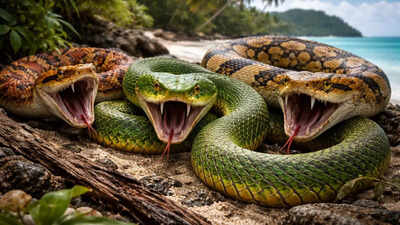
Every year around March 17, stories about Saint Patrick begin to resurface across Ireland and beyond. Among them, one tale stands out more than most. The claim that Ireland has no snakes because Saint Patrick drove them all into the sea continues to capture attention. For many, it forms part of the charm of Irish folklore.According to Born Free USA, when you step back and look at the evidence, a quieter and more grounded explanation begins to appear. Scientists, historians, and geologists have all weighed in over the years, and their conclusions suggest something far less dramatic, though no less interesting.
Story behind Saint Patrick and Ireland’s snakes
The legend of Saint Patrick banishing snakes from Ireland is one of the most widely recognised Irish myths. According to the tale, he stood on a hillside and drove every snake on the island into the sea after they disturbed him during a long fast.Stories like this tend to stick because they are simple and visual. You can imagine it happening. Many historians believe the story was never meant to be taken literally. It seems more likely that the “snakes” represented something else entirely. Some suggest they symbolised pagan beliefs or older religious practices that were gradually replaced as Christianity spread across Ireland.
The real reason Ireland has no snakes
When experts looked for real evidence of snakes in Ireland, they came up empty. There are no confirmed fossil records showing that snakes ever lived there naturally.During the last Ice Age, Ireland was completely covered in ice. The conditions were harsh and freezing, making survival impossible for many species, especially cold-blooded animals like snakes. They simply could not live in such an environment.When the ice eventually melted, Ireland had already become separated from mainland Europe. Rising sea levels cut it off before many animals had the chance to migrate.
When Ireland became an island, snakes missed out
Geography quietly shaped Ireland’s wildlife. As glaciers retreated, land bridges that may have once connected Ireland to Britain and Europe disappeared under rising seas. This left Ireland isolated, surrounded by water. Animals that had already reached the island managed to survive and adapt. Snakes fall into that second category. They are not known for long-distance swimming, and without a land connection, their chances of reaching Ireland were extremely low.There have been occasional reports of snakes being brought into Ireland by humans, either intentionally or by accident. These attempts, however, never resulted in lasting populations. Ireland’s climate is cool, damp, and often unpredictable. While not completely uninhabitable, it is far from ideal for reptiles that rely on warmth to regulate their body temperature.
Why the snake myth still matters in Ireland
The legend of Saint Patrick continues to hold a place in Irish culture, no matter the scientific explanations. In this case, people noticed something unusual. An entire country without snakes. Instead of a geological explanation, they created a story that connected the absence to a figure of great importance.








 English
  हिन्दी