 Sipu Jha
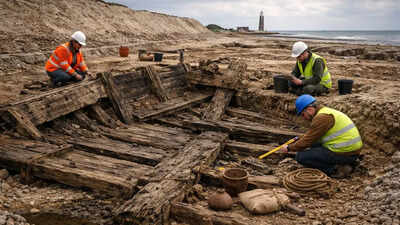
History is not always found in grand monuments or famous battlefields. Sometimes it is found in unexpected places. A gravel quarry is one such place. In 2022, wooden relics were discovered in a quarry near Dungeness in Kent. The relics turned out to be much more than simple rubble. They were discovered to be a remarkably well-preserved ship that dated back almost 500 years. The history of this ship provided insight into the era of great change in English history.This is because this ship helped historians understand how shipbuilding techniques developed during the Tudor era and how this helped England become a dominant world power. Instead of battles and monarchs, this is the history of how design and craftsmanship played an important part in helping England dominate the world.
Discovery of the Dungeness shipwreck
The wreckage of the vessel was located in 2022 in a gravel quarry in Dungeness, Kent. There were approximately 140 oak timbers located almost 1,000 feet inland from the current shoreline. This is documented in the official investigation by Wessex Archaeology.The unusual location of the wreckage implies that the shoreline has changed significantly to move the wreckage from its former location.
Dating the ship to the Tudor period
A scientific technique called dendrochronology was used to date the wood. This showed that the ship was constructed between the mid-1530s and mid-1540s, firmly placing it within the period of Henry VIII. This was published in the Journal of Maritime Archaeology.There is evidence of repairs to the ship that were carried out after 1561.
A major shift in shipbuilding techniques
The ship was made using a construction method referred to as “carvel construction,” whereby planks are placed edge to edge on top of a pre-existing frame. This was different from the traditional “clinker construction,” whereby planks overlapped each other.This new construction allowed for the building of bigger and stronger ships, which could be used for long voyages and in warfare.
Materials and construction details
The material mainly used in the making of this vessel was oak, although some sections of the external hull had been made from elm. The fasteners, instead of nails, had been made of wood and were referred to as treenails.In making the vessel waterproof, the materials included cattle hair, tar, and resin. Although some sections of the vessel had been made in a refined manner, some sections had not been as refined.
Connection to the Gresham Ship
The Dungeness wreck has also helped researchers understand more about the other vessel, termed the Gresham Ship. Similar structural features have indicated the presence of a regional shipbuilding style, which had English as well as continental influences.This has provided valuable context in the understanding of the ships of the Tudor period.
How this shaped England’s naval power
During the 16th century, England started investing in naval dockyards and hiring experienced shipbuilders from other parts of Europe. This helped England improve its shipbuilding techniques and designs.This helped England build better ships, which contributed to its rise as a powerful nation.





 English
  हिन्दी