 Sipu Jha
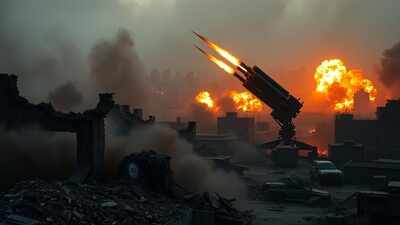
The United States Central Command claims to have recorded the longest artillery strike during the current conflict in Iran. The attack was carried out by a long-range Precision Strike Missile (PrSM), which is commonly known as prism.The projectile is launched from systems such as the M142 High Mobility Artillery Rocket System (HIMARS) or the M270 Multiple Launch Rocket System (MLRS). These two platforms are the most common type of tactical rocket launch systems in the US Army.
“The US Army launched the longest field artillery strike in Army combat history using the Precision Strike Missile. The strike took out Iranian military infrastructure, demonstrating the US military’s unmatched reach and lethality”, the leader of America’s Central Command, Admiral Bradley Cooper, stated.The PrSm, with a whopping maximum range of 500 kilometres, carries a 91 kg warhead, which is slightly less powerful than the one on India’s indigenously developed Pinaka rocket system. Lockheed Martin, the makers of the projectile are currently working on doubling the range of the system to 1,000 kilometers. The 470 mm rocket projectile is expected to achieve this target via improved aerodynamics and improvements in propulsion technology.India too is working on improving its rocket artillery, with improvements to the rocket artillery. The first variant of the 214 mm rocket system had a range of 37.5 kilometres.The range of this rocket system will soon be taken to 120 kilometers and reports suggest that there are plans to take this range to 300 kilometres. At these ranges, the Pinaka will be able to hit targets deep inside Pakistan and on the Tibetan plateau.The Indian Army currently has seven operational Pinaka regiments and the plan is to have 22 regiments equipped with these systems. The army’s Regiment of Artillery is also equipped with 122mm Grad MLRS as well as the 300mm Smerch MLRS, both acquired from Russia.One of the first recorded uses of rockets in combat was by Tipu Sultan against the British during the Anglo-Mysore Wars. The same rockets were reverse-engineered by the British and used against the Americans in the War of 1812.And the rocket’s red glare, the bombs bursting in air,Gave proof through the night that our flag was still thereThe lines above are from the Star Spangled Banner, the national anthem of the United States. Yes, a part of the US national anthem has a reference to India.Rockets were also used in the Second World War with great success. The Russians introduced the Katyusha rocket system, which were called ‘Stalin’s organ’ by the Germans at the receiving end. The Germans, too, introduced their own rocket system and so did the Western Allies.The advantage of using rockets is that they can either saturate in a moment a large area with deadly firepower or they can strike a target with scalpel-like precision.Rocket artillery can easily bridge the gap between regular gun artillery and heavier weapons such as cruise or ballistic missiles. The case in point is the PrSM systems used in the ongoing conflict. Such systems can also destroy targets deep inside enemy territory, in this manner, an important target can be hit without risking an aircraft and its crew.Army chief General Upendra Dwivedi had spoken about the need for a rocket-cum-missile force earlier this year. This requirement of such a force was felt after the kinetic phase of Operation Sindoor. Both Pakistan and China have an operational rocket force in their armies. Pakistan raised their rocket force a few months after the active phase of Operation Sindoor.The recent long-range use of rockets from Ukraine to Israel to now the use against Iran demonstrates that the MLRS is becoming an indispensable system in modern warfare and India too should focus on this system as this platform is now shaping up to be a multi-role platform with an expanding role in the age of precision firepower.








 English
  हिन्दी