 Sipu Jha
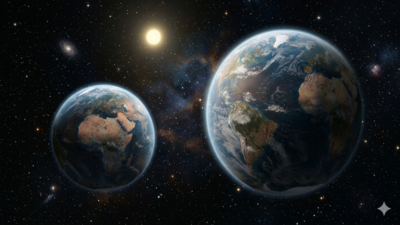
The universe is at it again; scientists have been baffled by a discovery that turns all the knowledge they have on planetary systems on its head. Scientists have discovered an alien solar system around 120 light-years away from our planet. This alien solar system apparently consists of two Earth-like planets, but the whole composition is completely unconventional according to scientists. Unlike the layout of the planets in our solar system, where rocky planets are located near the sun and gas giants far from the sun, this solar system breaks the norms altogether.
Two Earth-like planets: A rare and intriguing discovery
Having two Earth-like planets, also known as super-Earths, within a single solar system is a very unique occurrence. Typically, these planets have been described by NASA as rock worlds that are only slightly bigger than the Earth, and that could be made up of a similar composition.Scientists have even suggested in the past that there were many differences between Earth-like planets including their makeup and whether or not they had water or rock layers.The most unique part of this discovery however is where the planets lie within the solar system. It has been proposed by astronomers that being able to examine two similar planets existing in an identical environment would allow for scientists to determine how such planets develop in identical situations.Essentially, it has been likened to studying two identical children raised in the same household yet developing completely differently.
A planetary system that defies formation models
But the true puzzle is actually in the configuration of the system itself. Based on the current scientific theory, planets are formed through a rotating disc of gas and dust surrounding a developing star. Rocky planets tend to form closer to their parent stars, whereas gaseous giant planets are formed further out.Nevertheless, in the case of this recently discovered planetary system, things seem to be in reverse order. An observation of a rocky planet orbiting past gas giant planets is something that does not fit within the current paradigm of planetary formation.In fact, such a phenomenon has led some researchers to classify the formation process as an “inside-out” or unconventional process for the formation of planets.This discovery, in particular, is important as it suggests that planets do not necessarily form the same way each time, challenging our current understanding of solar system formation.
New research and what it means for space science
This discovery was made using information gathered by advanced telescopes and spacecraft intended for the search of exoplanets. Such tools as NASA’s Transiting Exoplanet Survey Satellite (TESS) and ESA’s Characterising ExOPlanets Satellite (CHEOPS) were very important in identifying remote planets using small variations in light from stars.Research on ‘Earth-Like Planets’ stresses that exceptional planetary systems like this are not mere oddities; they are crucial for improving scientific models. Their study allows scientists to test various hypotheses related to planet migration, gravity, and stellar environment.These systems might even clarify the reason for our Solar System being different from others, or maybe even unique.In summary, this particular solar system containing two habitable planets is not only one more instance of an unknown world that lies beyond our Solar System but also a testament to how much there remains for us to discover about space.


 English
  हिन्दी