 Sipu Jha
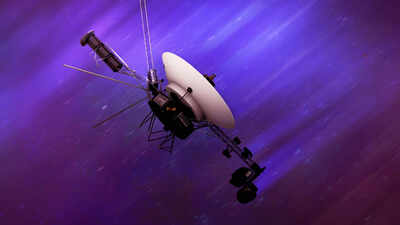
Voyager 1 keeps moving farther from Earth than any human-made object. Launched in 1977, it flew by Jupiter and Saturn, sending back images and information that changed our understanding of the outer planets. It left the asteroid belt early and overtook its twin, Voyager 2, on its way out. The probe crossed into interstellar space in 2012, entering a region with material like long-dead suns. Voyager 2 followed in 2018. Both spacecraft are still sending data through the Deep Space Network, though signals now take nearly a full day to reach Earth. Their journey has lasted over 40 years and continues, beyond Pluto, beyond the planets we know.
Voyager 1 approaches one light-year milestone
Signals from Voyager 1 now take hours to reach Earth. Currently, one-way communication takes 23 hours and 32 minutes, meaning messages from Earth arrive almost a full day later. By late 2026, estimates suggest it will be 16.1 billion miles from Earth, roughly 25.9 billion kilometres. At that point, a radio signal will take 24 hours to get there. It is a quiet milestone, more a measure of distance than a dramatic event. The spacecraft itself will just keep moving outward, drifting into emptiness, carrying instruments still able to record tiny particles and magnetic fields far from the sun.Voyager 2 is exploring parts of space no one has visited Voyager 2 took a slightly different path and reached interstellar space years later. It visited Uranus and Neptune, making it the only spacecraft to study those planets directly. Signals from Voyager 2 also take long periods to travel to Earth but remain a constant trickle of information about a region beyond the planets. Both Voyagers are essentially explorers without return. Each day, they leave more of the familiar behind, moving past regions shaped by the sun into the slow, diffuse interstellar medium.Missions continue far beyond the original objectives The Voyagers were initially designed to study the giant planets. Discoveries like the volcanoes on Io and Saturn’s rings were unexpected. Their missions were extended, and they now form the Voyager Interstellar Mission. They measure particles, cosmic rays, and magnetic fields at distances impossible to recreate. Scientists continue to analyse the signals, though the data arrive slowly, over hours. The pace of exploration is dictated by distance and the finite speed of light.Distance highlights human perspective on space Voyager 1’s milestone of a 24-hour signal travel time is a reminder of the scale of space. The spacecraft moves through regions shaped by phenomena millions of years old. Its instruments still function, quietly sensing its surroundings. For Earth observers, the lag in communication shows the limits of connection. The spacecraft’s motion is steady, indifferent, and ongoing, a quiet witness to a cosmos that humans can only touch indirectly.Voyagers are moving beyond familiar space No spacecraft has gone this far before. They carry instruments, memories of our early planetary exploration, and now measurements of the edge of our solar bubble. Signals will continue to take longer, and distances will keep growing. The Voyagers leave a trail of knowledge, and even as they fade from immediate reach, the information they send forms a bridge to places humans cannot visit.








 English
  हिन्दी