 Sipu Jha

Unusual sounds have a habit of attracting unusual interpretations. Online, a short audio clip of thin, whistling electronic tones is surprising listeners: at first, it sounds like random noise, but when the accompanying sentence is revealed, many report suddenly hearing the words hidden within the same tones. The effect is striking and unsettling, producing a moment many describe as unsettling.The clips and posts are often positioned in ways that encourage darker readings. They are cited as evidence of subliminal conditioning, long-running psychological manipulation by governments or media, or proof that something hidden has been accidentally revealed. Such interpretations are common in online spaces, where ambiguity is frequently filtered through a conspiratorial lens. The effect is undeniably eerie. But the mechanism behind it is neither secret nor new: it has been studied in laboratories for decades, and it reveals less about covert influence than about how readily the human brain imposes meaning once it knows what to hear.
What people are hearing, and why it feels unsettling
The sound in the clip is an example of sine-wave speech, often abbreviated as SWS. It is not encrypted language, nor a covert broadcast technique. It is a deliberately simplified version of speech, stripped down to just a few pure tones that track the changing frequencies of a spoken sentence.A sine wave is the most basic possible sound: a smooth, single-frequency tone with no texture or richness. In everyday speech, by contrast, the human voice contains many overlapping frequencies at once. Sine-wave speech removes almost all of that complexity, leaving behind only a handful of moving tones that loosely follow the contours of speech. In this sense, sine waves act like the building blocks or alphabet of sound: complex audio can be thought of as combinations of these simple, pure tones. To an unprepared listener, those tones sound like random beeps, whistles or science-fiction sound effects. That is exactly what most people report hearing the first time. The unsettling moment comes later, when the listener is told what the sentence is supposed to be saying, hears the original spoken version once, and then listens to the sine-wave version again. Suddenly, the noise “turns into” speech. And once that switch flips, it is extremely difficult to go back to hearing it as meaningless sound. That sharp before-and-after experience is why the effect feels eerie. But the sound itself has not changed at all.
A well-documented auditory illusion , not a hidden signal
Sine-wave speech was first developed in the late 1970s and early 1980s at Haskins Laboratories in New Haven, Connecticut, by researchers including Robert E. Remez and Philip E. Rubin. Their landmark 1981 paper, “Speech perception without traditional speech cues,” published in Science, showed just how little acoustic information the brain actually needs to recognise language.
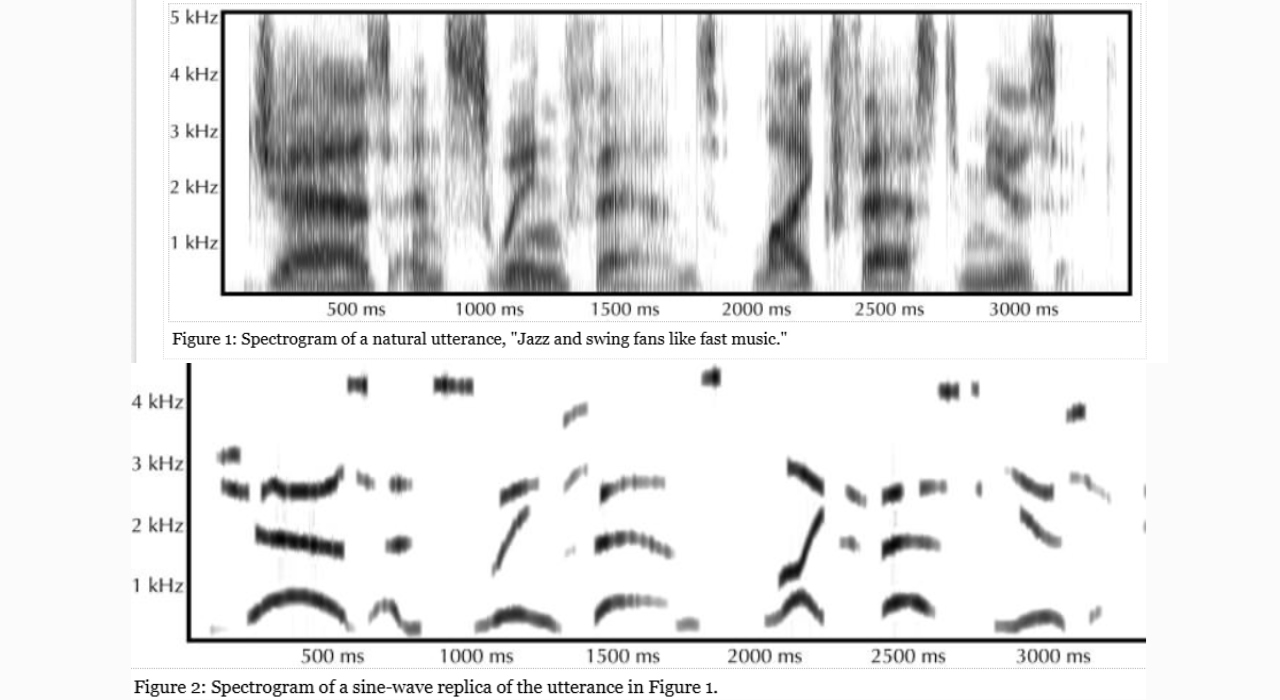
Sine-wave speech/ scholarpedia.org
Their experiments revealed a striking pattern. People with no prior knowledge almost always described sine-wave speech as whistles or electronic noise. But once listeners were told that the sounds represented speech, and especially once they heard the original sentence, perception changed dramatically. The tones “popped out” as intelligible language. Researchers describe this as perceptual insight or pop-out: a top-down process in which higher-level knowledge reshapes sensory experience. In simple terms, the brain learns what to listen for and then does the rest on its own, without conscious effort. After repeated exposure, many people even become able to understand new sine-wave speech samples without hearing the originals first. This is an example of perceptual learning. The phenomenon is closely related to other auditory illusions, such as the well-known “Green Needle / Brainstorm” clip, where what you hear depends entirely on which word you are primed to expect.
How the brain fills in the gaps
The key point, often missed in viral discussions, is that speech does not live solely in sound waves. It lives in the brain. Human hearing is not a passive recording process. The brain is a pattern-seeking machine, constantly predicting, organising, and filling in missing information. When someone hears the clear sentence first, the brain forms a template: rhythm, timing, pitch patterns, pauses. When the stripped-down sine-wave version plays again, the brain matches those expectations to the incoming tones and imposes meaning on them. This is sometimes described as auditory priming, supported by a broader tendency known as auditory pareidolia, the same impulse that makes people hear voices in static or patterns in noise. Neuroscience studies add another layer. Brain regions such as the left superior temporal cortex, long associated with speech processing, respond differently to the same acoustic stimulus depending on whether the listener perceives it as speech or as noise. That makes sine-wave speech a powerful research tool: the sound stays identical, while perception flips entirely based on experience.
Why conspiracy claims don’t hold up
Because the perceptual shift can feel sudden and hard to reverse, it is easy to assume something external has changed, that a hidden message has been revealed or “unlocked”. But nothing in the signal itself is altered. What changes is the listener’s frame of reference.There is no evidence that sine waves are used to secretly control thoughts or condition behaviour. While sound can influence mood or attention in limited, temporary ways, it cannot implant beliefs or override free will. The audio in these clips contains no concealed information beyond what the brain itself supplies once it knows what to expect.Outside the realm of conspiracy theories, sine waves are prized for their simplicity and precision. Their predictability makes them fundamental tools across a range of disciplines: in music and audio production for synthesis, sound design, and equipment calibration; in medicine and science for hearing assessments and brain-activity studies; in engineering for testing signals and communications systems; and in psychology and linguistics as a way to investigate how the brain processes speech, including in experiments with sine-wave speech. According to researchers, rather than being a tool of secret influence, sine waves are primarily used to explore the relationship between sound and perception. The surprising effects people notice come entirely from how our brains interpret what they hear, and while it lacks the thrill of hidden agendas, the science behind it is equally compelling.







 English
  हिन्दी