 Sipu Jha
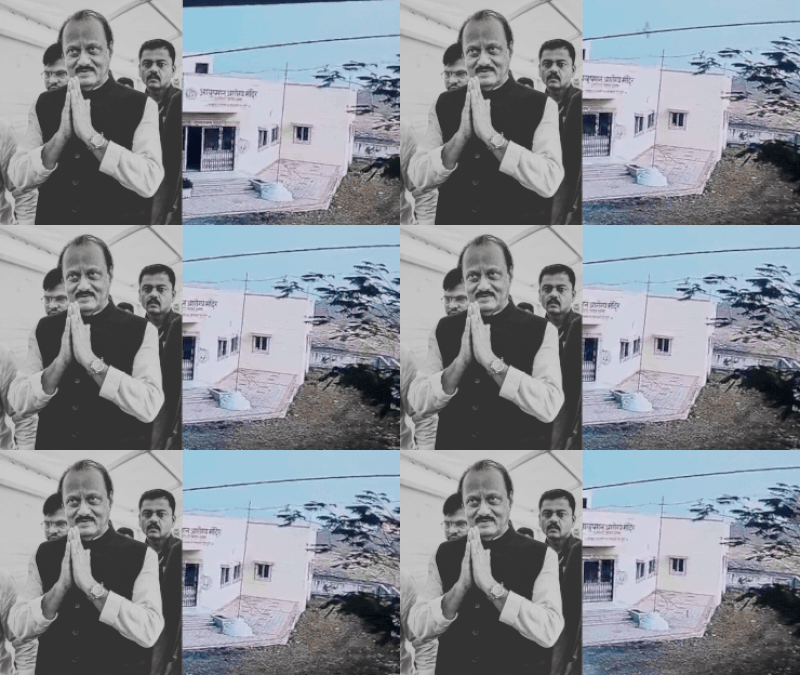
MUMBAI: Low visibility did set off the series of events that led to Wednesday Learjet crash that killed deputy chief minister Ajit Pawar and four others, said senior pilots who analysed the CCTV footage of last seven seconds of the accident. The fixed CCTV camera installed at Gojubavi village gram panchayat office that captured the last seconds of the plane before crash was not positioned for aviation monitoring and had partial visual obstructions from buildings, trees and overhead cables. According to the time stamp on the footage, the aircraft entered the camera’s field of view at 08:43:58, descending towards the runway. Two seconds later, at 08:44:00, the aircraft was seen undergoing an abrupt roll to the left, with the bank angle increasing suddenly to nearly 90 degrees. The Learjet was in a near-vertical orientation as it continued its descent in an abnormal attitude. A second or two later, the aircraft disappeared from view due to obstructions along the CCTV camera’s line of sight. At 08:44:05, a fireball soared up, indicating that the aircraft had impacted the ground. The short interval between the onset of the steep roll and the crash suggests that the loss of control occurred while the aircraft was still airborne and at low altitude. “The pilots had no time or altitude to recover and do a second go-around,” said an A320 commander. During final approach on runway 11, the crew reported to the Baramati air traffic control, manned by pilots of a flying training organisation, that the runway was not in sight and initiated a go-around, said a statement issued by the ministry of civil aviation on the day of the accident. During the second attempt too, they could not visually spot the runway, again indicating a visibility issue. “After a few seconds they reported runway is in sight and the aircraft was cleared to land,” the statement said, adding that the pilot did not give a read-back of the landing clearance, as is the norm in the radio communications protocol. Officials familiar with the probe said the visuals are not consistent with a controlled flight into terrain (CFIT) scenario, in which an aircraft under control impacts the ground due to factors such as poor visibility or navigation error. Instead, the footage shows that the wings were not straight and level in the final few seconds before the crash. Pilots attributed the reason for that sharp and abrupt roll to various possible factors. “It could be an engine failure leading to asymmetry and possible application of wrong rudder,” said a senior pilot. Another pointed to a possible technical problem with control surfaces. “It’s possible that they visually spotted the runway late, when they were well below the ‘decision height’, and then they tried to align the aircraft to the runway to land, and the aircraft went out of control either because of too much correction or some other technical problem,” said another commander. Ideally, if the runway is not in sight by the time the aircraft descends to the decision height, which is about 200 metres above ground, then a go-around or diversion should be the next course of action.






 English
  हिन्दी