 Sipu Jha
NEW DELHI: It has become more common for women in Delhi to have kids in their 30s, compared to two decades ago. Delhi govt data from 2024 shows one in four children were born to mothers in their 30s. The share of children being born to women who are 35 or above has gone from 2.7% to 8.9% between 2005 and 2024.Former director of hospital administration of MCD, Arun Yadav, said the numbers reflect a change in marriage patterns and career trajectories. The sharpest rise is seen in 30-34 age group as births rose from 9.9% in 2005 to 24.6% in 2024. “We consider 25-30 asideal age, but such choices are welcome as one has to look at several factors before choosing motherhood.”
Late 20s Now Most Preferred Age Slot For Women To Have ChildrenWomen should go for regular scans to ensure that there are no genetic anomalies, as such chances increase after 35,” Former Director of Hospital Administration of MCD Arun Yadav said.A senior govt official said marriage among young adults was more common earlier. “Now the age at which people get married is increasing, especially in urban areas. Newly-married couples want some stability in their career before planning a family,” she said. Also, the healthcare facilities are better and more accessible, which helps people conceive even at a later stage in their life, she said.
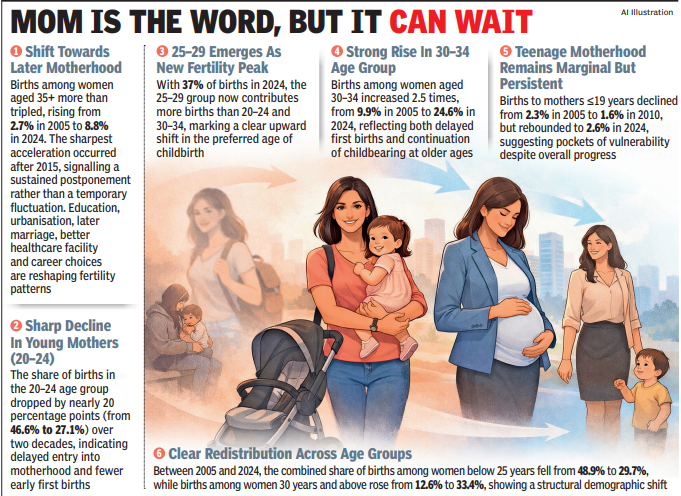
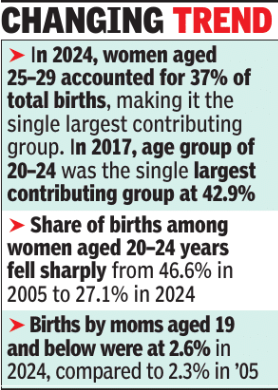
At the other end of the age spectrum, data shows a significant decline in births among younger women. The share of births in women aged 20–24 years fell sharply from 46.6% in 2005 to 27.1% in 2024. This nearly 20-percentage-point decline indicates that early motherhood is no longer the dominant pattern in a city like Delhi.The data also shows a shift in the age group contributing the highest number of births. In 2024, women aged 25–29 years accounted for 37% of total births, making it the single largest contributing group. This was not the case even in 2017, when the age group of 20–24 was the single largest contributing group at 42.9%. This suggests that childbirth is increasingly concentrated in the late 20s, replacing the earlier trend of early-20s motherhood, said an official. The rise in births among women aged over 30 indicates a clear postponement of childbearing rather than a reduction in fertility alone.
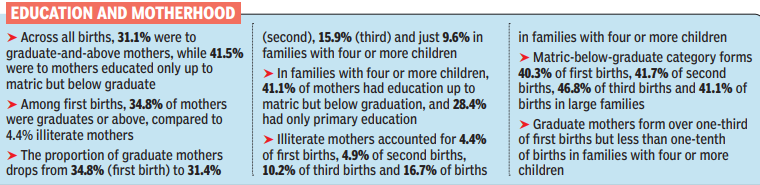
Teenage motherhood remains relatively low but persistent. Births to mothers aged 19 years and below stood at 2.6% in 2024, compared to 2.3% in 2005. While the proportion remains small, the data suggests that early-age pregnancies persist.A senior official from the health department said, “With advancement of medical science, we can handle late pregnancy better now. We cannot dictate when a woman should have a child just because it may lead to complications later; there needs to be a balance.” “Career is also important, and if someone wants security before having children,it is a personal choice. If someone’s career takes a back seat due to pregnancy, that wouldleave a scar in their mind, which can cause life-long stress,” she said.Govt data on motherhood and education highlights the role of education in shaping these trends. Among women giving birth to their first child, 34.9% were graduates or above, while 4.4% were illiterate. In contrast, among women with four or more children, only 9.6% were graduates, while 16.7% were illiterate.The data shows that mothers educated up to class X, but below graduation, form the largest group across all births, accounting for 41.5% overall. Their share rises as family size increases, reaching 41.1% among families with four or more children.Mothers with only primary education also form a higher share in larger families, accounting for 28.4% among women with four or more children, compared to 16% among first-time mothers.






 English
  हिन्दी