 Sipu Jha
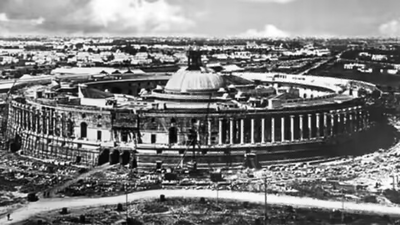
NEW DELHI: As India prepares for the Union Budget for 2026–27, scheduled to be presented on February 1, it is worth noting that when the country’s budgetary journey began, in a vastly different India, still finding its feet after independence.India’s first Union Budget was presented on November 26, 1947, three months after the country attained freedom. At the time, there was no elected Parliament. The Constituent Assembly, tasked with the monumental job of drafting the world’s lengthiest written Constitution, also functioned as the legislative body.The first finance minister of newly-independent nation, RK Shanmukham Chetty, presented the Budget in the House that would later evolve into the Parliament. The country was still grappling with the trauma of Partition, widespread violence, displacement and economic uncertainty.Chetty delivered a sweeping overview of India’s economic condition and laid out his financial roadmap. He described the Budget as an interim measure, covering seven and a half months from August 15, 1947, to March 31, 1948. The projected revenue was Rs 171.5 crore, while expenditure was estimated at Rs 197 crore, resulting in a fiscal deficit of Rs 26 crore.The Budget reflected India’s political and economic challenges of the time. Major allocations were directed towards Partition-related relief and rehabilitation, defence, and achieving self-sufficiency in foodgrains. Defence alone accounted for a substantial 47% of the total Budget outlay.According to the Institute of Chartered Accountants of India (ICAI), the 1947 Budget was meant for a period of seven and a half months, after which a full-year Budget was to take effect from April 1, 1948. Notably, it was also the first Union Budget in which India and Pakistan agreed to share the same currency until September 1948.Shanmukham Chetty later resigned as finance minister, and the responsibility passed to John Mathai, who presented the Union Budgets for 1949–50 and 1950–51. The 1949–50 Budget was significant as it was the first prepared for a united India that included all the princely states.Over the decades, the Union Budget has evolved, but secrecy around its preparation has remained absolute. Any leak of official figures can have serious consequences. Even today, the finance minister is not authorised to keep the crucial “Blue Sheet”, which contains key budget numbers. Only the joint secretary (Budget) is permitted to handle it.In the early years, budget documents were printed within the Rashtrapati Bhavan premises. After a data leak scare, the process was shifted to a government press on Minto Road, where it continued until 1980. Since then, budget papers have been printed in a basement at North Block, home to the finance ministry.The famous Halwa Ceremony marks the start of the printing process. Once it is held, officials involved in the Budget are effectively “locked in” to maintain secrecy. During this period, even the finance minister is not allowed to carry a mobile phone inside the secure zone.Under British rule, India’s fiscal system had been exploitative, designed primarily to serve colonial interests. Heavy taxation, combined with the economic impact of World War II, had left the country financially strained. At independence, India faced the daunting task of rebuilding an economy weakened by decades of colonial extraction.The early post-Independence budgets therefore focused on rehabilitation, reconstruction and stabilisation. Fiscal policies aimed to lay the foundation for agriculture, industry, education and nation-building, as the young republic charted its economic path.Fast forward to 2026, India is now preparing for the ninth consecutive Union Budget presentation by finance minister Nirmala Sitharaman under the Narendra Modi-led government. February 1, however, was not always Budget Day. Until 2017, the Budget was presented on the last working day of February. The date was advanced during the Modi government, with then-finance minister Arun Jaitley arguing that it would allow quicker implementation of budgetary measures within the same financial year.The buzz around this year’s Budget has grown with the start of the Budget Session of Parliament. President Droupadi Murmu, in her address to the joint sitting of both Houses, outlined the government’s vision of a “Viksit Bharat”, highlighting progress in social justice, economic growth, infrastructure, national security and global engagement. A day later, Prime Minister Narendra Modi described India as a self-confident nation and a “ray of hope for the world”.From a seven-month financial statement presented amid the chaos of Partition to a detailed annual roadmap for one of the world’s fastest-growing economies, India’s Union Budget reflects the country’s long and evolving economic journey.





 English
  हिन्दी