 Sipu Jha
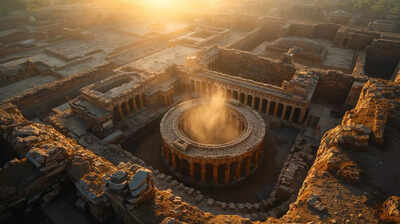
Italy has identified the remains of a Roman public building in the city of Fano that closely match the only known written description of a basilica attributed to Vitruvius, the ancient architect whose ideas shaped Western architecture. The structure, buried beneath the later layers of the city, dates back more than 2,000 years and appears to match the dimensions, layout, and proportions recorded in his writings. Archaeologists say the discovery offers rare physical proof of theories that survived mostly on paper for centuries. Officials describe the site as unusually precise in its correspondence with classical texts, a quality seldom seen in Roman archaeology. Further excavation will determine the extent of the find’s preservation and the possibility of public access.
After 500 years of searching, scientists may have found Vitruvius’ legendary basilica
Vitruvius lived in the first century BC and is best known for writing De architectura, a ten-volume treatise that set out principles of proportion, symmetry and construction. His work became a foundation for Renaissance architecture and later academic teaching, even though almost none of his buildings had ever been securely identified. Scholars debated for generations whether the basilica he described in Fano was a real structure or merely theoretical. The current excavation has practically reopened that question.
Excavation site in Fano reveals strong alignment
The site lies in the historic centre of Fano, a coastal town northeast of Rome. Archaeologists uncovered wall foundations and column bases that form a rectangular plan. According to Andrea Pessina, regional archaeological superintendent, the structure matches Vitruvius’ description down to the number and placement of columns. Ten columns appear along the long sides, with four along the shorter ends. When excavators calculated where a missing column should be based on the text, they dug in that exact spot and found it. Such accuracy is rare, even in well-documented Roman sites.
Archaeologists describe an unusually precise match
Researchers involved in the project have been cautious but visibly struck by the results. Pessina said there are few certainties in archaeology, yet the correspondence between text and remains was difficult to dismiss. Mayor Luca Serfilippi described the basilica as something scholars had searched for over 500 years. Italian Culture Minister Alessandro Giuli called it a discovery that would be discussed far into the future. These comments were made at a press conference in Rome, where officials formally presented the findings.
Cultural impact rooted in classical theory
Vitruvius’ influence extends far beyond ancient Rome. His ideas on proportion famously inspired Leonardo da Vinci’s Vitruvian Man, a drawing that links human anatomy to architectural balance. Finding a building that appears to follow those principles in physical form gives historians a reference point that has long been missing. It allows comparison between theory and construction, something usually inferred rather than observed.
The next steps and public access remain uncertain
Only part of the basilica has been excavated so far. Officials say further digging will determine whether more of the structure survives underground and whether it can be safely displayed. Conservation concerns remain, especially given its location within a modern city. The reporting on the discovery was published by Reuters, whose account brought international attention to the find. For now, the site rests quietly beneath Fano, offering more questions than answers and a rare pause between text and stone.








 English
  हिन्दी