 Sipu Jha
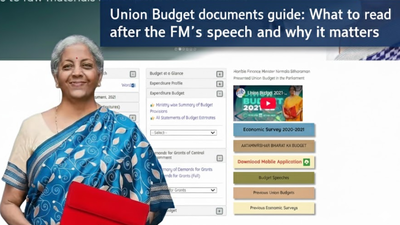
Once the finance minister finishes delivering the Union Budget speech in Parliament, the focus quickly shifts from headline announcements to the fine print. The speech sets the direction, but the real fiscal picture lies in a set of detailed Budget documents tabled alongside it, each serving a specific purpose.Here is a practical guide to what each key Budget document contains and what readers should track once the Budget is presented.
1. Annual Financial Statement (AFS)
Mandated under Article 112 of the Constitution, the Annual Financial Statement is the most important Budget document. It presents estimated receipts and expenditure for the coming financial year, revised estimates for the current year and actuals for the previous year.What to look for:
- Total receipts and total expenditure
- Fiscal deficit, revenue deficit and primary deficit
- Revenue versus capital expenditure
- Break-up across the Consolidated Fund, Contingency Fund and Public Account
Together, the revenue and capital sections of the AFS constitute the Union Budget.Also Read: Budget 2026 Live Updates
2. Demands for Grants : Ministry-wise spending plans
Required under Article 113, the Demands for Grants detail how much money each ministry and department seeks Parliament’s approval to spend.What to look for:
- Allocations to individual ministries and departments
- Revenue and capital spending at the ministry level
- New schemes or services flagged at the end of each demand
With Demands for Grants, this document is key to tracking sector-specific priorities.
3. Finance Bill
Presented under Article 110, the Finance Bill gives legal effect to the tax proposals announced in the Budget.What to look for:
- Changes in income tax, corporate tax and indirect taxes
- Amendments to tax laws and compliance provisions
- New levies, exemptions or rate changes
This is the document that turns Budget announcements into law.Also Read: Income Tax Budget 2026
4. FRBM statements
Mandated under the Fiscal Responsibility and Budget Management Act, these statements explain the government’s fiscal thinking beyond a single year.(a) Macro-Economic Framework Statement
- Growth assumptions
- Inflation outlook
- Assessment of fiscal balance and external sector
(b) Medium-Term Fiscal Policy and Strategy Statement
- Three-year rolling targets for fiscal deficit, revenue deficit, primary deficit and debt
- Strategy on taxation, expenditure, borrowing and guarantees
- Rationale for any deviation from fiscal targets
These documents are crucial for assessing fiscal credibility.
5. Expenditure Budget
This document consolidates scheme-wise spending that may otherwise be scattered across multiple Demands for Grants.What to look for:
- Spending on Central Sector and Centrally Sponsored Schemes
- Transfers to states and Union Territories
- Establishment costs versus programme expenditure
It shows how headline allocations translate into programmes.
6. Receipt Budget
Provides a detailed break-up of the government’s revenue sources and capital receipts.What to look for:
- Direct versus indirect tax trends
- Non-tax revenues such as dividends and interest
- Disinvestment receipts
- Borrowings, guarantees and liabilities
It also explains tax arrears and the revenue impact of tax incentives.
7. Expenditure Profile
An aggregated view of government spending after adjusting for recoveries and inter-departmental transfers.What to look for:
- Sectoral priorities such as defence, railways and social spending
- Gender budgeting and welfare allocations
- Transfers to states
- Major variations between Budget and revised estimates
8. Budget at a Glance
A concise snapshot of the Budget.What to look for:
- Fiscal, revenue and primary deficits
- Resource transfers to states
- Broad tax and expenditure aggregates
This is the quickest way to grasp the overall fiscal stance.
9. Memorandum explaining the Finance Bill
An explanatory note that decodes tax proposals in the Finance Bill.What to look for:
- Rationale behind tax changes
- Likely impact on taxpayers and businesses
10. Output–Outcome Monitoring Framework
A performance framework linking spending to measurable outcomes for major schemes.What to look for:
- Targets and indicators for large schemes
- Output versus outcome tracking
- Why these documents matter
The Union Budget is more than a statement of receipts and expenditure. While the speech sets the narrative, these documents reveal the strategy, constraints and trade-offs shaping government policy. For anyone tracking public finance, markets or governance, the real Budget story begins after the speech — inside these papers.




 English
  हिन्दी