 Sipu Jha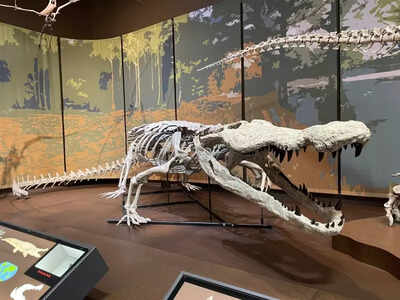
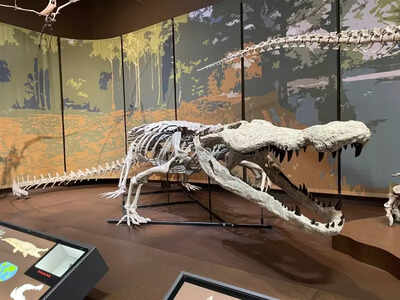
A giant crocodilian that once shared wetlands with dinosaurs has taken physical form again, this time inside a museum. A new life-sized mounted skeleton of Deinosuchus schwimmeri has been installed at the Tellus Science Museum in Georgia, following years of scientific work behind the scenes. The replica is the first of its kind to be built with close attention to fossil evidence rather than artistic impression. It draws on decades of research by palaeontologist Dr David Schwimmer, whose work has reshaped understanding of this predator and its role in Late Cretaceous ecosystems. The display offers visitors a clearer sense of scale, anatomy and context, grounded in scholarship rather than spectacle.
Scientists reconstruct a 31-foot Deinosuchus crocodile from fossil evidence
Deinosuchus schwimmeri lived between about 83 million and 76 million years ago, when much of eastern North America was covered by coastal plains and shallow seas. Closely related to modern alligators, it grew to lengths of around 30 feet and weighed several tonnes. Fossil evidence suggests it fed on large animals, including dinosaurs that ventured close to water. Its size alone placed it at the top of the food chain. Bite marks on dinosaur bones support the idea that it was not just a scavenger, but an active hunter in its environment.The new mounted skeleton reflects more than two years of technical work, but the research behind it stretches back over 40 years. Schwimmer began collecting Deinosuchus fossils in the late 1970s, focusing on sites across Georgia, Alabama and Texas. Many of these fossils are now held in major museums, including the Smithsonian and the American Museum of Natural History. Grants from National Geographic supported much of this fieldwork. Over time, the growing fossil record allowed researchers to move beyond fragments and start reconstructing the animal with greater confidence.
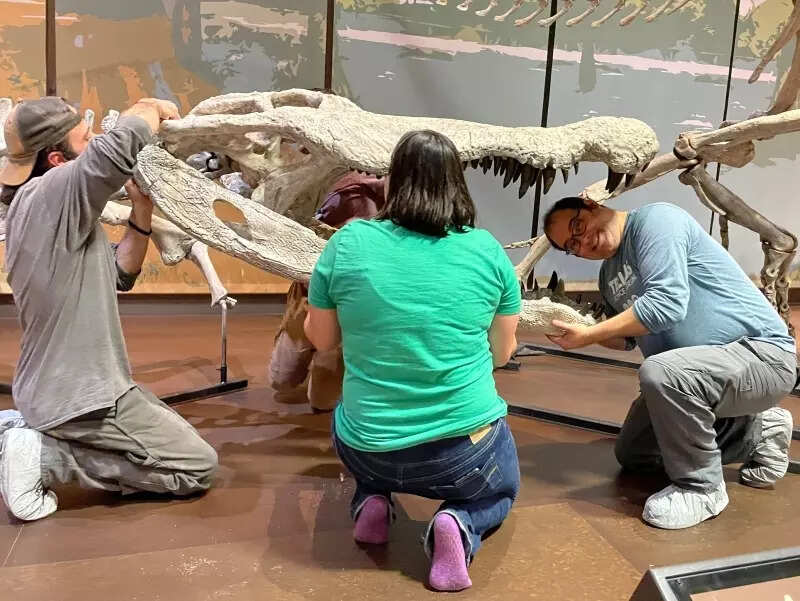
Scientists reconstruct a 31-foot Deinosuchus crocodile from fossil evidence (Credit – Tellus Science Museum)
Deinosuchus schwimmeri recognised as a distinct species
For many years, fossils of Deinosuchus from across North America were treated as belonging to a single widespread species. That view changed in 2020, when a group of palaeontologists formally recognised Deinosuchus schwimmeri as a distinct eastern species. The name honours Schwimmer’s long contribution to the study of the genus. The research clarified differences between eastern and western fossils and helped resolve long standing taxonomic confusion. This distinction is reflected in the new replica, which is based specifically on material attributed to D. schwimmeri.
Building accuracy into a museum-scale skeleton
Creating the replica involved close collaboration between Schwimmer and Triebold Paleontology, a company specialising in scientific fossil models. The team used high resolution 3D scans of original fossils to reconstruct the skeleton and the heavy armour that covered the animal’s body. This process allowed missing elements to be inferred from related specimens while staying within known anatomical limits. The result is not meant to dramatise the animal, but to represent it as accurately as current evidence allows. Subtle proportions and joint positions reflect how the animal likely moved and held itself.
A slow return of an ancient animal
The replica does not attempt to resolve every question about Deinosuchus. Gaps remain, and interpretations may change as new fossils emerge. What it offers instead is a grounded reconstruction, built patiently from evidence collected over decades. In museum light, the animal stands less as a monster and more as a product of its world, shaped by water, prey and time.




 English
  हिन्दी