 Sipu Jha
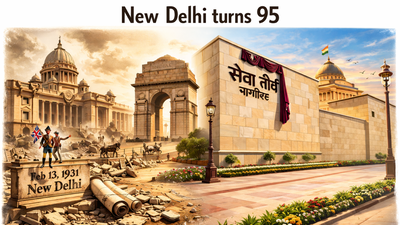
95 years of Delhi (Representative Image: Created with AI)
The national capital, New Delhi, turns 95 today — a milestone that links two defining moments in the city’s history.On this very date, when Lord Irwin moved the imperial administration into the Viceroy’s House, Prime Minister Narendra Modi on Friday inaugurated the relocation of the PMO to Seva Teerth. The transition from South Block to Seva Teerth has been framed as the final “unlinking” of the Eighth City from its colonial inheritance. Yet the birth of New Delhi itself was neither overnight nor was it a ribbon-cutting unveiling a new settlement.However, the inauguration of New Delhi was not a decision made overnight, and surely not a simple ribbon-cutting. After George V dropped the bombshell announcement of the capital being shifted to New Delhi on December 12, 1911, during the Delhi Durbar, it took two decades for the city to come to life.The inauguration of New Delhi unfolded over the course of a week-long series of ceremonies. During this period, the then Viceroy dedicated the All India War Memorial Arch — now known as India Gate — on February 12. The monument was built in memory of soldiers who died in the First World War (1914–1918) and the Third Anglo-Afghan War (1919), as it continues to bear the names of thousands of soldiers inscribed on its surface.Three days later, a ceremony took place at the Government of India Camp, recalling the moment when King George V and Queen Mary had laid the foundation stones of the new capital in succession. Archival records note that the stone blocks carried nothing more than a simple inscription: “15th December 1911.”The making of New Delhi was shaped by history as much as by politics and planning. After the Swadeshi boycotts and the violence that followed the 1905 Bengal partition took over the streets of Calcutta, it became a necessity for the British Raj to make a strong statement. So they fell back on the strategy of the predecessors.The central part, dripping with Mughal ghosts, that shall give them a stronghold. And thus, New Delhi came to be, for the eighth time.Before this, the capital was established and abandoned seven times.The city that accommodates everyone today stands on the ruins of various other establishments and civilisations. And it was precisely because of this that the British Raj chose Delhi as the imperial capital.
The Bombshell at the Durbar
On a sunny, windy day, the Delhi Durbar that sprawled across 25 square miles near Burari had over 84,000 spectators. It was the coronation of King George V and Queen Mary as Emperor and Empress of India, following their crowning in Britain earlier that year.He also became the first reigning monarch to set foot on Indian soil. And it was for a reason.“We are pleased to announce to our people that, on the advice of our ministers, tendered after consultation with our Governor-General-in-Council, we have decided upon the transfer of the seat of the Government of India, from Calcutta to the ancient capital of Delhi,” George V announced, as mentioned in Sam Miller’s Delhi, Adventures in a Megacity.Why? Bengal’s agitation made Calcutta a powder keg. Delhi’s central location astride rail networks, Punjab’s military recruits, and the Afghan frontier made it strategically superior for administration and defence.It also served as a power statement symbolically. Emperors from Pandavas to Mughals ruled here.King George V laid the foundation stones for the Viceroy’s House, which is now Rashtrapati Bhavan and the Secretariat, which are the North and South Block buildings, adjacent to the Rashtrapati Bhavan, during the Delhi Durbar week.This grand gesture symbolised Britain’s long-term commitment to ruling India amid growing nationalist unrest.
Delhi’s eternal game of thrones: The seven cities
The tale of Delhi’s seven cities isn’t some neat stack in one spot, but a history revolving around a central high point called the Aravalli Ridge.From Purana Qila to Mehrauli, the central Yamuna-facing plateau commanded rivers, trade routes, and monsoons. It was the “magnetic North” for power.Whoever held Delhi held India.In essence, Delhi’s foundation began as a mythical forest settlement of Indraprastha and eventually grew into a medieval capital named after its rulers.
Lal Kot/Qila Rai Pithora (1052 CE)
Anangpal Tomar II and Prithviraj Chauhan turned Delhi from a series of scattered settlements into a fortified superpower known as the First City of Delhi.Lal Kot (The Red Fort of its time): Built by Anangpal Tomar II around 1060 CE, these were the original high walls of red sandstone. It was strategically placed on the rocky Aravalli ridge to make it nearly impossible to climb.Qila Rai Pithora: When the legendary Rajput hero Prithviraj Chauhan took over, he didn’t tear it down; he expanded it. He wrapped the original fort in massive new walls, creating a sprawling urban centre that could house a massive army and 27 grand temples.
Siri (1303)
Enter the Delhi Sultanate’s first true urban innovator, Alauddin Khilji. He didn’t just build a city; he built a fortified machine designed to survive both Mongol invasions and starvation.Facing constant threats, he shifted the capital to Siri, the second of the seven cities, and turned it into a logistical marvel.He built massive, 13-meter-thick stone walls to stop Mongol horsemen.To solve the water crisis, he excavated the Hauz-i-Alai, now known as Hauz Khas, a massive tank that captured rainwater to sustain the city through the dry season.This would later go on to become a poetic rivalry that history would remember.
Tughlaqabad (1321)
Ghiyasuddin Tughlaq was a man of stone and war. Unlike the previous rulers who built for beauty, he built Tughlaqabad, the third city, as a grim, sloping fortress meant to withstand the end of the world. While the ruler carried forward the legacy of the grand vision for Dilli, the beloved Sufi saint Nizamuddin Auliya was building a community well.The drama with Sufi saint Nizamuddin Auliya reached its peak here. Ghiyasuddin was so obsessed with finishing his city that he banned all labourers from working on the Saint’s stepwell or his baoli.And thus came the popular curse, “Hunooz Dilli door ast” (Delhi is still far off). But this was not all, he also allegedly whispered a second, darker curse regarding the city itself:“Ya base Gujar, ya rahe ujar.” (May it be inhabited by nomads, or remain a wilderness.)And thus, the city was abandoned almost as soon as it was finished.While returning from a campaign, Ghiyasuddin died when a wooden pavilion built by his own son, Muhammad bin Tughlaq, “accidentally” collapsed on him. He never spent a single night in his completed palace. Delhi was, indeed, too far.Despite the massive reservoirs, the area lacked a sustainable groundwater source. The water turned brackish and undrinkable. Disease and drought forced the population to flee back to the older cities. Within five years, the “impregnable” capital was a graveyard.
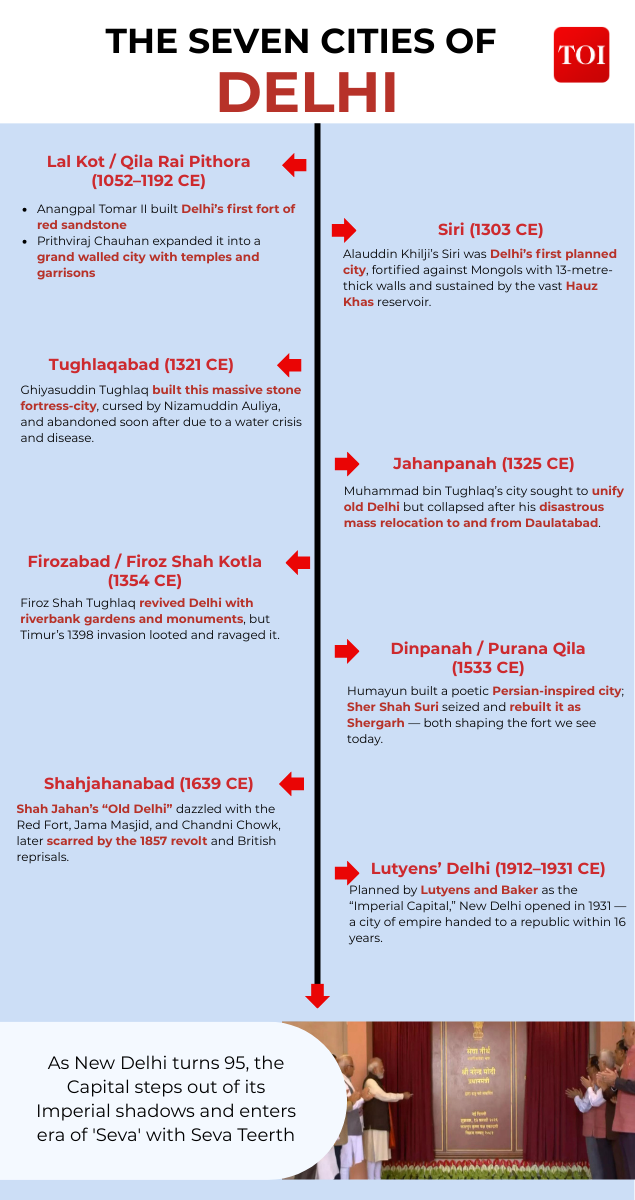
Jahanpanah (1325)
Muhammad bin Tughlaq is history’s ultimate “cautionary tale.” He was arguably the most learned man of his age—a mathematician, physician, and philosopher—but his brilliance lacked a pulse for human reality.He didn’t just build the fourth city, Jahanpanah; he tried to re-engineer the entire concept of an empire.He built madrasas and hospitals, and famously, the Begumpur Mosque.But, in 1327, the Sultan decided that Delhi was too far north to manage his growing southern territories. He picked Daulatabad, today in Maharashtra, as the new centre of India. Most kings would just move their court. Muhammad bin Tughlaq ordered the entire population of Delhi to move.Old men, women, children, and even the sick were forced to walk as thousands perished during the journey, and Delhi became a ghost town.Two years later, he admitted defeat and ordered everyone to march back to Delhi. Thousands more died on the return trip. Those who made it back found a city that had been looted and reclaimed by the jungle.
Firozabad/Firoz Shah Kotla (1354)
Firoz Shah Tughlaq was the “calm builder” of recovery. He established Firozabad, the fifth city of Delhi, and shifted the capital’s focus to the riverbanks. The heart of this city was the Firoz Shah Kotla, where today stands the Arun Jaitley Stadium.But the “idyll” of Firozabad didn’t last. A few years after Firoz Shah’s death, the Central Asian conqueror Timur swept into Delhi.Timur’s forces systematically looted the city for days.He was so impressed by the architecture of Firozabad’s Jama Masjid that he spared the stone-masons, only to take them back to Samarkand as prisoners to build a similar mosque for him there.
Dinpanah/Purana Qila (1533)
The transition from the Tughlaqs to the Mughals brought a new aesthetic to Delhi: the Persian style. This era was defined by a bitter rivalry between the Mughal Emperor Humayun and the Afghan lion Sher Shah Suri. They essentially “co-authored” the sixth city of Delhi, known today as Purana Qila.When Humayun took the throne, he wanted to create a city that reflected his love for astronomy, poetry, and Persian elegance. He began building Dinpanah, the Sixth City, in 1533. He chose the high ground near the Yamuna, supposedly the same spot where the ancient city of Indraprastha once stood.But his dream was cut short after Sher Shah Suri defeated him in 1540 and chased him into exile in Persia.Sher Shah didn’t just conquer the city; he renamed it Shergarh. He tore down Humayun’s incomplete structures and rebuilt the fort with massive, “masculine” stone walls.Eventually, Sher Shah died in a gunpowder accident, and Humayun returned from Persia 15 years later to reclaim his throne. However, his “return” lasted only six months.
Shahjahanabad (1639)
This is the seventh city, the Delhi that most people still recognise today as Old Delhi.While previous cities were forts or strategic outposts, Shahjahanabad was a masterpiece of urban planning, designed to be the most beautiful city in the world.Shah Jahan moved the capital back from Agra to Delhi in 1639, bringing with him the peak of Mughal architectural refinement.He built the Red Fort, Jama Masjid and Chandni Chowk. However, the glory didn’t last. Shah Jahan’s son, Aurangzeb, spent the last 27 years of his reign fighting endless wars in the Deccan.The final blow came during the revolt of 1857.Indian rebels took over Shahjahanabad, declaring the elderly Bahadur Shah Zafar their leader. The British besieged the city for months. When the British finally broke through the Kashmere Gate, they cleared a “shooting space” around the Red Fort, demolishing nearly 80% of the exquisite palaces and gardens inside the fort and the city to build ugly brick barracks.
Lutyen’s Delhi: The eighth city
Following the 1911 announcement, Edwin Lutyens and Herbert Baker were tasked by the 1912 Delhi Town Planning Committee with a mad four-year deadline for 6,000 acres. What started as a then Rs 10 crore budget ballooned as World War I diverted materials and money to the front lines.The shift cost the British approximately £4 million at the time — estimated to be around £610 million today, or roughly Rs 7,528 crore in current value.Ironically, by the time the city was officially inaugurated in 1931, the British Empire was already crumbling. They built a “City of Kings” only to hand the keys over to the Indian Republic just 16 years later.The grand inauguration: Rain, sun, and imperial pompAfter 20 years’ toil, festivities erupt in February 1931.The timing was almost cinematic. After three days of torrential rain, the clouds famously parted on February 10th. At exactly 11:00 AM, the sun struck the red sandstone of the Secretariats, signalling the start of the ceremonies.Standing in the Great Court of the Viceroy’s House, Lord Irwin and Lady Irwin unveiled the four Dominion Columns.The celebrations turned the city into a theatre of military and social might. The 2-mile stretch of Kingsway, the now Kartavya Path, saw the thunder of the British Indian Cavalry. Above, the Royal Air Force performed flypasts—a relatively new and terrifying display of modern power to the crowds below.Once the fireworks faded, the “Paper Empire” began its move. This was one of the largest bureaucratic shifts in history. Thousands of files, desks, and Babus (clerks) were moved from the humid streets of Calcutta to the dry heat of Delhi via special trains.By 1932, the “Viceroy’s House” was fully operational. The British had finally occupied their “eighth city.”Today, the “eighth city” is no longer the city of Lutyens or the British. It belongs to the millions who migrated here in 1947, the dreamers from across the subcontinent, and the ghosts of the Pandavas whispering beneath the Purana Qila.As the Urdu poet Zauq once famously said, “Kaun jaye Zauq, Dilli ki galiyan chhod kar?” (Who would ever leave the streets of Delhi?)







 English
  हिन्दी