 Sipu Jha
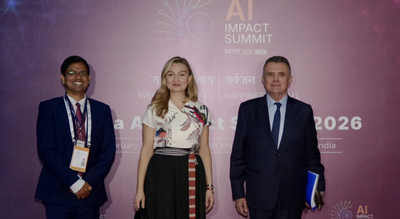
Sweden’s Deputy Prime Minister Ebba Busch is in New Delhi today to attend the India-AI Impact Summit 2026, as India positions itself at the centre of global conversations on artificial intelligence. Busch, who also serves as Sweden’s Minister for Energy, Business and Industry, is participating in high-level engagements alongside a Swedish business delegation and holding bilateral meetings with Indian ministers. Her visit comes weeks after the conclusion of a long-negotiated India–European Union Free Trade Agreement, and against the backdrop of deepening India-Sweden ties across technology, innovation, energy and trade.
The AI Impact Summit and Sweden’s message
The India AI Impact Summit 2026 is underway at Bharat Mandapam in New Delhi from February 16 to February 20. It is billed as the first global AI summit to be hosted in the Global South and has drawn participation from more than 110 countries and 30 international organisations, including around 20 heads of state or government and about 45 ministers.The summit is part of an evolving international process focused on strengthening cooperation on AI governance, safety and societal impact. It is guided by three foundational pillars, People, Planet and Progress, aimed at promoting human-centric AI that safeguards rights and ensures equitable benefits, environmentally sustainable advancement of AI, and inclusive economic and technological growth. It aligns with India’s national vision of “Sarvajana Hitaya, Sarvajana Sukhaya” (welfare for all, happiness for all) and the broader principle of AI for Humanity.Upon her arrival, India’s Ministry of External Affairs welcomed her visit and highlighted the breadth of India-Sweden ties in a post on X, writing:“Warm welcome to the Deputy Prime Minister and Minister for Energy, Business and Industry @BuschEbba of Sweden, in New Delhi for the India-AI Impact Summit. India-Sweden ties span a broad spectrum of cooperation, including trade, economy, science, innovation, climate action and education among others.”During her visit, she praised India as a key partner in AI, innovation, and trade, highlighting the growing ties between the two nations across sectors such as energy, business, and technology, particularly in the wake of the recently concluded EU-India free trade agreement.Speaking exclusively to NDTV on the sidelines of the summit, Ms Busch described India as central to the global AI conversation. “It’s not a coincidence that India is now chairing and hosting this global AI summit for the first time in the Global South,” she said, crediting Prime Minister Narendra Modi’s leadership and his emphasis on technology that is “coming from man and serving the greater good of humanity.”She added that her participation was a “given”, underscoring what she called India’s growing influence in shaping global AI discourse. Referring to Sweden’s own innovation credentials, she said: “Sweden is number one, two or three in many global rankings on innovation. We are a knowledge-hungry people, always looking to partner with others who want to solve complex problems. India is definitely such a partner.”
Bilateral ties: telecom, trade and the FTA
During her visit, Ms Busch met Union Communications Minister Jyotiraditya Scindia. In a social media post, Mr Scindia said India and Sweden are poised to build a strong, future-ready digital and telecom partnership.Innovation, science and technology already anchor India-Sweden relations. In recent years, the two countries have signed bilateral cooperation agreements across innovation, research and energy. There is extensive trade between them, and nearly 300 Swedish companies are established in India.Ms Busch’s visit also comes shortly after the conclusion, in January 2026, of a free trade agreement between India and the European Union following nearly 20 years of negotiations. Under the agreement, customs duties on EU exports are set to decrease by more than 90 per cent. There are indications that exports could double by 2030, with expanded opportunities for small and medium-sized enterprises.Describing the agreement as a turning point, Ms Busch told NDTV: “We were celebrating finally,” calling it a “truly big day” for Europe. She stressed that the agreement was about “far more than trade.”According to her, the FTA brings together “the fourth largest economy in the world and the second largest market,” creating long-term strategic alignment in addition to economic opportunity. “This free trade agreement is more than just trade. It’s about building value-based relations that can last for generations,” she said, adding that in a time of geopolitical turbulence, Europe was choosing its partners carefully. “Sweden is definitely choosing India for a reason.”She concluded with a message to Indian businesses and innovators: Sweden was “open for business”. Around 300 Swedish companies operating in India indirectly support nearly 2.5 million jobs, she noted. “We’d like to do more, and we’d also like to see more investments in Sweden, especially in industry and healthcare when it comes to innovation and AI,” she said. Linking the agreement to long-term ambitions, she added: “It’s about building for the next generations, for my two children back home in Sweden.”







 English
  हिन्दी