 Sipu Jha
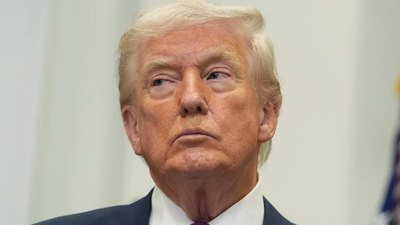
TOI correspondent from Washington: The US Supreme Court on Friday delivered a stunning rebuke to President Donald Trump, ruling in a 6–3 decision that his global tariffs are illegal. In opinion penned by Chief Justice John Roberts, the court said Trump did not have the authority under the International Emergency Economic Powers Act (IEEPA) of 1977 to impose tariffs and “had Congress intended to convey the distinct and extraordinary power to impose tariffs, it would have done so expressly.”
The opinion upholds earlier rulings by the US Court of International Trade and a federal appeals court, both of which found that IEEPA—traditionally used to freeze assets and block financial transactions during national emergencies—did not implicitly authorize tariffs.In dissent were three conservative justices — Clarence Thomas, Samuel Alito and Brett Kavanaugh — who argued that the statute’s broad language granting the president authority to “regulate” economic transactions during a declared emergency should be read to encompass tariffs.Also Read | Trump announces new 10% global tariff after Supreme Court ruling: What are Sections 122, 232 and 301? ExplainedAccording to the dissenters, the majority unduly narrowed presidential power at a time when economic threats from abroad, including currency manipulation and industrial overcapacity, warranted swift executive action. They contended that Congress, in drafting IEEPA, understood the president would need flexible tools to respond to evolving economic crises.But the majority rejected that interpretation, drawing a sharp distinction between regulating financial flows and levying import taxes—an authority the Constitution vests in Congress. The court emphasized that tariffs are a form of taxation and that delegations of taxing power must be explicit.The lead challengers in the case were US companies and trade associations whose members had paid billions of dollars in duties under the administration’s blanket tariffs imposed via IEEPA, and who were represented by Indian-American attorney Neal Katyal, a former Acting Solicitor General during the Obama administration.“Today, the US Supreme Court stood up for the rule of law, stood up for Americans everywhere. It’s message is simple: Presidents are powerful, but our Constitution is more powerful still. In America, the chief justice said, only Congress can impose taxes on the American people, and that’s what tariffs are. Tariffs are taxes,” Katyal said, standing in front of the SCOTUS moments after the 6-3 opinion. On his part, Trump is said to have exploded when he heard about the ruling during a meeting of the National Governors Association, calling it a “disgrace.” The ruling marks the first time the US Supreme Court has definitively struck down a major policy initiative of Trump’s second term. In other cases since his return to office in January, the court’s conservative majority has largely afforded him expansive leeway in wielding executive authority. But here, a coalition of three conservative and three liberal justices concluded that Trump exceeded the bounds set by Congress.The practical effect is immediate and sweeping. Much of the administration’s tariff agenda—especially the global Liberation Day tariffs first announced April—now stands on legally untenable ground. Economists at Penn-Wharton have estimated that more than $175 billion in tariff revenue would have to be refunded if the tariffs are invalidated, raising complex logistical and fiscal questions. Importers who paid the duties—ranging from multinational retailers to small manufacturers—could file claims for refunds through US Customs and Border Protection. Depending on how the Treasury processes those claims, repayments could ripple through corporate balance sheets and potentially lower consumer prices in some sectors, a prospect that buoyed markets on Friday. Attention now turns to the administration’s “Plan B,” with legal analysts noting that while IEEPA is off the table for blanket tariffs, other statutes provide narrower pathways. For example, Section 232 of the Trade Expansion Act allows tariffs on national security grounds, as Trump did during his first term with steel and aluminum. Section 301 of the Trade Act of 1974 authorizes targeted tariffs in response to unfair trade practices.
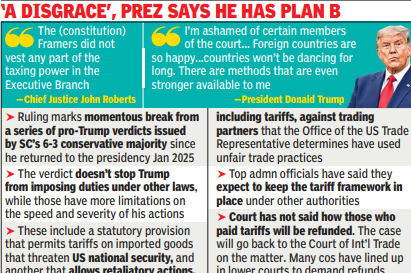
Prez says he has ‘plan B’
However, both mechanisms involve procedural requirements and substantive limits that make broad, across-the-board tariffs more difficult to justify. Other trade laws impose stricter criteria, require agency investigations, and often limit tariffs to specific sectors or countries.At the same time, the ruling injects uncertainty into global trade relationships. Negotiating pressure on countries like India could ease since the Trump administration can no longer credibly threaten across-the-board emergency tariffs under IEEPA to extract concessions. Instead of negotiating under the immediate risk of blanket tariffs, discussions may revert to more structured bilateral trade talks and sectoral agreements.Trump had repeatedly urged the justices to uphold his tariff authority. In a series of posts on social media, he warned that striking down the tariffs would trigger an economic “disaster,” weaken America’s leverage over China and other trading partners, and undermine his broader effort to revive domestic manufacturing.Yet the court’s decision signals that even a sympathetic conservative majority is not prepared to endorse expansive readings of executive power absent clear congressional authorization.The administration could also seek explicit congressional authorization for new tariffs, though that route would require bipartisan support in a divided political climate and a very narrow GOP majority in which there are Republican dissenters. Alternatively, it might narrow its focus—targeting specific industries such as electric vehicles or semiconductors—where national security arguments may be more defensible.





 English
  हिन्दी