 Sipu Jha

For years, biryani has reigned uncontested as India’s most-ordered dish. Food delivery platforms have repeatedly declared it the undisputed king of online orders, with tens of millions of plates delivered annually. In Hyderabad, where biryani is not merely cuisine but civic identity, the dish is both heritage and industry. Brands have scaled from Old City kitchens to international franchises. Seasonal spikes during Ramzan’s haleem rush generate crores in weeks. Outlets open at dawn with paya counters and close past midnight after the final dum batch is scraped from deghs.Then, in November 2025, biryani entered an entirely different arena: the digital forensics lab of the Income Tax Department.What began as a targeted survey of a few popular Hyderabad outlets rapidly expanded into what officials now describe as one of the largest tax-evasion investigations in the city’s food and hospitality sector. Searches were conducted across nearly 30 locations linked to three of Hyderabad’s most prominent restaurant chains — Pista House, Shah Ghouse and Mehfil — including kitchens, corporate offices, warehouses and residential premises.The immediate suspicion was large-scale suppression of sales. What investigators say they uncovered instead was a layered digital system allegedly designed to erase cash transactions with precision.
Petpooja: The investigation that began with a pattern
The Hyderabad unit of the Income Tax Investigation Wing did not begin with dramatic raids. It began with data.Officials gained access to transactional records from a widely used restaurant billing platform, Petpooja, which services over one lakh eateries across the country. Working from backend servers accessed in Ahmedabad and analysing data at the department’s digital forensic lab in Hyderabad’s Ayakar Bhavan, investigators began crunching 60 terabytes of billing information spanning six financial years, from 2019–20 to 2025–26.
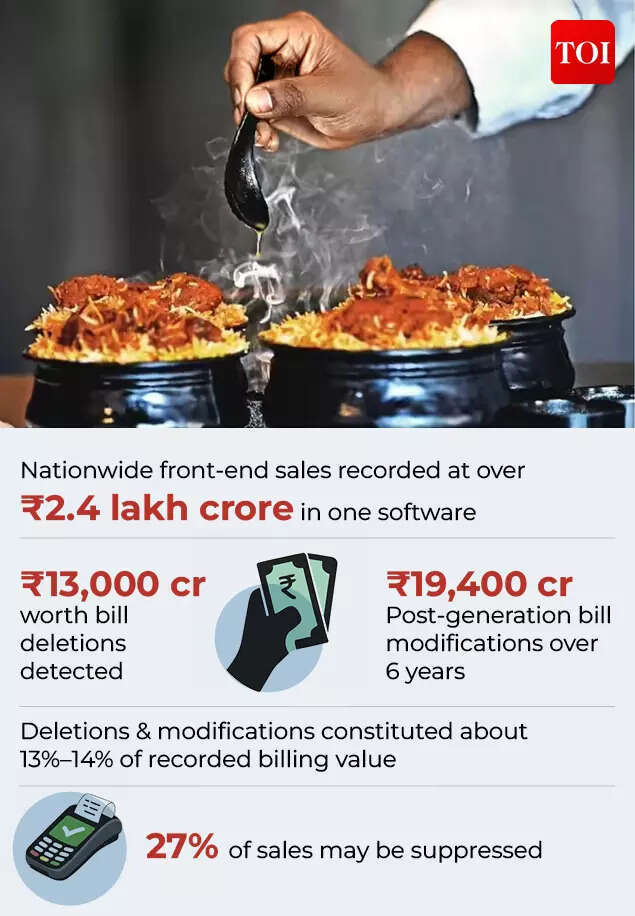
The dataset covered approximately Rs 2.43 lakh crore in billing transactions across 1.77 lakh restaurant IDs nationwide.The anomaly that first triggered deeper scrutiny was simple but statistically implausible: unusually high levels of cash invoice deletions clustered around month-end, often 8 to 10 days before GST filing deadlines.The department’s preliminary national estimate now suggests that restaurants using this platform suppressed sales turnover worth nearly Rs 70,000 crore over six years, with around Rs 13,317 crore attributed specifically to post-billing deletions. Officials estimate that roughly 27 percent of total sales were not reflected in tax returns.Hyderabad became ground zero because that is where the first physical verification matched the digital suspicion.
Decoy purchases and the cash trail
Before conducting searches, officials carried out decoy purchases at multiple outlets. Teams visited branches, paid via cash and UPI, and quietly tracked what happened next.The billing software was designed to record every order internally. Each entry triggered kitchen preparation and remained open until settlement, ensuring that waiters or cashiers could not siphon off revenue. In theory, the system strengthened internal control. In practice, investigators allege, management-level access allowed selective deletion after settlement.
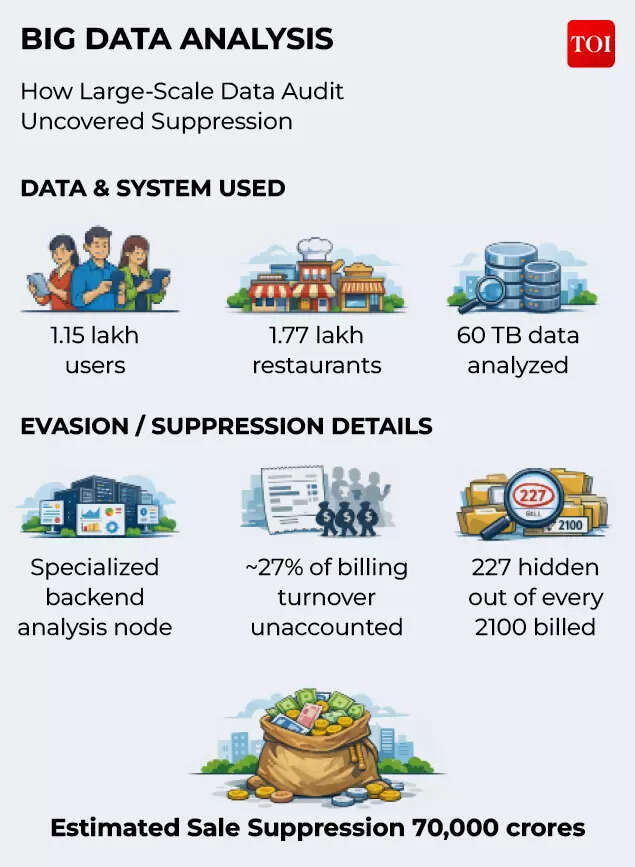
UPI and card payments remained intact because they generated invoice numbers tied to banking systems. Cash transactions, however, were vulnerable. Investigators say entire blocks of cash invoices were later erased from backend logs.When confronted, some establishments cited “cancelled orders.” Officials rejected the explanation. Cancellation rates of 40 to 50 percent, exclusively for cash payments, did not align with normal restaurant behaviour.
The ‘bulk delete’ function
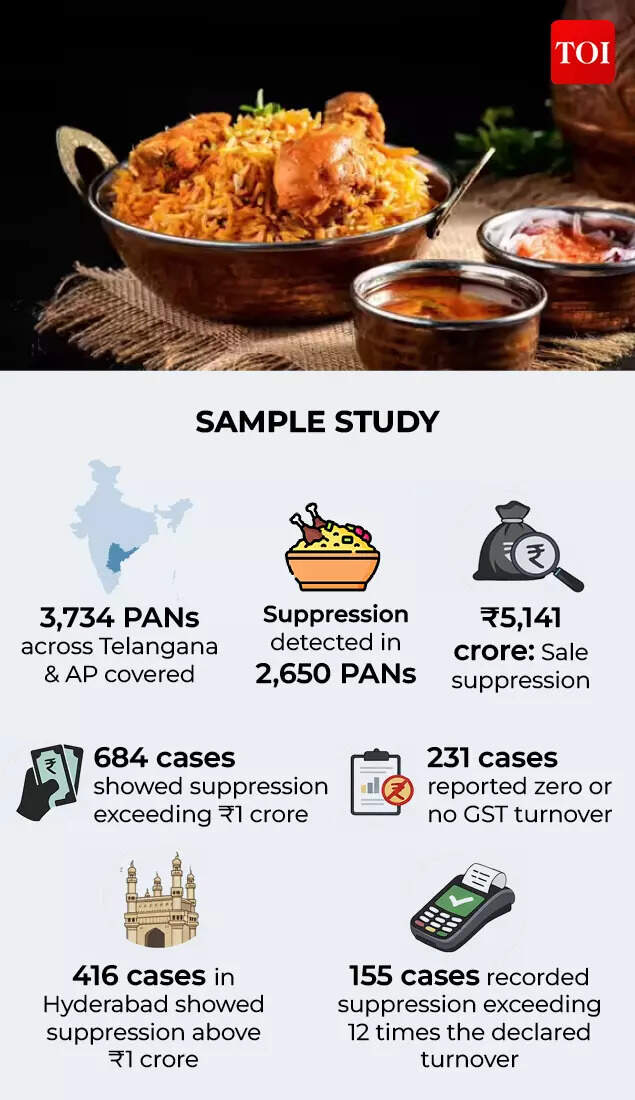
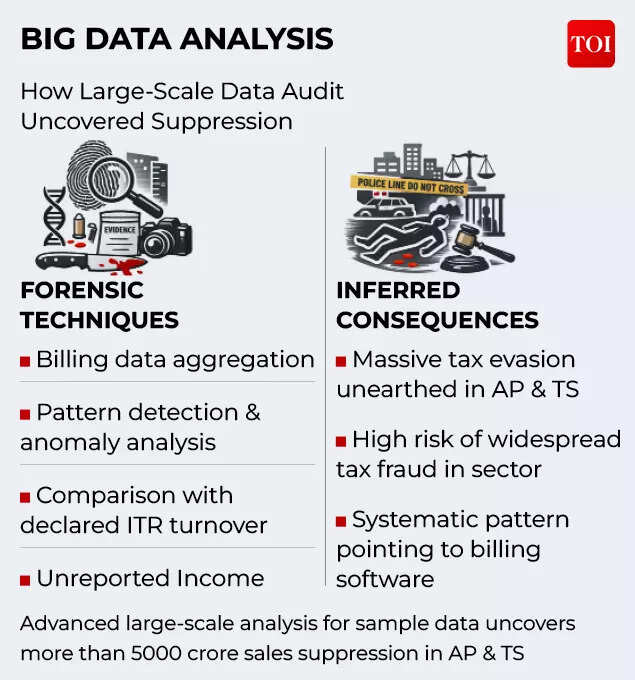
Central to the probe is what officials describe as a powerful bulk deletion feature embedded within the billing system. This function allowed users to wipe bills within a selected date range — sometimes up to 30 days — in seconds.Unlike minor same-day corrections for errors, these deletions often occurred weeks or months later, sometimes close to the end of the financial year. In some instances, entire date ranges were reportedly erased within moments.Investigators also flagged post-generation invoice modification. Bills worth thousands of rupees were allegedly reduced to nominal values after issuance. While genuine discounts and reconciliations occur in hospitality businesses, officials observed reductions exceeding 20 to 30 percent of original amounts long after the transaction date.Using forensic reconstruction, officers recalculated turnover by adding deleted invoices and value reductions back into visible sales figures. These reconstructed totals were then compared with declared income.In Hyderabad alone, 416 cases reportedly showed suppression above Rs 1 crore each. Across Andhra Pradesh and Telangana, suppression crossed Rs 5,000 crore. Nationally, Karnataka logged the highest deletion figures, followed by Telangana and Tamil Nadu.
From restaurants to rice and mutton
By early December, the investigation moved upstream.Income Tax teams began inspecting suppliers of rice and meat linked to the chains. The logic was straightforward: if a restaurant’s sales were suppressed, its raw material consumption should tell a different story.Investigators began matching three layers of data — supplier dispatch records, restaurant purchase books and reconstructed billing logs. In one case, officials found that while recorded quantities of mutton were reduced in books, the associated cost was inflated to preserve output ratios. This discrepancy is now central to calculating the actual scale of suppression.A supplier in Hyderabad’s AC Guards and Red Hills area was among those scrutinised. The department believes raw material manipulation and billing deletions together created a closed loop that concealed actual turnover.
Cash in lockers, UPI rotation and layered accounts
Searches yielded not just documents but cash.Around Rs 6 to Rs 10 crore was seized from premises linked to the three chains. In one instance, officials found a rented flat allegedly used solely to store cash in a locker. No one lived there.
Another discovery involved multiple UPI IDs registered in employees’ names. Different floors or service areas reportedly used separate QR codes linked to different accounts, though management allegedly controlled collections. These UPI IDs were rotated every two months to avoid large accumulations under any one individual. Cash withdrawn from these accounts was handed over to management, forming another channel of off-book income.Investigators also monitored the movements of individuals associated with the chains and traced significant cash to undisclosed premises.
The scale of alleged suppression
Preliminary internal assessments suggest that Pista House alone may account for Rs 250–300 crore of suppressed income, while Shah Ghouse and Mehfil together may account for around Rs 150 crore.Overall, the three chains are suspected to have suppressed roughly Rs 600 crore in income over several years. At an effective exposure rate of about 60 percent including tax and penalty, liabilities could cross Rs 360 crore.Investigators believe the figure could rise once peak-season sales — particularly during Ramzan’s haleem rush and extended business hours beginning at dawn — are fully analysed.
International links and expansion models
The probe also flagged overseas investments in real estate, particularly in Dubai and other emirates, linked to some promoters. These findings may trigger separate information requests through international channels.The organisational structures of the chains vary. Pista House operates as a single-family promoter-driven enterprise with outlets across India, the United States and the Gulf. Mehfil has expanded into the UAE while continuing aggressive domestic growth. Shah Ghouse reportedly operates through multiple companies controlled by family members.Beyond finances, search teams also documented hygiene concerns in certain kitchens, including sanitation lapses. While outside the primary tax scope, such findings have been recorded.
The technology arms race
To analyse the massive dataset, the department deployed high-capacity forensic systems and AI tools, including generative AI. Around 15,000 GST numbers were mapped to restaurant entities using open-source information rather than waiting for official responses.Ironically, digitisation — intended to formalise India’s economy — may have enabled new forms of structured evasion. The same software that prevented waiter-level theft allegedly facilitated management-level deletion.
Officials believe their current findings represent only a fraction of the industry. The billing platform analysed controls roughly 10 percent of the restaurant software market. Multiple other systems operate nationwide.
What this means for india’s restaurant economy
India’s food delivery boom has doubled the organised restaurant market in the past five to six years. From neighbourhood tiffin centres to international franchises, billing systems, aggregator platforms and digital payments have reshaped hospitality.But the biryani probe exposes a fundamental tension: digitisation increases scale, but it also creates new backend vulnerabilities.If 27 percent suppression holds across similar systems, the implications for GST revenue and income tax collections are significant. More importantly, the case signals a shift in enforcement — from physical raids to data-driven reconstruction.
A dish, a symbol, a system
Food critic Vir Sanghvi once described biryani as a mosaic — each grain distinct yet part of a whole. That metaphor now carries unintended resonance.India’s restaurant economy is similarly layered: cash and digital, formal and informal, small vendors and global franchises. The crackdown reveals how quickly the informal can re-enter the formal system through digital loopholes.The biryani boom is real. So is the tax net tightening around it.The question is no longer whether evasion occurred in select outlets. It is whether India’s hospitality sector — one of its fastest-growing urban employers — is prepared for forensic-level scrutiny in an era where every invoice leaves a trail somewhere.And in a country that ordered over 93 million biryanis online in a single year, that trail may be longer than anyone imagined.






 English
  हिन्दी