 Sipu Jha

Australia’s $40 cigarettes and the rise of tobacco smugglersWhen cigarette prices began climbing across India in early February, the effect was immediate and oddly chaotic. Smokers paid different prices for the same pack on the same street. Retailers blamed wholesalers. Wholesalers blamed the new tax regime. What was framed as a clean public health reform quickly revealed a messier economic story.Popular culture has long understood what policymakers sometimes underestimate. In Money Heist, the Professor insists the real vulnerability is never the vault but the system around it. Apply enough pressure and the cracks appear elsewhere. In The Wolf of Wall Street, excess is not driven by morality but by margins; when the spread is wide enough, someone will step in to capture it. And in Gangs of Wasseypur, power does not shift with speeches but with control over supply. Whoever controls distribution controls the street.India’s 2026 tobacco overhaul sits at the intersection of those three insights. Raise taxes sharply and you do not just change behaviour. You change incentives, redistribute margins and test the resilience of the supply chain. What follows is less a story about cigarettes than about what happens when policy pressure meets market reality.
The scale of the problem
Although the most recent nationally representative surveys predate the 2026 reforms, they remain the clearest benchmark of India’s tobacco burden. According to the Global Adult Tobacco Survey (2016–17), approximately 267 million individuals aged 15 and above, nearly 29% of the adult population, consume tobacco in some form in India. Of these, an estimated 130 million are smokers. The World Health Organisation (WHO) reports that India accounts for nearly 12% of the world’s total smokers.Tobacco use patterns vary significantly across regions and demographics. A survey from 2013 conducted by the International Institute of Population Sciences in collaboration with the ministry of health and family welfare found that Kolkata records the highest smoking rate in the country, with 56.6% of its population identified as smokers. The data further reveals a stark gender disparity in the city: 82% of men and 23.5% of women smoke. Meanwhile, Uttarakhand reports the highest prevalence of beedi smoking. A 2008 health ministry report estimated that around 100 million people — largely from economically disadvantaged and less educated communities — smoke beedis. The report also linked beedi smoking to approximately 200,000 deaths due to tuberculosis, highlighting the severe health consequences associated with tobacco use in India.Since February 1, the legal trade has fractured into what smokers describe as a landscape of sticker-shock and secrecy: packs sold at more than 20 % above MRP, wholesalers hoarding stock, retailers charging different prices to different customers, and a growing presence of non-compliant foreign brands entering through porous borders.
India’s 2026 cigarette tax hike takes effect
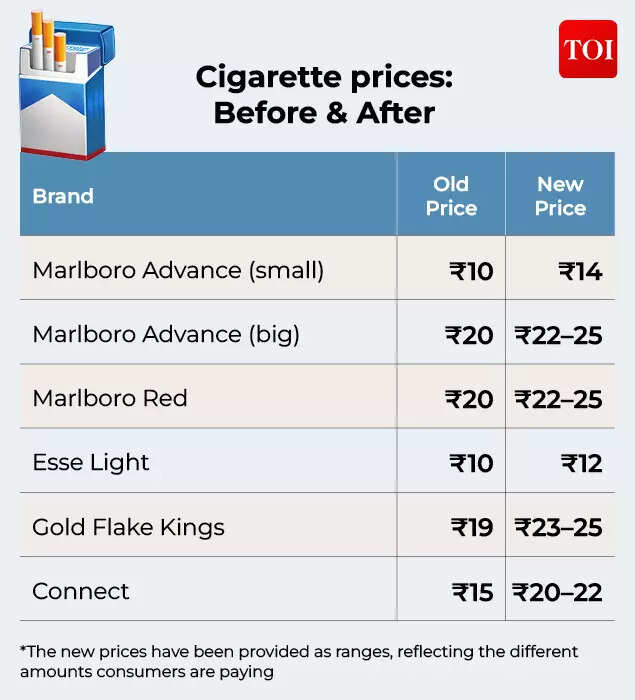
In late 2025, the government enacted a sweeping tax reform to raise cigarette prices further. A December 2025 order imposed high specific excise duties (Rs2,050–8,500 per 1,000 sticks, depending on length) effective Feb 1, 2026. This stacked atop the existing 40% goods-and-services tax (GST). After implementation, the total tax share on cigarettes will jump from roughly 55% to about 66% of retail price. GST on cigarettes was hiked from 28% to 40%, and a new National Health Cess was introduced.Finance Minister Nirmala Sitharaman, announcing major Goods and Services Tax (GST) rate cuts, said the new two-tier system would ease the burden on the common man. “That special rate of 40% has also been proposed, and it’s been cleared and will apply only to paan masala, cigarettes, gutka, and other tobacco products such as chewing tobacco, products like zarda, unmanufactured tobacco, and Bidi,” she said during the GST Council meeting.Cigarette prices have increased by a minimum of Rs 22 to 25 per pack of 10 sticks following the implementation of additional excise duty from Sunday.
What happened on the ground
The immediate aftermath of the February 2026 tax announcement was marked by confusion and disruption across several Indian cities. Even before the revised duties formally came into effect, retailers began reporting acute shortages and sharp price increases. In Ahmedabad, paan-shop owners said cigarette and paan masala stocks had “virtually disappeared” from shelves in the days leading up to the deadline. Wholesalers were accused of hoarding inventory or supplying retailers only at the full printed maximum retail price, and in some cases above it, in anticipation of the higher taxes.Several shopkeepers reported being forced to procure stock at or near MRP, effectively paying around Rs 10 more per pack than usual, which eroded their margins. To compensate, they began charging customers a premium. Cigarettes were sold at Rs 1–2 above the printed price per stick, with loose cigarettes sometimes marked up by Rs 2–4. One retailer noted that when he ordered ten packs, he often received only six or seven. Consumers, meanwhile, complained that full packs were frequently unavailable and that they were offered only loose cigarettes at inflated rates.Similar accounts emerged from Delhi. In Mayur Vihar, street vendors said wholesalers had abruptly “stopped giving cigarettes”, creating what they described as artificial scarcity. One shopkeeper, who previously sold around 15 packets a day, said sales had fallen to just three after the tax hike announcement. Eventually, he stopped stocking cigarettes altogether, citing constant disputes with customers over prices. Vendors also observed that the price of a popular pack had jumped from roughly Rs 200 to Rs 360 even before the new tax structure officially took effect, almost doubling in a matter of weeks. As prices rose, consumption appeared to fall. Customers who once bought five cigarettes a day were now purchasing only two or three.Reports from other regions, including parts of Kullu district, reflected the same pattern. Stocks began disappearing from shelves in mid-January as the tax increase became imminent. Smokers alleged that both wholesalers and retailers were deliberately withholding supply in anticipation of higher margins once the revised prices were implemented.After the hike, cigarettes were routinely sold at more than 20 per cent above the printed MRP, with sellers citing “new rates” or ongoing shortages. Yet some traders privately admitted that profiteering, rather than taxation alone, was driving the spike. One conceded that in many outlets the prevailing selling price already exceeded what the officially revised prices would be.Consumers described the situation as exploitative. “You cannot justify overcharging simply because the product is taxed more,” said one smoker. “If the government revises GST, that is one thing, but selling cigarettes above the MRP is illegal and unfair.” Another regular smoker pointed to the lack of clarity in policy communication. Although the new rates were effective from 1 February, sellers began raising prices immediately after the January announcement, despite regulations requiring existing stock with old MRPs to be sold at the printed price. The result, he said, was “mayhem, chaos and confusion.” In February, he claimed to have paid four different prices for the same brand, including two different prices at the same shop on the same day.The absence of consistent interpretation and enforcement created extraordinary price variation, sometimes even within individual outlets. On the ground, both smokers and shopkeepers focused less on public health objectives and more on immediate financial pressures. As one Delhi retailer put it, the tax hike “did not increase my income; it only increased the income of the people above us,” a reference to manufacturers and wholesalers.
Rising taxes, rising illicit trade in India
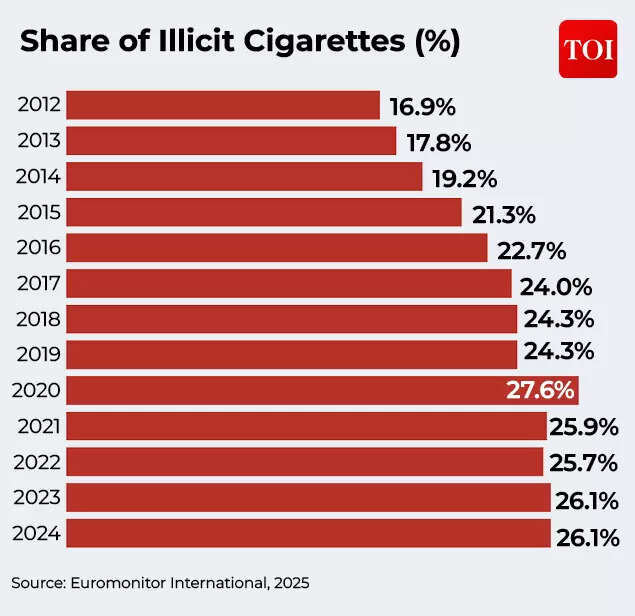
India saw the surge coming. Illicit cigarettes already account for 26.1 % of the market by volume, according to Euromonitor International, making the country the world’s fourth-largest illicit cigarette market. The Tobacco Institute of India estimates illicit volumes are now nearly one-third of legal cigarette sales, more than double the 12.6 % share recorded in 2012.Industry estimates put annual tax losses at Rs 21,000–23,000 crore through 2024.The core economic mechanism is straightforward. When taxes push up legal cigarette prices, illicit cigarettes (untaxed and cheaper) also rise in price because of demand, but remain relatively affordable. That widening price differential increases profit margins for illegal sellers, encouraging smuggling and counterfeiting.
Australia’s $40 cigarettes and the rise of tobacco smugglers
The trajectory mirrors developments in Australia, where cigarette taxes rose steeply over a decade, eight hikes in ten years, to drive smoking down. The policy worked and smoking rates declined steadily.But the unintended consequence was dramatic. Australia now has the most expensive cigarettes in the world: a mid-market pack averages about 55 Australian dollars (nearly US $40), almost double the price in New York City. Those prices created a powerful incentive for illicit supply.However, economists warn Australia’s tobacco tax has now “passed a tipping point”. Regular excise hikes have not further reduced smoking rates (already low) but have exploded the black market. The Australian Treasury estimates that roughly 20% of cigarettes for sale are now illegal. Some state officials claim it may be even higher. In 2024 police seized illicit stock worth A$1.8m in Sydney alone (piles of contraband packs). Organized crime has moved in: state premiers reported tobacco smuggling linked to syndicates, and even firebomb attacks on shops selling contraband.The financial fallout is stark. Federal tax receipts peaked in 2019-20 and have since plummeted. By 2024, the Budget forecast tobacco excise will fall from A$7.4bn to A$6.7bn over the next few years – the lowest real revenue in a decade, despite higher rates. Economists like Bob Breunig of ANU argue that each further tax increase is now merely shifting consumers to illicit sources, with “every time we raise excise at this point we are not reducing smoking at all”. In short, Australia’s case shows how relentless tax hikes can top out: once legal cigarette prices become wildly higher than alternatives (licit or illicit), the fiscal incentive tips the balance to the black market.
The UK and other high-tax markets
Australia’s experience is mirrored in other high-tax countries. Take the United Kingdom, which has among the highest cigarette prices in Europe (regular hikes and plain packaging rules). Legal sales in the UK have collapsed in recent years: HM Revenue & Customs data show duty-paid cigarettes fell by ~45% from 2021 (23.6 billion sticks) to 2024 (13.2 billion). A KPMG study (for industry) found that by 2024 over one in four cigarettes consumed in the UK was illicit. (Illicit packs can sell for as little as £5–7, versus ~£15 legal.) The lost tax revenue was enormous – on the order of £3–4 billion per year. Here again, aggressive anti-smoking policies (taxes, flavours ban, generational restrictions) have driven some smokers underground. The lesson is that when demand persists, a parallel contraband market will emerge if it’s profitable and enforcement is stretched.Other countries tell similar stories. For example, illicit cigarettes from Eastern Europe and Asia circulate widely across the EU, wherever prices differ. In the US, high-tax states (New York, California) see border smuggling from low-tax states, though data suggest tight enforcement can mitigate it. Even in Singapore and Malaysia (with notorious price gaps) sophisticated smuggling networks exist. On the prohibition side, Bhutan’s decade-long sales ban (2010–21) offers a cautionary tale: despite a strict ban and high taxes on imports, smuggling became rampant and tobacco use barely fell (prevalence ~25% before and after). Bhutan eventually lifted its ban (after 2021) partly because illicit trade overwhelmed the legal gap. In short, any extreme measure – very high taxes or total bans – can invite a persistent black market unless accompanied by robust enforcement and viable legal alternatives.
India approaching the same crossroads
India’s tobacco curb has entered a delicate phase. The intent behind the 2026 overhaul is clear: discourage consumption, raise revenue and align policy with global public-health standards. But markets rarely respond in straight lines. They respond to incentives.The early signs, hoarding, arbitrary pricing, shrinking legal supply and a visible uptick in untaxed brands, suggest that taxation alone cannot carry the burden of reform. If price becomes the only instrument, the system strains at its weakest points: border controls, supply chains and enforcement capacity. The result is not simply fewer cigarettes, but a reshaped market.The lesson from Australia, the United Kingdom and elsewhere is not that taxes fail. It is that taxes, when pushed beyond a threshold without equal investment in enforcement and cessation support, change who profits from smoking. The lesson from high-tax economies is not that taxes fail. It is that taxes without enforcement capacity create parallel markets. India’s real test is not how high it can push prices, but whether it can prevent its own policy from financing the shadow economy.







 English
  हिन्दी