 Sipu Jha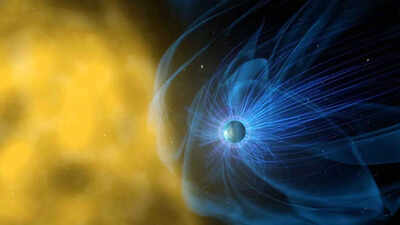
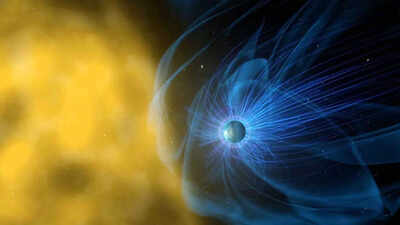
There is a constant outward flow of charged particles from the Sun. This flow, known as the solar wind, moves across space and reaches Earth every day. When it arrives, it meets the planet’s magnetic field, an invisible region that bends and redirects much of this energy away from the surface. The boundary between the two is active and changeable. Since 2015, NASA has been examining this area through its Magnetospheric Multiscale Mission, or MMS. The Space Umbrella project invites members of the public to review mission data and help identify moments when solar activity and Earth’s magnetosphere interact most strongly, contributing to ongoing research into solar storms and space weather.
NASA’s Space Umbrella project tracks solar wind interactions near Earth
The MMS spacecraft was launched to observe a process called magnetic reconnection. This happens when magnetic fields from the Sun and Earth briefly link, then break apart, releasing bursts of energy. The process is small in scale but significant in effect. It plays a role in shaping auroras and in driving space-weather conditions that can propagate through near-Earth space.Scientists monitor these exchanges because the released energy can disturb satellites, GPS signals and radio systems. Astronauts working beyond the thickest part of Earth’s atmosphere are also exposed to higher levels of radiation during intense solar events. The data gathered by MMS offers detailed measurements, but sorting through it takes time.
Public volunteers review Nasa data through the Space Umbrella Project
The Space Umbrella project was set up to widen that effort. Volunteers are asked to examine visual data from MMS instruments and mark periods where strong interactions appear. A short online tutorial explains how to recognise when the spacecraft is inside the magnetosphere and when it is passing through more turbulent regions influenced by the solar wind.No scientific training is required. The task is observational. Many small contributions build into a larger dataset that researchers can use to refine models of solar storms. The work does not promise dramatic discoveries. It adds pieces, slowly, to a broader understanding of how the Sun affects technology and human activity in space.





 English
  हिन्दी