 Sipu Jha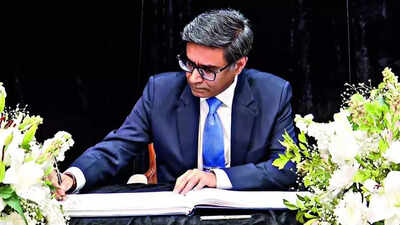
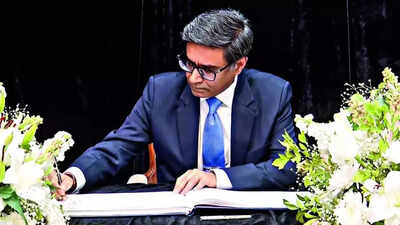
NEW DELHI: Foreign secretary Vikram Misri signed the book of condolence – on behalf of the Indian government and people – opened at the Iranian embassy on Thursday, following the killing of Iran’s supreme leader Ali Khamenei on Feb 28, amid criticism over India’s silence.External affairs minister S Jaishankar spoke to his counterpart Abbas Araghchi, and posted about the “telecon” on X, without elaborating. Araghchi had said earlier in the day that the Iranian warship destroyed by a US submarine was a guest of the Indian Navy.The two sides may have their first high-level contact since the war began, on Friday, with Tehran seeking a meeting for visiting deputy foreign minister Saeed Khatibzadeh. It is learnt that Misri may meet the minister who is in India for the Raisina Dialogue.After signing the condolence book, Misri meets the Iranian ambassadorTehran had been hoping India would express condolences over the killing of Khamenei, if not condemn the US-Israel attacks on Iran. After signing the book, Misri had a short meeting with Iranian ambassador Mohammad Fathali.Russian ambassador Denis Alipov and Pakistani charge d’affaires Saad Ahmad Warraich were among the first to sign the condolence book when it was opened in the morning. In his message, Misri expressed condolences on behalf of the government and people of India. “We pray for peace for the departed soul,” he said. However, in 2024, after the death of then Iranian President Ebrahim Raisi, Jaishankar had himself visited the embassy to sign the condolence book. India had then also declared a day-long national mourning.Misri signed the book on the first day of its opening but the fact that India had not offered its condolences for Khamenei, who was killed on Saturday, had drawn criticism from the opposition. India always had mixed feelings about Khamenei who endorsed efforts to address shared regional interests with the Indian government, most notably for connectivity through the Chabahar port, but also riled India on several occasions with his “misinformed and unacceptable” utterances about J&K and Muslims in India.Khamenei met PM Narendra Modi when the latter travelled to Tehran in 2016 for what was the first bilateral visit by an Indian PM to Iran in 15 years. The Indian foreign ministry had described the meeting then as a rare honour for the PM.Iran also denied that it is indiscriminately attacking the Gulf countries where close to 10 million Indians live. “We told all our neighbours we are attacking US bases from which they target us,” said Iran’s ambassador to India Mohammad Fathali. He also said Iran has good relations with India with a historical background and wants to improve ties further. “But in this case, all governments and all people are being put to the test,” he said.According to Iranian authorities, Tehran has always sought to maintain robust ties with India and does not want the relationship to be affected by any third country. It also maintains that no country should cherry-pick on international law.Iran is also non-committal about safe passage for Indian or other tankers through the Strait of Hormuz as it believes its action will depend on specific conditions. Iran has maintained it communicated to neighbours in an official communication that US bases would be legitimate targets if Iran was attacked by the Trump administration. Tehran’s contention is insurance companies as also others looking to avoid the war are also responsible for the strait’s closure.






 English
  हिन्दी