 Sipu Jha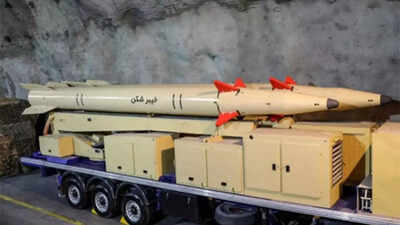
The conflict involving the United States, Israel and Iran has now entered its second week, with continued strikes on Tehran and retaliatory attacks across the wider Middle East as tensions deepen across the region.Amid the escalating war, Iran’s Islamic Revolutionary Guard Corps (IRGC) announced the 27th wave of attacks under “Operation True Promise 4,” targeting American and Israeli positions, in response to the new phase of “unprovoked US-Israeli aggression towards the Islamic Republic.”
According to the IRGC, the latest strikes were carried out using newly developed solid-fuel missile technology deployed by its Aerospace Division.“In this strategic and multidimensional operation, Zionist military targets in [the occupied city of] Haifa were struck by the IRGC’s Aerospace Division’s new solid-fuel Kheibar-Shekan missiles, which possess terminal guidance capability up to the point of impact,” the official dispatch stated.
What are solid-fuel missiles?
Unlike liquid-fuel missiles that must be filled with fuel shortly before launch, solid-fuel missiles contain fuel stored inside the rocket itself, allowing them to be fired quickly with minimal preparation.The fuel is typically a mixture of metallic powders such as aluminium combined with an oxidiser like ammonium perchlorate, bound together with a rubber-like material and packed inside a metal casing, Reuters reported.
What makes them different?
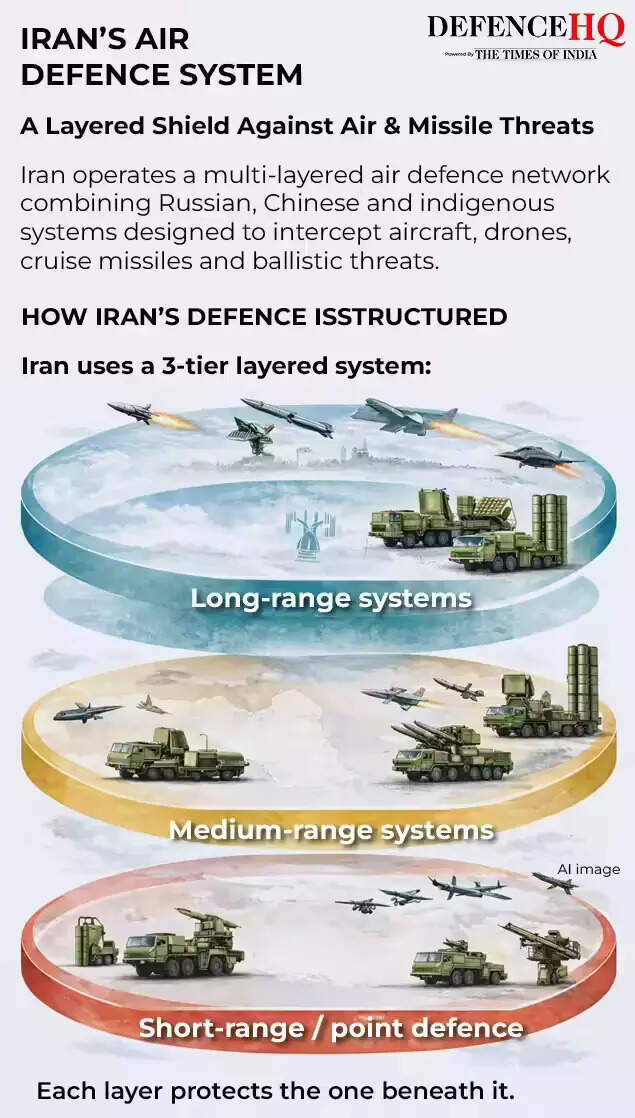
Solid-fuel missiles offer several operational advantages that make them more difficult to intercept and counter. Unlike liquid-fuel systems, they do not require fueling immediately before launch, allowing them to be fired at short notice. This significantly reduces preparation time and limits the opportunity for adversaries to detect or target launch sites in advance.They are also highly mobile, as many solid-fuel missiles can be launched from mobile platforms and multiple locations, making them harder to track. In addition, these systems require less logistical support and are generally easier and safer to operate compared to liquid-fuel missiles.Because the fuel is stored within the missile itself, they can remain launch-ready for extended periods. These characteristics allow them to be launched within minutes, giving air defence systems less time to react.
Inside the Kheibar Shekan Missile
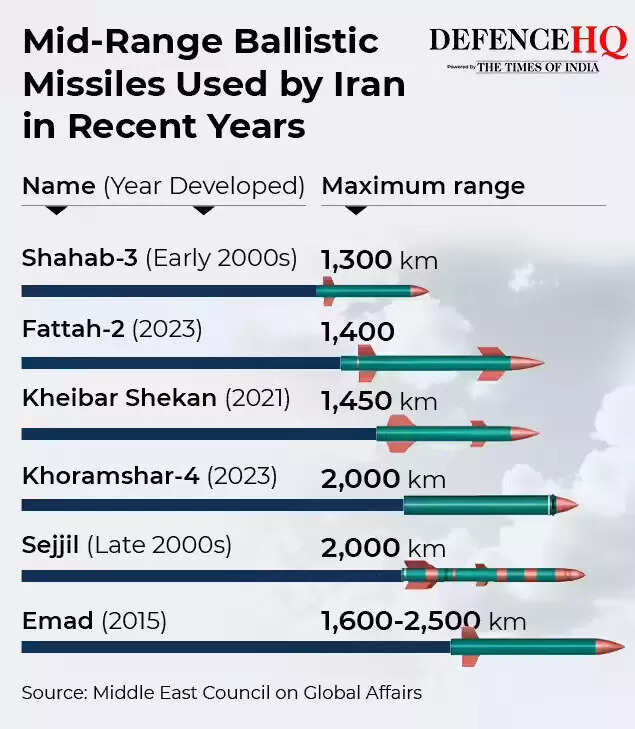
The missile used in the latest barrage, known as Kheibar Shekan, is a solid-fuel, medium-range ballistic missile operated by the IRGC Aerospace Force.The name “Kheibar Shekan,” meaning “Castle Buster” or “Fortress Buster,” reflects its intended role in striking fortified targets.According to Iranian media, the missile has a range of around 1,450 kilometres, enabling it to reach Israel from western Iran. It is equipped with satellite guidance and a manoeuvrable warhead, designed to improve accuracy.The missile is about 4 metres long and weighs roughly 1,500 kilograms, and is reportedly capable of reaching speeds of up to 19,500 km/h within the atmosphere and about 9,800 km/h outside it, making interception difficult even for advanced air defence systems.Propulsion comes from a single-stage solid-fuel motor known as the “Arond” engine, which is integrated into the fuel tank to reduce the missile’s size and make detection harder.The system can be launched from mobile platforms and reportedly prepared for firing in under 15 minutes, carrying a high-explosive warhead weighing between 550 and 600 kilograms.The Kheibar Shekan is part of Iran’s Khorramshahr family of ballistic missiles, which has undergone several upgrades since the first version was introduced in 2017.Earlier models used liquid fuel, but the newer variants represent a shift toward lighter, more mobile solid-fuel systems designed for rapid deployment and improved survivability.Iran’s missile programme is considered one of the largest and most diverse in the Middle East, covering both short-range and medium-range ballistic missiles.Short-range systems, typically capable of travelling 150 to 800 kilometres, are designed for rapid strikes against nearby military targets.Medium-range missiles, including systems like Shahab-3, Emad, Ghadr-1, Sejjil and Kheibar Shekan, extend Iran’s reach to 1,500 to 2,000 kilometres, allowing it to target Israel, US-linked bases in the Gulf and other regional sites, AL JAZEERA reported.Iranian state media reported that unmanned aerial systems were also deployed during the latest offensive.According to the IRGC statement, drone units “successfully targeted the location where American forces are stationed in ‘Marina,’ in the vicinity of the buildings of the ‘Warner Brothers’ company,” during the 27th wave of Operation True Promise 4.Dubai authorities confirmed that debris from an interceptor missile killed one person during the exchange. At the same time, the IRGC Navy reportedly engaged facilities linked to the US Fifth Fleet in Bahrain, indicating that the conflict is spreading across multiple fronts.The IRGC said Operation True Promise 4 launched after foreign strikes last week, has already involved hundreds of ballistic missiles and drones targeting strategic locations including Tel Aviv, Jerusalem (al-Quds) and the technology hub of Be’er Sheva.







 English
  हिन्दी