 Sipu Jha
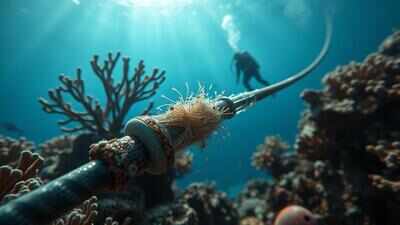
Facebook-parent Meta is one of the latest technology companies to be affected by the ongoing war between Iran, and the US and Israel. The company has reportedly paused work on a segment of its 2Africa underwater cable project in the Persian Gulf. This comes as the US-Iran war makes it unsafe for the French contractor laying the fibre-optic line to continue operations in the region, a report claims. According to a Bloomberg report, Alcatel Submarine Networks (ASN), the French company tasked with installing the cable, has issued force majeure notices to customers. The company has also reported the stranding of its installation ship, the Ile De Batz, off the coast of Dammam, Saudi Arabia.
The pause affects a segment of the 45,000-kilometre 2Africa cable system that was set to connect landing stations across Oman, the United Arab Emirates, Qatar, Bahrain, Kuwait, Iraq, Pakistan, India and Saudi Arabia. This is the stretch that Meta and consortium partners, including Saudi Telecom Co.’s Center3, had planned to bring online as early as this year. The cable has been laid on the sea floor, but not all landing stations are connected.The halt marks the second disruption to 2Africa linked to the Middle East conflict in under six months. Meta had previously acknowledged delays to another section of the cable due to geopolitical tensions in the region.
Importance of subsea cables and why have such projects faced challenges in Middle East
lines accounting for more than 95% of global internet traffic. When completed, 2Africa will be one of the largest fiber-optic cable systems ever built, linking countries along the entire coast of Africa to Europe and the Middle East. The Persian Gulf section, known as “Pearls,” and a segment in the Red Sea are the two remaining sections to finish.Just four months ago, Meta disclosed that it had stopped work on a section of 2Africa in the Red Sea following Houthi attacks and problems getting permits to install the cable. Other live cables damaged in Houthi strikes in early 2025 were only repaired within the last four months, Alan Mauldin from the telecommunications research firm TeleGeography told Bloomberg.Such conflicts highlight how vulnerable internet infrastructure can be to physical attacks and have raised questions about whether technology giants will continue to invest billions of dollars in geopolitically volatile regions.Laying cables in the Red Sea has historically been a direct, cost-effective way to connect Europe, Asia, and Africa. But the Houthi threat has compelled tech companies to explore other options.“Everyone has been trying to find alternate routes,” Hasnain Ali, a subsea cable consultant, told Bloomberg. Until the US and Israel launched their joint military campaign against Iran, the Persian Gulf was a popular substitute.Meta does plan to build a new cable, Project Waterworth, that will bypass the Middle East to connect the US, India, South Africa, and Brazil. But that is years away from completion.Mauldin and others reported that the war has also affected other undersea cable projects in the Gulf, which is in their earlier stages of development. Work has been halted on Sea-Me-We 6, a cable under development by a consortium involving the French telecom company Orange. FIG, a cable project overseen by the Qatari firm Ooredoo, is also on pause. (Representatives for the consortium behind Sea-Me-We 6 and Ooredoo did not respond to requests for comment.)The conflict has also made it difficult for repair ships to service the undersea cables already in use in the area. “Cable ships are not going to operate in areas where there is active military operations happening, its too risky,” Mauldin added.Cables could also be damaged by the anchors of ships hit by missiles, as happened in the Red Sea last year, said Bertrand Clesca, a submarine consultant at Pioneer Consulting. If that happens, it will be a long time before they can be repaired, he added.Internet traffic can be rerouted through other cables, including terrestrial routes across Oman and Saudi Arabia, Mauldin mentioned. “So there is at least still a way to continue connectivity,” although internet speeds in the region could slow down.Even after the war ends, undetonated bombs and other weaponry will present another challenge for cable installations in the Persian Gulf, Ali highlighted. Iran intercepted many missiles and landed them in the Gulf, where they could still detonate. He mentioned the need to survey the seafloor before proceeding with work, though they are still in their early stages.






 English
  हिन्दी