 Sipu Jha
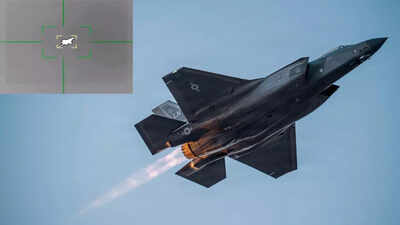
Iran’s claim that it struck a US F-35 Lightning II has drawn sharp global attention, with early indications suggesting that infrared-guided air defence systems may have played a role in the incident now under investigation.A US F-35 stealth fighter was damaged during a combat mission over Iran and forced to make an emergency landing at a US air base in the Middle East, according to American officials. The pilot survived and is in stable condition. While Washington has not fully confirmed Tehran’s claim, it has acknowledged the aircraft was hit by what is believed to be Iranian fire.
Iran has described the incident as a “world’s first hit”, raising questions about how one of the most advanced stealth aircraft may have been tracked and targeted.
Infrared systems in focus
Analysts are increasingly looking at Iran’s infrared-guided surface-to-air systems, which rely on heat signatures rather than radar, as a possible factor.Among the key systems:
- Misagh-2: A locally developed shoulder-fired missile with a range of around 6 km, designed to lock onto an aircraft’s heat signature.
- Majid: A newer short-range system using electro-optical and infrared tracking, built for point defence against low-flying targets.
- Herz-9: A passive, mobile air defence system that tracks targets without emitting radar signals, making it harder to detect.
- Misagh-1 and Misagh-3: Earlier and upgraded variants of Iran’s heat-seeking missile family.
- Sayyad-1A: An upgraded anti-aircraft missile believed to incorporate infrared tracking elements.
Unlike traditional radar-guided systems, these platforms operate passively, meaning they do not broadcast signals that stealth aircraft are designed to evade. This raises the possibility that infrared detection may have complemented or substituted radar tracking in the engagement.
Can infrared systems hit an F-35?
The F-35 is built to minimise both radar and infrared signatures, but it is not completely invisible. Its engine still produces heat, particularly during high-speed or combat manoeuvres.Infrared-guided systems, in theory, can exploit this by:
- Locking onto engine exhaust heat
- Tracking targets without radar emissions
- Engaging aircraft at short to medium ranges
However, such a hit would still be considered highly challenging. The F-35 is equipped with advanced countermeasures, including flares and electronic warfare systems, and is designed to detect threats early through its sensor fusion capabilities.
What makes this incident significant
Capt Tim Hawkins, spokesperson for US Central Command, said the fifth-generation jet was “flying a combat mission over Iran” when it was forced to land. “The aircraft landed safely, and the pilot is in stable condition,” he said.Even a partial strike carries weight. The F-35 is widely seen as one of the most survivable aircraft in contested airspace due to its stealth, sensor fusion and network-centric warfare design.If Iranian systems were able to track and hit the jet, it could point to:
- Improved passive detection capabilities
- Effective use of layered air defence networks
- Potential operational vulnerabilities in high-threat environments
- Iran has claimed the strike reflects upgrades to its integrated air defence network, though details remain unclear.
The bigger picture
The reported hit comes amid an ongoing conflict in which the US has lost at least 16 aircraft, including multiple MQ-9 Reaper drones, according to a Bloomberg report. Other losses have been attributed to accidents and friendly fire.While US officials maintain that operations are proceeding as planned, analysts note that only “localised air superiority” has been achieved in parts of Iranian airspace.Against this backdrop, Iran’s claim of striking an F-35 — whether through infrared systems alone or in combination with other tracking methods — could mark a shift in how stealth aircraft are challenged in modern warfare.





 English
  हिन्दी