 Sipu Jha
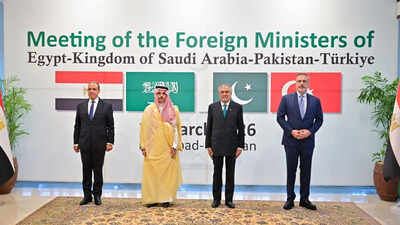
Top diplomats from key regional powers gathered in Pakistan over the weekend to discuss ways to end the ongoing conflict in the Middle East, even as fighting continued with US-Israeli strikes on Iran and retaliatory missile and drone attacks by Tehran.Pakistan said foreign ministers from Saudi Arabia, Turkey and Egypt were participating in the talks in Islamabad. However, neither the United States nor Israel is part of the discussions.Egyptian foreign minister Badr Abdelatty and Turkish foreign minister Hakan Fidan arrived on Saturday, while Saudi foreign minister Prince Faisal bin Farhan reached on Sunday at the invitation of Pakistan’s Deputy Prime Minister and Foreign Minister Ishaq Dar.The two-day quadrilateral meeting is part of Pakistan’s effort to push diplomatic solutions to the crisis.According to the Pakistani Foreign Office (FO), participants will hold “in-depth discussions on a range of issues, including efforts to de-escalate tensions in the region,” and are also scheduled to call on Prime Minister Shehbaz Sharif.On the sidelines, Dar also held separate bilateral meetings with his counterparts, the Dawn reported.In talks with Saudi foreign minister Prince Faisal bin Farhan, both sides discussed “evolving regional and international developments” and underscored the importance of dialogue and cooperation.“They underscored the importance of dialogue, diplomacy, and collective efforts to promote peace, security and stability in the region,” the FO said, adding that both countries agreed to continue working together to strengthen cooperation and contribute to regional peace.Dar also met Turkey’s Hakan Fidan, reaffirming Pakistan’s commitment to expanding ties “across all sectors of mutual interest” and highlighting the “historic and fraternal ties” between the two countries.In a separate meeting with Egypt’s Badr Abdelatty, both sides reiterated their “commitment to deepening cooperation across multiple areas.”The quadrilateral meeting was initially planned to be held in Turkey but was later shifted to Islamabad, as Ishaq Dar was unable to travel, as Pakistan was trying hard in positioning itself as a diplomatic player in efforts to facilitate talks between the United States and Iran, the dawn reported.
Strait of Hormuz and shipping relief
In a key development, Dar also announced that Iran had agreed to allow 20 more Pakistan-flagged ships to pass through the Strait of Hormuz, a vital global energy route through which about 20% of the world’s oil flows.“I am pleased to share a great news that the Government of Iran has agreed to allow 20 more ships under the Pakistani flag to pass through the Strait of Hormuz; two ships will cross the Strait daily,” he said.“This is a welcome and constructive gesture by Iran and deserves appreciation. It is a harbinger of peace and will help usher stability in the region,” he added, emphasising that “dialogue, diplomacy, and such confidence-building measures are the only way forward”.
Limited progress, continued tensions
Despite the diplomatic push, there were few signs of a breakthrough. The United States has sent additional troops to the region, while Iran’s parliament speaker Mohammad Bagher Qalibaf dismissed the talks as a cover and warned Tehran was ready to retaliate strongly against any ground invasion.On the ground, hostilities continued. Israel reported fresh incoming strikes from Iran, while explosions were heard across Tehran.Meanwhile, Iran-backed Houthis in Yemen entered the conflict, launching missiles toward what they described as “sensitive Israeli military sites”.US Secretary of State Marco Rubio said Washington “can achieve all of our objectives without ground troops,” even as domestic opposition to a wider war grows.
Iran’s conditions and threats
Top diplomats met in Islamabad just days after the United States offered a 15-point “action list” as a framework for a possible peace deal with Iran.Tehran, however, has rejected the proposal and is reportedly working on its own plan, which includes demands such as halting attacks on Iranian officials, guarantees against future strikes, reparations, and recognition of its sovereignty over the Strait of Hormuz.Tensions escalated further after Israeli strikes hit Iranian universities. Iran’s Revolutionary Guard warned that Israeli and American university campuses in the region could become “legitimate targets” unless safety assurances are provided.“If the US government wants its universities in the region spared, it should condemn the bombardment of (Iranian) universities by 12 o’clock Monday, March 30, in an official statement,” the Guard had said.
Rising toll of the conflict
The war, which began with US-Israeli strikes on Iran, has killed more than 3,000 people across the region.Iran reports over 1,900 deaths, while at least 19 people have been killed in Israel. In Lebanon, more than 1,100 people have died amid Israeli operations against Hezbollah. In Iraq, 80 security personnel have been killed, while 20 deaths have been reported in Gulf states and four in the occupied West Bank.Despite diplomatic efforts, the gap between the US and Iran remains wide, with both sides continuing military actions even as talks struggle to gain traction.








 English
  हिन्दी