 Sipu Jha
India’s school education system shows visible progress but persistent gaps continue to challenge the next phase of the National Education Policy (NEP) 2020. Enrolment in classes IX to XII, especially among boys, digital infrastructure deficits, and teacher shortages in rural areas remain serious concerns. Dropout rates, though declining, trouble states like West Bengal, Jharkhand and Assam, while rural-urban and north-south divides are evident in the Unified District Information System for Education Plus (UDISE+) 2024-25 report released Thursday.With 24.8 crore students and one crore teachers across 14.7 lakh institutions, India’s school system has achieved near-universal access at the elementary stage with a Gross Enrolment Ratio (GER) of 90.6%. But enrolment dips to 78.7% at secondary and 58.4% at higher secondary.
.
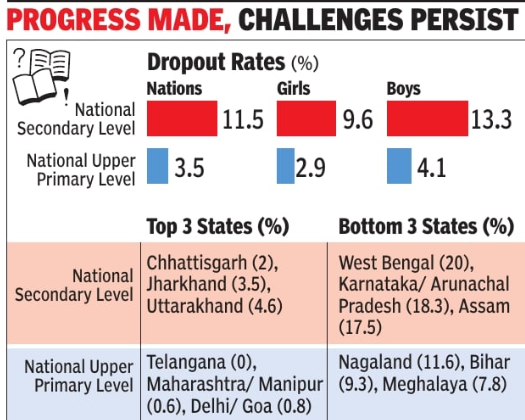
Dropouts rise steadily — from 0.3% at primary to 3.5% at upper primary, peaking at 11.5% in secondary classes. Boys are more affected (13.3%) than girls (9.6%). Though improved from 14.1% in 2023-24, gaps persist. States such as West Bengal (20%), Karnataka/Arunachal Pradesh (18.3%), Assam (17.5%), Gujarat (16.9%), Madhya Pradesh (16.8%) and Andhra Pradesh (15.5%) report the highest secondary dropouts. At the primary stage, contrasts are stark: Mizoram records 10.8% dropout while Delhi, Haryana and Himachal Pradesh report zero. In fact, 22 states/ UTs recorded less than 1% dropout at primary level.UDISE+ 2024-25, covering all institutions (69% govt, 5% aided, 23% private unaided, 3% others), shows a modest 1.2% post-Covid enrolment rise, with girls at 48.3% and OBC students at 45%. Yet overall enrolment fell by 11 lakh from last year and 50 lakh since 2022-23, attributed to declining birth rates.Encouragingly, dropout rates are falling across stages — from 3.7% to 2.3% at preparatory, 5.2% to 3.5% at middle, and 14.1% to 11.5% at secondary. Retention has also improved: 98.9% at foundational, 92.4% at preparatory, 82.8% at middle and 47.2% at secondary. Expansion of secondary schools has eased access, helping students stay on.Teacher numbers are rising too. National pupilteacher ratio (PTR) is 24:1, better than the NEP norm of 30:1. By stage, PTR is 10 at foundational, 13 at preparatory, 17 at middle and 21 at secondary. Teacher strength grew 6.7% since 2022-23.Yet challenges persist. PTR is still 36:1 in Jharkhand and 30:1 in Bihar and Gujarat. Andhra Pradesh and Jharkhand each have nearly 20% single-teacher schools, forcing teachers to juggle multiple grades. More than one-third of schools have fewer than 50 students, and some are completely empty. In West Bengal and Telangana, over 4% of schools report zero enrolment.







 हिन्दी
  English