 Sipu Jha
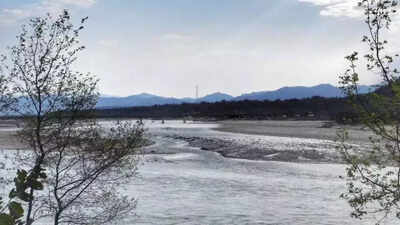
DEHARDUN: The Ganga — a lifeline for more than 600 million people across India, Nepal and Bangladesh — is facing its most severe drying phase in 1,300 years and is likely to undergo major hydrological changes with future warming, according to a recent study published in Proceedings of the National Academy of Sciences (PNAS), an American peer-reviewed scientific journal. The findings raised grave concerns for water security, agriculture and power generation in one of the world’s most densely populated regions.Researchers from IIT Gandhinagar and the University of Arizona reconstructed Ganga river’s streamflow over the past 13 centuries using instrumental data, paleoclimate records and advanced hydrological models. Their analysis revealed that the river’s decline since the early 1990s is far more intense than even the mega-droughts of the 16th and 18th centuries. “The Ganga has faced frequent and prolonged droughts in the last three decades, with the 2004-2010 drought ranking as the most severe in over a millennium,” said lead author Dipesh Singh Chuphal of IIT Gandhinagar.Between 1991 and 2020, the basin endured two unprecedented seven-year droughts — 1991-97 and 2004-10 — both among the “ten longest droughts in the basin’s 1,300-year history”, the study said. While droughts were primarily linked to natural monsoon variability, the study emphasised the dominant role of human-driven factors. Weakening summer monsoons, partly due to Indian Ocean warming and aerosol pollution, have reduced rainfall in the basin by nearly 10% since the 1950s, with western regions witnessing over 30% decline.The study warned that rising temperatures could further alter the basin’s hydrology. “Reduced summer monsoon rainfall is the primary driver of declining river flow, while warming has a smaller impact. However, under extreme climate scenarios, if rainfall deficits combine with higher temperatures, streamflow could fall sharply — by 5% to 35%,” it stated.Excessive groundwater pumping to compensate for unreliable rainfall has further depleted the river, reducing baseflow and intensifying summer drying. The combined effect of declining rainfall and unsustainable groundwater use, the researchers said, is “pushing the Ganga beyond its natural limits”.The consequences are already visible. Between 2015 and 2017, historically low water levels disrupted drinking water supplies, irrigation, power generation and navigation, affecting over 120 million people. Declining freshwater discharge is also diminishing nutrient flow into the Bay of Bengal, threatening one of the world’s most productive marine ecosystems.What makes the findings more alarming is that most global climate models fail to capture this drying trend, with many projecting increased streamflow under warming scenarios due to expected rises in precipitation. Only a few models simulate the observed decline, raising doubts about the reliability of future water forecasts.“Future water security in the Ganga basin will depend on how effectively we integrate climate science with policy and local water management,” said co-author of the study, Vimal Mishra, a professor at IIT Gandhinagar.Some projections suggested that increasing rainfall under climate change could reverse the drying by 2040. However, researchers cautioned that without better management of human intervention, particularly groundwater exploitation, such a rebound may not materialise.The Ganga basin contributes about 40% of India’s GDP and sustains the country’s agricultural heartland. With prolonged droughts becoming more frequent, the study called for urgent reforms in water governance, improved monsoon forecasting and sustainable groundwater management.





 हिन्दी
  English